In recent years, the global mining landscape has been increasingly shaped by geopolitical considerations and the urgent need for secure, domestic supply chains. For the United States, this imperative has manifested in a robust national strategy for critical minerals, recognizing the strategic vulnerability posed by reliance on overseas sources. Among these vital resources, boron has emerged as a key priority, sparking renewed focus on homegrown production capabilities after decades of absence.
Boron's Critical Role and Supply Chain Vulnerabilities
Boron is far from a household name, yet its compounds are indispensable across a spectrum of high-technology and industrial applications. It is a fundamental component in defense systems, integral to the manufacturing of semiconductors, essential for advanced manufacturing processes, and plays a crucial role in the development of energy infrastructure. Beyond these, boron also finds applications in agriculture and various chemical sectors. Its versatile properties, including hardness, light weight, and neutron-absorbing capabilities, underscore its strategic importance.
Despite its widespread utility, the United States has faced a significant supply chain vulnerability for decades. The nation has lacked any homegrown boron production capability for an extended period, making it entirely dependent on foreign sources. This dependency is further exacerbated by the highly concentrated global supply market, where effectively two companies control the vast majority of worldwide production. This duopoly introduces substantial risks, from market manipulation to supply disruptions, and creates a scenario where global demand is already struggling to keep pace with existing supply.
Recognizing these critical challenges, the United States federal government officially added boron to its list of critical minerals in late 2025. This designation signals a clear intent by policymakers to prioritize domestic supply chain development for this essential element, acknowledging its profound implications for national security and economic resilience.
Fort Cady Emerges as a Domestic Solution
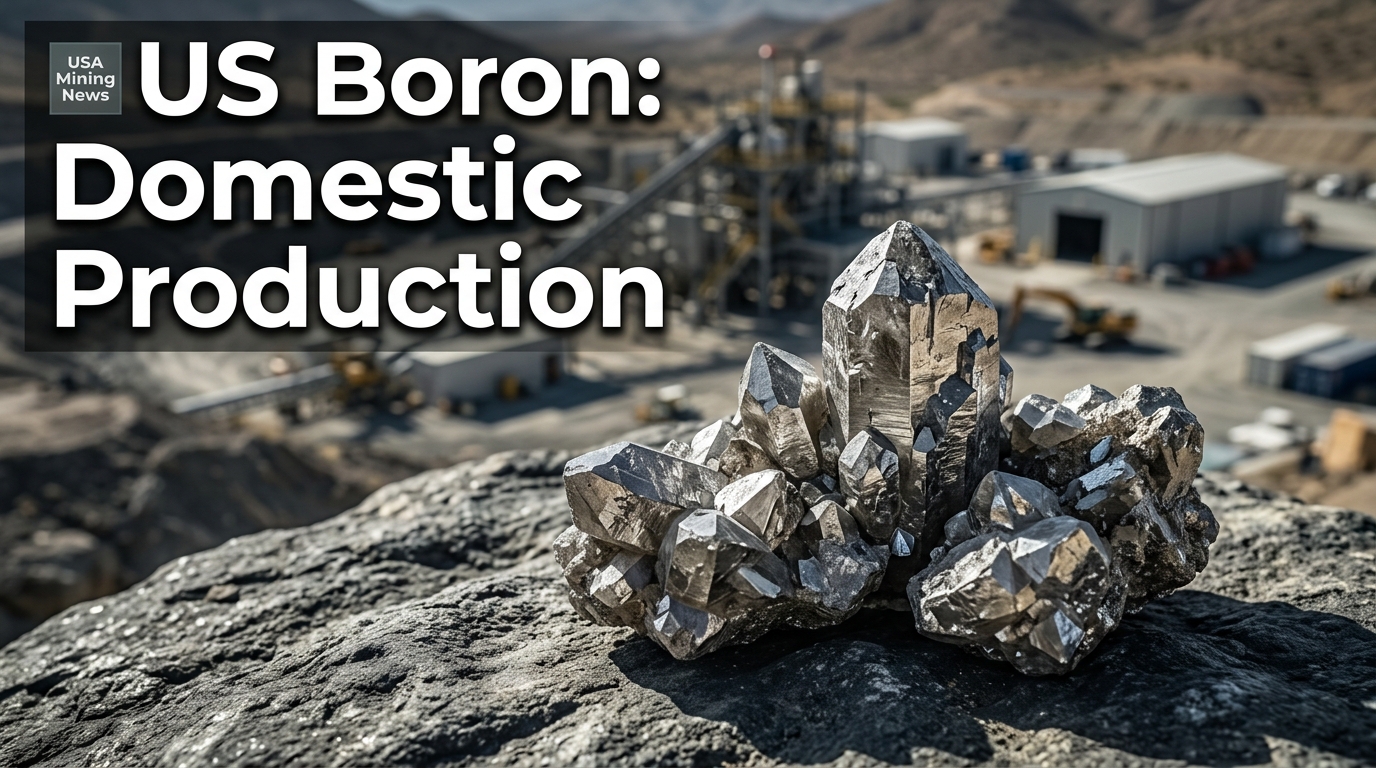
Amidst this backdrop of policy shifts and supply chain concerns, 5E Advanced Materials (Nasdaq: FEAM) has positioned its Fort Cady project as the leading candidate to re-establish domestic boron production in the United States. Located in Southern California, Fort Cady represents not just a mining venture, but a strategic asset designed to address a pressing national need. The project has garnered significant attention from both government and industry as a tangible step towards rebuilding America’s critical mineral supply chain.
Initial signs of government support have been encouraging. The White House recently announced more than $2 billion in new domestic mining investments, underscoring a broad commitment to revitalizing the nation's raw materials sector. More specifically for Fort Cady, the Export-Import Bank has committed $8 million towards the project, a crucial early investment that signals confidence in 5E Advanced Materials' capabilities and the strategic importance of the resource.
As Paul Weibel, Chief Executive Officer of 5E Advanced Materials, articulates, while recognition and initial funding are vital, they are merely the starting points. The true challenge lies in translating these critical designations into actual, operational supply chains.
Translating Policy into Production: The Fort Cady Development Pathway
The journey from a mineral discovery to a fully operational mine is a complex, multi-stage process that demands significant capital, technical expertise, and regulatory navigation. For critical minerals projects, this pathway is even more scrutinized due to their strategic importance. Every credible project, irrespective of its strategic significance, must successfully complete a series of rigorous steps. These include:
- Exploration: Identifying and defining the mineral resource.
- Feasibility Studies: Assessing technical viability, economic profitability, and environmental impact.
- Permitting: Obtaining all necessary governmental approvals and licenses.
- Engineering: Designing the mine, processing facilities, and associated infrastructure.
- Customer Qualification: Ensuring the product meets the specifications and quality standards of prospective buyers.
- Financing: Securing the substantial capital required for construction and operation.
The Fort Cady project stands out because it has already progressed significantly through these stages. It is notable for being fully permitted, a crucial milestone that often represents a major hurdle for mining projects. Furthermore, Fort Cady hosts the largest reported borate resource in the United States, a geological advantage that is projected to support decades of future production at a substantial scale, with a target of up to 90,000 tonnes per year. This combination of an extensive resource and advanced permitting puts 5E Advanced Materials in a strong position to move towards full-scale production.
Strategic Financing and De-risking Domestic Projects
Despite the strategic importance and advanced stage of projects like Fort Cady, securing the necessary project-level financing for domestic supply can still be challenging. The capital requirements for constructing and commissioning a modern mining and processing facility are immense, and private capital often seeks to minimize risk. This is where government involvement can play a pivotal role.
The $8 million commitment from the Export-Import Bank to Fort Cady is a welcome initial development, but it precedes a much larger opportunity. 5E Advanced Materials has applied for a $285 million project-level debt facility, for which it already holds a letter of intent. This substantial debt facility is critical for financing the remaining development and construction phases of the project. The involvement of government-backed financial institutions in such a capacity is strategically important because it can "de-risk" a project enough to attract further private capital. By providing initial funding or guarantees, government entities help to signal the project's viability and strategic importance, thereby reducing the perceived risk for private investors and encouraging their participation.
The sentiment from policymakers is clear: government capital does not necessarily need to fund construction outright, but it can provide the critical leverage needed to unlock the much larger pools of private investment required to bring these strategically vital projects to fruition.
Beyond Extraction: Forging a Complete Domestic Value Chain
The vision for Fort Cady extends beyond simply extracting critical minerals. A central tenet of the US critical minerals strategy, and a core principle for 5E Advanced Materials, is the creation of complete domestic value chains. Weibel emphasizes that merely mining critical minerals only to ship them overseas for processing and refining would be tantamount to "trading one dependency for another."
The real goal, and Fort Cady's operational design, is to build comprehensive domestic capabilities that span from extraction through advanced materials production. This means not only developing the capacity to mine the borate ore but also to refine it into high-purity borates and convert these into the higher-value boron materials that domestic industries actively utilize. This vertically integrated approach is crucial for true supply chain security.
5E Advanced Materials is actively advancing the production of refined borates today while simultaneously developing these higher-value boron materials. These advanced materials are specifically tailored for critical applications in key sectors such as:
- Defense: For lightweight armor, high-energy propellants, and advanced optics.
- Semiconductors: As dopants for silicon wafers and in specialized glass for displays.
- Advanced Manufacturing: In high-strength lightweight alloys, ceramics, and composites.
- Energy Infrastructure: For high-performance permanent magnets, battery technologies, and thermal insulation.
- Agriculture: As essential micronutrients for crop health and yield.
This holistic approach ensures that the entire value chain remains within US borders, maximizing economic benefits and minimizing external vulnerabilities.
Connecting Production to Domestic Demand
A domestic supply chain, even if fully integrated, can only be effective if it connects directly to domestic demand and reaches U.S. customers. Understanding and securing off-take agreements are as important as resource definition and permitting.
At Fort Cady, the market validation is already underway. 5E Advanced Materials has secured four commercial agreements across diverse sectors including industrial, construction, and chemical. These agreements are a strong indication that robust domestic demand for boron products exists and is ready to absorb the future production from Fort Cady. This demonstrates that the project is not just a government-backed initiative but also a commercially viable enterprise driven by existing market needs.
The success of this endeavor will hinge on continued collaboration between government and industry, working in concert to build and fortify the necessary supply chains to meet this critical demand.
The Future of US Boron: A Model for Critical Mineral Independence
The United States has correctly identified its dependence on foreign critical minerals as a strategic vulnerability. The recent momentum, particularly the late 2025 critical mineral designation for boron and subsequent funding commitments, clearly shows that this recognition is now widely shared across governmental agencies and key industries. The next, and most crucial, step is to transform this strategic recognition into a tangible reality of permitted, financed, and fully operating projects.
The Fort Cady project, under the leadership of 5E Advanced Materials, represents a tangible pathway to achieving this objective for boron. Its advanced stage of development, the significant resource base, and the commitment to a vertically integrated domestic value chain position it as a benchmark for future critical minerals projects in the US.
Ultimately, success in this critical endeavor will not merely be measured by the number of funded projects, but by the actual secure domestic supply chains that are built and sustained. The development of Fort Cady signifies a pivotal step towards achieving true critical mineral independence for the United States, providing a robust model for how policy can effectively translate into domestic production and enhance national security.