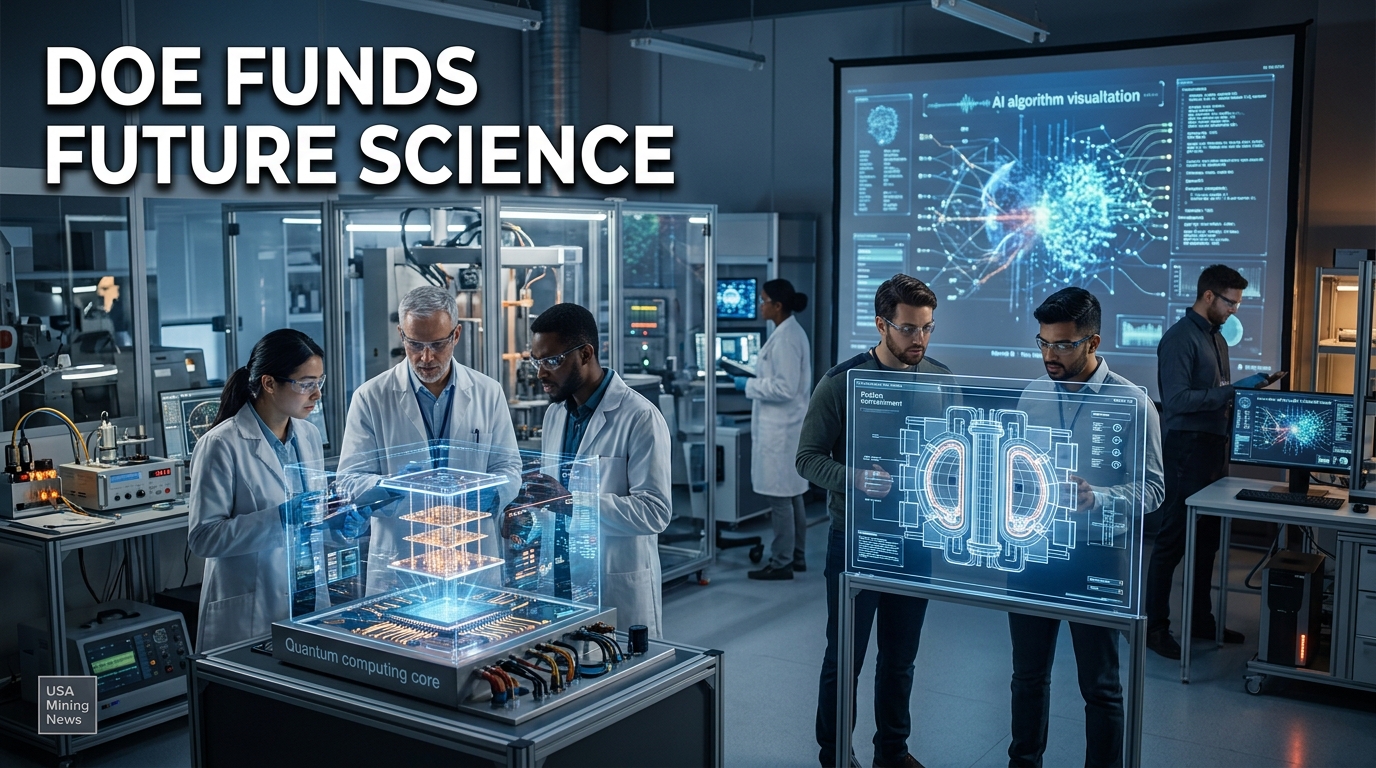
WASHINGTON – On October 8, 2026, the U.S. Department of Energy’s (DOE) Office of Science made a pivotal announcement, allocating a combined $96 million to 67 exceptional early career scientists through its 2026 Early Career Research Program (ECRP). This substantial investment underscores the nation's unwavering commitment to fostering the next generation of scientific leadership, propelling forward research in areas deemed critical for America’s sustained scientific and technological preeminence. The initiative directly supports President Trump’s Executive Order, Restoring Gold Standard Science, by backing rigorous, mission-driven research across universities, national laboratories, and user facilities.
DOE's Strategic Investment in Future Technologies
The core objective of the 2026 ECRP awards is to catalyze breakthroughs in fields that are poised to redefine the technological landscape of the 21st century. The program specifically targets three transformative areas:
- Super Intelligence (SI): Research into advanced artificial intelligence and computational capabilities that promise to revolutionize data processing, automation, and decision-making across numerous sectors.
- Fusion Energy: The pursuit of clean, virtually limitless energy through nuclear fusion, offering a long-term solution to global energy demands and environmental concerns.
- Quantum Science: Exploration of quantum mechanics for developing revolutionary technologies such as quantum computing, quantum communication, and ultra-sensitive quantum sensors.
Dr. Darío Gil, DOE Under Secretary for Science, emphasized the foundational nature of this investment, stating, “Groundbreaking science begins with empowering extraordinary people. These 67 early career researchers represent the very best of American ingenuity. DOE is proud to invest in their vision as they push the boundaries of knowledge and cement U.S. leadership in the technologies that will define our century.” This statement highlights the program's dual focus on individual scientific brilliance and national strategic advantage.
The breadth of the program's reach is impressive, with the 67 selectees representing a diverse ecosystem of innovation. These scientists hail from 39 distinct universities, 11 DOE National Laboratories and Office of Science User Facilities, and originate from 26 states across the nation. This wide distribution ensures that scientific talent from various regions and institutional types is recognized and supported, fostering a robust and interconnected research community.
The Early Career Research Program: A Track Record of Success
The Early Career Research Program, since its inception in 2010, has played a crucial role in nurturing emerging scientific talent. With the latest round of awards, the program’s cumulative impact now stands at an impressive 1,238 awards. Of these, 797 have been granted to researchers at institutions of higher education, while 441 have supported scientists at DOE National Laboratories. This consistent investment over more than a decade underscores the DOE's long-term vision for maintaining America’s scientific edge.
The financial structure of the awards is tailored to support sustained research efforts at critical career junctures. Scientists affiliated with institutions of higher education receive approximately $875,000 over a five-year period. In contrast, researchers based at DOE National Laboratories or Office of Science User Facilities are awarded approximately $2,750,000 over five years, reflecting the typically higher operational costs and infrastructure requirements associated with national laboratory research. This strategic funding mechanism aims to provide a stable foundation, enabling these early career scientists to pursue bold, innovative research that aligns with DOE's overarching mission.
Further details regarding the 67 selectees and their specific research projects are made available on the Office of Science Awards page, offering transparency and insights into the diverse array of inquiries being pursued. Additionally, profiles of previous award recipients, illustrating the program's long-term impact on their research and careers, are accessible on the Early Career Program profiles page.
Bridging Advanced Research and Mining Innovation
While the DOE's 2026 ECRP awards do not explicitly name mining or critical minerals as direct research areas, the foundational technologies being advanced—Super Intelligence, fusion energy, and quantum science—hold profound, albeit indirect, implications for the global mining industry. For mining professionals and investors, understanding these broader scientific trends is crucial for anticipating future operational landscapes, technological integration, and shifts in commodity demand.
- Impact of Super Intelligence (SI) and Advanced AI: The advancements in SI research funded by the ECRP are directly transferable to enhancing efficiency and safety in mining operations.
- Exploration and Resource Modeling: SI algorithms can process vast datasets from geological surveys, satellite imagery, and drilling logs to identify new mineral deposits with greater precision and speed, reducing exploration costs and risks.
- Autonomous Operations: From self-driving haul trucks and drilling rigs to robotic inspection systems, SI is critical for developing and optimizing autonomous mining fleets, leading to increased productivity, reduced labor costs, and improved safety in hazardous environments.
- Predictive Maintenance: AI-driven analytics can forecast equipment failures, allowing for proactive maintenance and minimizing costly downtime for critical machinery.
- Processing Optimization: SI can optimize mineral processing plants by analyzing real-time data from sensors to improve recovery rates, reduce energy consumption, and minimize waste.
- Implications of Fusion Energy: The pursuit of fusion energy could dramatically reshape the energy landscape, with significant consequences for mining.
- Energy-Intensive Operations: Mining and mineral processing are inherently energy-intensive. The advent of commercially viable fusion energy could provide a stable, clean, and potentially low-cost power source, revolutionizing operational economics and drastically reducing the carbon footprint of the industry. This could make previously uneconomical deposits viable and allow for more sustainable extraction methods.
- Demand for Specific Minerals: Fusion reactors require specific materials for their construction, including lithium (for tritium breeding), niobium, copper, and various specialty alloys. This will inevitably drive increased demand for these critical minerals, creating new market opportunities and strategic imperatives for mining companies.
- Revolutionary Potential of Quantum Science: Advances in quantum science, including quantum computing and sensing, offer groundbreaking tools for the mining sector.
- Enhanced Geophysical Exploration: Quantum sensors could enable unprecedented precision in detecting subtle geological anomalies and mineral concentrations deep underground, far surpassing current capabilities. This allows for more targeted drilling and reduced environmental impact.
- Advanced Materials Discovery: Quantum computing can simulate complex atomic and molecular interactions, accelerating the discovery and development of new materials for mining equipment (e.g., more durable drills, corrosion-resistant components) and more efficient separation processes.
- Secure Data and Communication: Quantum cryptography offers unhackable communication channels, vital for securing sensitive operational data and intellectual property in remote mining sites.
- Critical Minerals for Quantum Technologies: The development of quantum computers and other quantum devices relies heavily on specific rare earth elements and other specialty minerals. This creates a feedback loop where advanced scientific research directly fuels demand for the very resources that the mining industry extracts.
Implications for the Mining Sector's Workforce and Supply Chains
The ECRP's focus on developing a robust pool of STEM talent has broader implications for the mining industry's workforce. As mining increasingly integrates these advanced technologies, there will be a parallel need for a highly skilled workforce proficient in data science, robotics, automation engineering, and advanced materials science. While ECRP awardees may not directly enter the mining sector, their research cultivates a scientific ecosystem that benefits all technology-driven industries.
Furthermore, the drive towards advanced technologies – whether for AI, fusion, or quantum applications – will place increasing pressure on critical mineral supply chains. Mining companies must be acutely aware of these evolving demands, strategically positioning themselves to meet the growing need for elements essential to the technologies of tomorrow. Government initiatives like the ECRP indirectly underscore the strategic importance of secure, resilient supply chains for these foundational materials.
Looking Ahead: Charting a Technologically Advanced Future
The U.S. Department of Energy's commitment to foundational scientific research, as exemplified by the 2026 Early Career Research Program, is a critical component of national technological leadership. While the selected scientists are currently undergoing award negotiations, signaling that funding is not yet finalized, the intent to invest significantly in these areas is clear.
This initiative, alongside other DOE programs such as the recently launched Genesis Mission Graduate Fellowship (also announced on October 8, 2026), highlights a sustained government strategy to cultivate a scientific pipeline that can address the nation's most pressing challenges and seize future opportunities. For the mining industry, these scientific advancements, though seemingly distant, represent the technological currents that will shape future exploration, extraction, processing, and ultimately, the demand for the very commodities that fuel global progress. Staying abreast of these developments is not merely an academic exercise but a strategic imperative for long-term competitiveness and sustainability.