US Uranium Sector Roars Back to Life as Output Triples, Driven by Strong Demand and Policy Support
Blair McBride | July 2, 2026
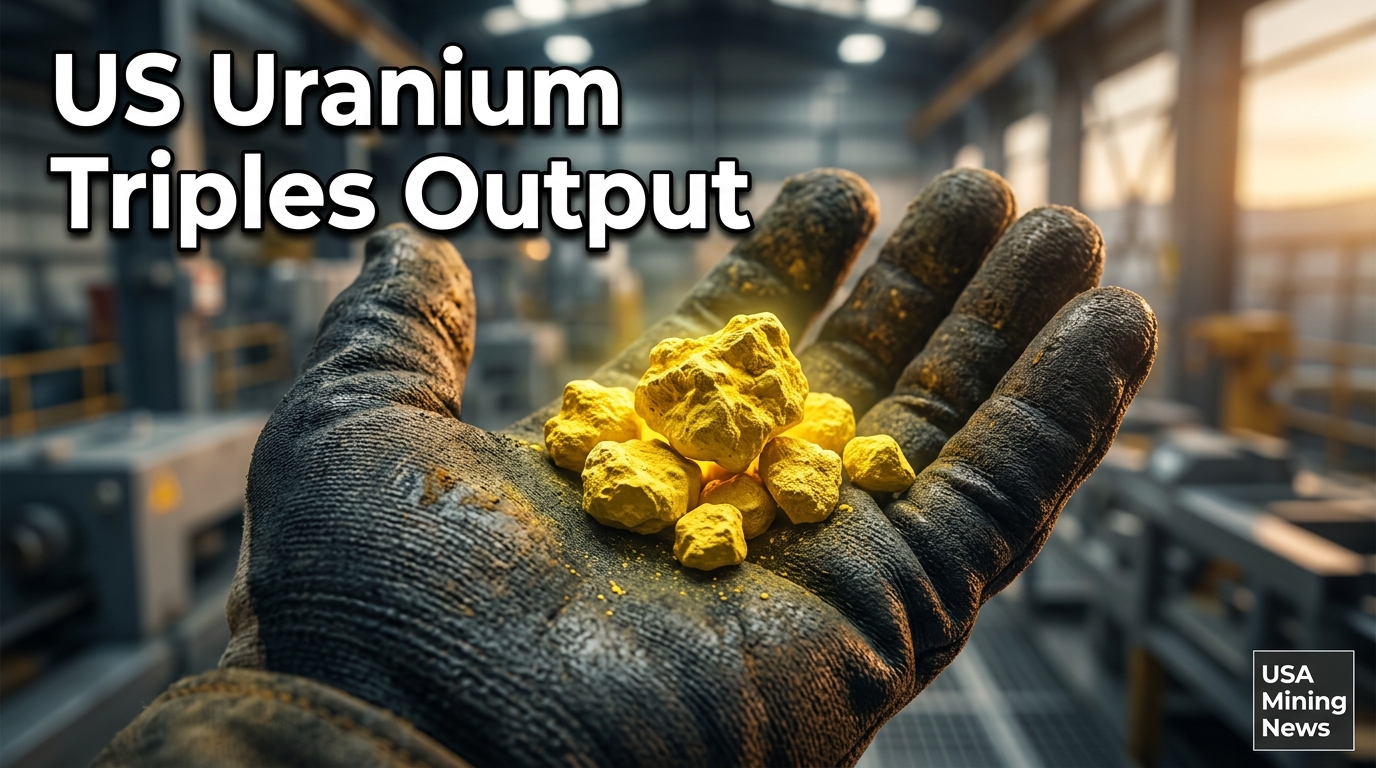
The United States uranium mining industry is currently undergoing a pronounced revival, with activity levels reaching their highest point in almost a decade. According to a recent report by the Energy Information Administration (EIA), domestic uranium oxide (U3O8) production in 2025 significantly escalated, tripling the previous year's output and signaling a robust recovery for a sector critical to energy independence and national security.
This resurgence comes amid a confluence of favorable market dynamics and supportive governmental policies. Rising spot prices for uranium, a renewed emphasis on nuclear energy as a cornerstone of clean power generation, increased government backing for both nuclear power development and domestic uranium mining, and a burgeoning demand for atomic power from energy-intensive data centers are all contributing to a revitalized domestic supply chain.
A Resurgence in Production Metrics
In a compelling demonstration of the industry's recovery, US uranium production in 2025 surged to 2.1 million pounds of U3O8. This represents an extraordinary 223% increase over the total output recorded in 2024. Such production levels have not been observed since 2016, when domestic sites collectively mined 2.5 million pounds of U3O8, underscoring the magnitude of last year's rebound.
The vast majority of this production stemmed from in-situ recovery (ISR) operations. In 2025, seven of the country’s nine producing uranium mines exclusively utilized the ISR method. ISR involves an environmentally controlled process where a solution is injected underground through wells to dissolve uranium from the orebody, subsequently pumping the uranium-rich solution to the surface for processing. This method is favored for its lower surface disturbance and often reduced operational costs compared to conventional mining. A significant portion of this ISR production continues to originate from Wyoming, a state historically rich in uranium deposits.
Intensified Exploration and Development
Beyond the immediate production figures, forward-looking indicators within the sector also displayed substantial growth, pointing to sustained future activity. Exploration drilling for uranium, a vital measure of future resource definition, witnessed a nearly 66% increase in 2025, totaling just over 1 million feet drilled across 1,824 holes. This represents an addition of 500 more holes compared to 2024, marking the highest levels achieved since 2013.
Complementing exploration efforts was a modest but significant gain in development drilling. Used to delineate known deposits, expand existing resources, and prepare specific areas for production, development drilling increased by 3% to 1.3 million feet across 3,708 holes. Notably, the number of development holes drilled surged by 50%. When combined, the total exploration and development drilling reported in 2025 reached levels not seen since 2013, signifying a renewed commitment to expanding the domestic uranium resource base.
Financial Commitment and Workforce Expansion
The expanded operational activities were mirrored by a substantial increase in financial investment and workforce development. Total expenditures allocated to land acquisition, exploration, drilling programs, production activities, and reclamation efforts reached $234.7 million in 2025. This figure represents a robust 47% increase compared to 2024 and marks the highest level of investment in these critical areas since 2014. Such financial commitments are essential for sustaining growth, developing new projects, and ensuring environmental stewardship.
The human capital aspect of the revival is equally impressive. The uranium production sector recorded 711 full-time person-years in 2025, reflecting a significant 40% rise over 2024. This increase in employment represents the highest number of full-time person-years in the sector since 2014, highlighting the industry's capacity to create skilled jobs and contribute to local economies, particularly in regions like Wyoming, Texas, and South Dakota where these operations are concentrated.
Strategic Idle Capacity and Key Players
While most metrics indicated strong growth, the annual production capacity notably declined by 5% to 13.3 million pounds in 2025, as per the EIA's report. This decline, however, is not necessarily a negative indicator. Instead, it suggests that the domestic industry still possesses substantial idle capacity that can be brought back online as market conditions continue to strengthen and long-term supply contracts materialize. This strategic reserve capacity provides flexibility and scalability to meet future demand without requiring immediately new greenfield development.
At the close of 2025, five key ISR plants remained on standby, collectively possessing an impressive annual production capacity of 8.8 million pounds of U3O8. These critical assets, poised to reactivate, include:
- enCore Energy’s Alta Mesa project in Texas.
- Ur-Energy’s Lost Creek project in Wyoming.
- Cameco’s Smith Ranch-Highland operation in Wyoming.
- Energy Fuels’ Ross project in Wyoming.
- Uranium Energy’s Willow Creek project in Wyoming.
These companies represent some of the most significant domestic players in the US uranium space, and their ability to bring these operations back online efficiently will be crucial for the continued expansion of US uranium output.
Catalysts Driving the Revival
The multifaceted tailwinds buoying the U.S. uranium sector are fundamental to understanding its current trajectory. Fundamentally, global average spot prices for U3O8 have seen a considerable ascent over the past couple of years, making domestic production economically viable and attractive once again. This price recovery has incentivized producers to restart operations and invest in new capacity.
Crucially, robust government support for nuclear energy is providing a stable long-term outlook for uranium demand. Nuclear power is increasingly recognized as a reliable, carbon-free baseload energy source, vital for achieving decarbonization goals and ensuring grid stability. This includes legislative and executive branch initiatives aimed at expanding existing reactors, deploying advanced reactor technologies, and securing domestic fuel supplies.
Beyond direct support for nuclear power, governmental backing for uranium mining specifically aims to bolster critical mineral supply chain resilience. The US has historically been reliant on foreign sources for a significant portion of its nuclear fuel, a vulnerability that recent geopolitical events have underscored. Promoting domestic mining reduces this dependency, enhances national security, and ensures a steady supply for the nation's nuclear fleet.
A more contemporary catalyst is the escalating demand for atomic power from the rapidly expanding data center industry. These massive computing facilities require enormous, uninterrupted supplies of electricity. Nuclear power plants, with their high capacity factors and consistent output, are an ideal solution for meeting this burgeoning energy appetite, further cementing the long-term demand for uranium.
Momentum Continues into 2026
The strong momentum from 2025 has demonstrably carried forward into the current year, 2026, with several significant developments already recorded. Just last month, in June 2026, enCore Energy secured a pivotal federal approval for the construction of its Dewey Burdock ISR site in South Dakota. This approval marks a critical step towards bringing a new, sizeable uranium production facility online in the coming years.
In another significant development earlier this year, in April 2026, Ur-Energy restarted production at its Shirley Basin mine in Wyoming. This marked a historic moment as it was the first time this mine had been operational since 1992, highlighting the confidence companies now have in the sustained recovery of the market.
Further demonstrating the committed federal support for nuclear power, the Department of Energy (DOE) announced in June 2026 its plans to offer an substantial $17.5 billion in loans. These funds are earmarked to accelerate the nationwide buildout of 10 large-scale commercial nuclear reactors. This direct financial injection into nuclear infrastructure will undoubtedly stimulate long-term demand for domestically sourced uranium.
Broader Implications for the US Mining Industry
The revitalized US uranium sector carries profound implications not only for the niche market of nuclear fuels but also for the broader US mining industry and national policy. From an energy security perspective, increasing domestic uranium production reduces reliance on potentially unstable foreign suppliers, safeguarding the operational continuity of critical nuclear power plants that provide roughly 20% of the nation's electricity.
Economically, the surge in exploration, development, and production generates significant investment, creates high-wage jobs in rural mining communities, and boosts local and state tax revenues. Environmentally, supporting domestic uranium extraction, particularly through modern ISR methods, strengthens the supply chain for a low-carbon energy source, helping the United States meet its climate change mitigation goals.
Moreover, the success of the uranium sector can serve as a template and provide impetus for the revitalization of other critical mineral mining industries in the US, fostering a broader national strategy for domestic resource development and supply chain resilience. This holistic approach is essential in a world increasingly focused on secure access to strategic materials.
Outlook and Next Steps
The outlook for the US uranium industry appears robust, with consistent growth expected if current market conditions and policy support persist. The presence of substantial idle capacity, totaling 8.8 million pounds across five major ISR facilities, provides a ready pathway for further production increases without immediate capital-intensive new mine development. The strategic activation of these operations will depend on firming up long-term contracts and sustained strong pricing, which itself will be influenced by global demand and continued geopolitical considerations.
On the policy front, continued governmental support — through loan programs, strategic reserve initiatives, and clear regulatory pathways for new projects — will be paramount. The recent DOE loan offers for new reactors are a powerful signal of commitment. As global decarbonization efforts intensify and energy security concerns remain high, the role of domestically sourced uranium in the US energy matrix is set to grow ever more critical, positioning the sector for continued expansion and significant contributions to the nation's future energy landscape.