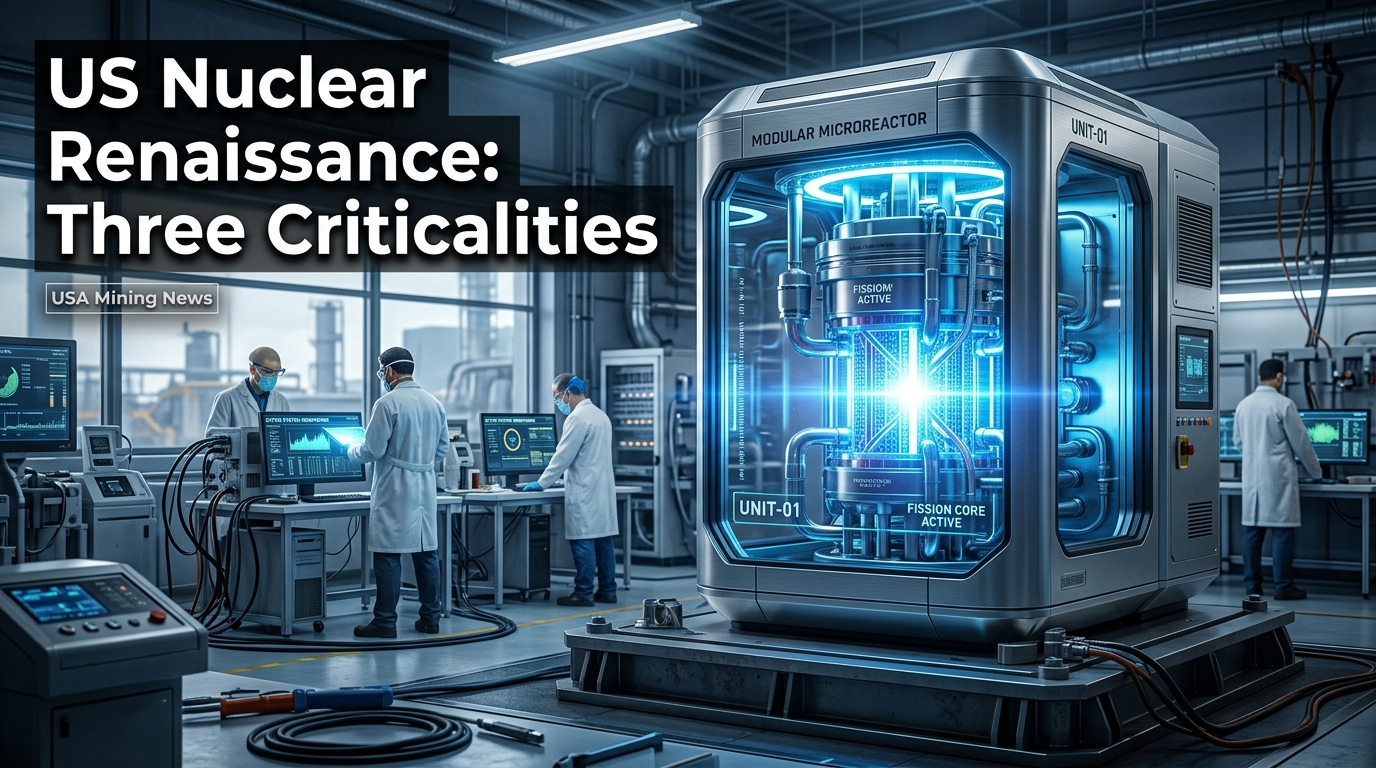
The U.S. Department of Energy (DOE) has announced a landmark achievement in the nation’s nuclear energy landscape, successfully fulfilling President Trump’s May 2025 executive order directing the DOE to authorize three advanced reactors with the goal of achieving criticality in each by July 4, 2026. This ambitious target was met on the eve of the deadline, with Deployable Energy’s demonstration reactor, Unity, successfully completing its zero-power fueled criticality demonstration at Idaho National Laboratory (INL) on June 30, 2026. This accomplishment follows closely on the heels of similar successes by Antares Nuclear’s Mark-0 and Valar Atomics’ Ward 250 reactors earlier in June, marking an unparalleled moment in nuclear innovation.
This trio of criticalities signifies not only the successful execution of an aggressive directive but also positions the United States as the first country in history to achieve criticality in three unique advanced microreactor designs within a single month. For the global mining industry, this resurgence of advanced nuclear power generation carries substantial implications, particularly concerning the demand for vital critical minerals, from uranium for fuel to specialized materials for reactor construction.
A New Dawn for U.S. Nuclear Innovation
The successful criticality of Deployable Energy’s Unity reactor at INL marks the culmination of an intensive period of development and testing under the DOE’s Nuclear Energy Launch Pad initiative. Unity’s demonstration, which achieved criticality late on June 30, 2026, was the third and final advanced reactor to meet the specific requirements set forth by the presidential executive order. This follows the earlier successes of Antares Nuclear’s Mark-0 and Valar Atomics’ Ward 250 reactors, both of which reached criticality earlier in June 2026 as part of the DOE’s Reactor Pilot Program.
Idaho National Laboratory, a cornerstone of U.S. nuclear research and development, served as the crucial host for these demonstrations. The collaboration between private sector innovators like Deployable Energy, Antares Nuclear, and Valar Atomics, along with the expertise of INL and the strategic oversight of the DOE, underscores a revitalized national commitment to advanced nuclear technologies. The achievement highlights a concerted effort to accelerate the development and deployment of these innovative energy solutions, which are seen as critical components of future energy security and industrial growth.
Fulfilling a Presidential Directive and Sparking a Renaissance
The directive for these accomplishments originated from President Trump’s significant May 2025 executive order, which aimed to authorize and bring three advanced reactors to criticality by July 4, 2026. This ambitious goal was designed to catalyze a new era of nuclear energy innovation, overcoming decades of relative stagnation in new reactor development within the United States.
Secretary of Energy Chris Wright underscored the historical significance of this milestone. “Last week, I had the opportunity to see the Unity demonstration reactor firsthand and meet with the talented teams from Deployable Energy, INL and DOE whose work made this historic moment possible on the eve of our nation's 250th anniversary,” Secretary Wright stated. He emphasized the role of presidential vision, proclaiming, “America’s nuclear renaissance is underway because of President Trump’s bold vision and ambitious goals. Yesterday, we accomplished a significant milestone on a timeline many thought was unachievable. Advanced nuclear technologies like Unity will help power the next generation of American industry, strengthen our energy security, and ensure the United States remains the world’s nuclear innovation leader.”
Bobby Gallagher, Co-Founder and CEO at Deployable Energy, echoed this sentiment, acknowledging the collective effort. “We are proud to be a part of this historic achievement and I want to express Deployable Energy's gratitude to the administration for setting an audacious goal to have three reactors reach criticality before July 4th, the U.S. Department of Energy for ensuring our ability to meet this goal with safety, quality, and speed, and the Idaho National Laboratory for providing an incredible partnership in execution,” Gallagher stated. He also extended thanks to his company’s team and supply chain partners, whose “brilliance, boldness, and grit” were essential in meeting the critical deadline.
Technical Prowess and Programmatic Success
The criticality demonstrations involved achieving a self-sustaining nuclear chain reaction at a very low power level—a "zero-power fueled criticality demonstration." This critical step confirms the fundamental nuclear physics calculations and the functional design of the reactor core, proving that the reactor can indeed sustain a controlled nuclear reaction. For advanced microreactors, which are typically compact and designed for modular deployment, this demonstration is a crucial precursor to higher-power testing and eventual commercial application.
The success of these projects is largely attributed to strategic government initiatives. Deployable Energy’s Unity project operated under the Nuclear Energy Launch Pad initiative, which is managed by the National Reactor Innovation Center at Idaho National Laboratory. This program builds upon the foundations of the Reactor Pilot Program, which authorized Antares Nuclear’s Mark-0 and Valar Atomics’ Ward 250. The Nuclear Energy Launch Pad is designed to leverage DOE authorization to expedite the certification and construction of these “first-of-a-kind advanced nuclear technologies for demonstration.” This streamlined approach, utilizing the extensive resources and regulatory expertise of national laboratories, demonstrably accelerates critical experiments and reactor demonstrations, as proven by Unity being the first Nuclear Energy Launch Pad project to achieve its criticality milestone.
Market Implications: Powering Industry and Securing Supply Chains
The successful achievement of criticality in three distinct advanced microreactor designs marks a pivotal moment for U.S. energy strategy and carries profound implications for the global mining sector. These advanced nuclear technologies are envisioned as powerful tools to energize the next generation of American industry, offering reliable, carbon-free energy sources that can bolster manufacturing capabilities, support data centers, and provide stable power for remote operations or critical infrastructure.
The resurgence of nuclear energy development inherently drives demand for a specific set of raw materials, creating significant opportunities and challenges for the mining industry.
- Uranium Demand: As these advanced reactors move towards commercial deployment, the demand for uranium, the primary fuel source for nuclear fission, is expected to grow. This will necessitate increased investment in uranium exploration, mining, and processing, potentially revitalizing domestic uranium production capabilities in the United States, which have seen a decline in recent decades. A secure and diversified supply of uranium is paramount for national energy security.
- Critical Mineral Requirements: Beyond uranium, advanced nuclear reactor designs utilize a diverse array of critical minerals and specialized materials. These include rare earth elements for magnets and control systems, zirconium for fuel cladding, hafnium, niobium, and tantalum for high-temperature alloys and structural components. The construction of these sophisticated reactors will also require significant quantities of copper, nickel, chromium, and specialized steels.
- Supply Chain Resilience: The acceleration of advanced nuclear technology development places a spotlight on the fragility of global supply chains for these critical materials. To ensure the rapid and secure deployment of reactors like Unity, Mark-0, and Ward 250, there will be an urgent need to de-risk and localize the sourcing and processing of these minerals. This could stimulate significant investments in domestic U.S. mining, refining, and manufacturing capabilities, aligning with broader strategic efforts to enhance national resilience. The DOE’s Office of Critical Minerals and Energy Innovation, which recently awarded $75 million to accelerate critical minerals and materials recovery from coal and coal-based feedstocks, underscores this strategic imperative.
- Innovation in Mining and Processing: The specific requirements of advanced reactors may also drive innovation within the mining and materials processing sectors, encouraging the development of new extraction techniques, recycling methods, and advanced manufacturing processes to produce high-purity, specialized materials tailored for nuclear applications.
The Road Ahead: From Demonstration to Deployment
While achieving criticality is a monumental step, it represents the beginning of a longer journey towards widespread commercial deployment. The next phases for Unity, Mark-0, and Ward 250 will likely involve sustained testing, higher-power operations, and rigorous safety evaluations to validate their performance characteristics and operational reliability. These demonstration reactors serve as vital proofs-of-concept, paving the way for larger-scale and more mature designs.
The success achieved at INL invigorates the broader vision of “Unleashing Commercial Nuclear Power in the United States.” It suggests a path towards establishing a more diversified energy portfolio, reducing reliance on fossil fuels, and providing a stable, baseload power source that complements intermittent renewables. Furthermore, the demonstrated ability to rapidly develop and certify advanced reactor designs positions the U.S. to reclaim its leadership in global nuclear technology exports, potentially creating new economic opportunities and solidifying geopolitical influence.
Challenges certainly remain, including navigating complex regulatory frameworks, securing substantial capital investment for commercial-scale projects, and addressing public perception and acceptance. However, the coordinated success of the DOE, national laboratories, and private industry in achieving this "unachievable" timeline for advanced reactor criticality provides a powerful blueprint for overcoming these obstacles. This pivotal moment not only marks a technological triumph but also signals a fundamental shift in U.S. energy policy, with profound implications for energy independence, climate goals, and the economic future of the mining sector. The stage is now set for these advanced nuclear technologies to move beyond demonstration and into the realm of practical energy solutions, promising a brighter, more secure energy future.