In the high-stakes world of mineral exploration and extraction, the narrative often centers on ore grades, geopolitical stability, and market demand. Geologists present promising discoveries, boasting strong grades, favorable jurisdictions, and scalable resources. Yet, as detailed in a recent report from May 15, 2026, an increasingly common and overlooked question is quietly derailing these ambitions: “Where is your water coming from?” Often, there is no satisfactory answer, transforming this fundamental requirement into a critical, project-killing constraint before operations can even commence.
According to Justin Vandenbrink, Vice President of Mine Water Strategy at Houston, Texas-based consultancy firm Woodard & Curran, the consistent challenge in the sector lies at the intricate intersection where water strategy, rigorous permitting processes, and overall mine economics collide. His insights, shared with MINING.COM, paint a vivid picture of an industry grappling with a paradigm shift that many were not anticipating.
A Paradigm Shift: Water Moves from Periphery to Priority
For decades, water requirements were largely relegated to the periphery of mining project analysis. It was considered a logistical concern, certainly, but seldom a dealbreaker. This perception has fundamentally changed. Vandenbrink emphasizes that a significant blind spot still exists within the industry, as operators frequently model water as merely a technical problem, focusing on treatment systems and discharge management, rather than recognizing it as a critical schedule and risk factor.
“A water permit in the western US can take two to four years. Sometimes longer. If that timeline wasn’t baked into the project schedule from day one, you already have a problem you haven’t discovered yet,” Vandenbrink warned. This delay, often stemming from unforeseen regulatory backlogs or formal objections from downstream water rights holders—issues Vandenbrink considers entirely foreseeable—can add years and millions of dollars to a project's development cycle, eroding its economic viability and stakeholder confidence.
The warning reflects a broader, accelerating trend across the global mining industry. Water scarcity is not an isolated problem; it is converging with increasingly stringent permitting timelines, heightened community opposition, and escalating demand from competing sectors such as agriculture, energy production, and the burgeoning field of artificial intelligence data centers. The Bradshaw Institute for Minerals and Mining has formally recognized this shift, noting that water has evolved from a secondary operational concern into a major environmental and economic constraint that can no longer be underestimated.
Vandenbrink elaborated on how companies often frame their own risk, treating water permitting as a downstream environmental task rather than a core development issue directly tied to project schedules, financing, and long-term economics. “The ore grade is good, the capital raise is underway, the technical team has done solid work on the process plant and the tailings facility,” he observed. “I’ve watched projects with strong ore bodies and good financing stall because the water story wasn’t credible – to regulators, or to the community.” Without a robust, credible water strategy, even well-funded projects with excellent resource fundamentals can find their progress halted indefinitely, often disappearing quietly without a clear post-mortem attributing their demise to water issues buried within fine print.
Intensifying Competition for a Finite Resource
At the heart of this challenge lies a stark reality: only about 3% of Earth’s total water is freshwater, and a mere fraction of that is readily accessible for human use. This limited supply is under unprecedented stress. Global demand is accelerating rapidly, driven not just by traditional sectors like agriculture, which accounts for the vast majority of freshwater consumption, and energy production, but also by new, intensive users. The rapid expansion of artificial intelligence data centers, for instance, requires significant amounts of water for cooling, adding another formidable competitor to an already strained resource pool. This convergence of pressures around a single, finite resource means water is no longer just an input; it has become an increasingly critical constraint.
The implications of this heightened water scarcity are already rippling outward through the global economy. Credit agencies are beginning to integrate water availability and management into their national and corporate risk assessments, influencing sovereign ratings and corporate bond pricing. Governments worldwide are reassessing water security as a strategic priority, recognizing its fundamental link to economic stability and social cohesion. Furthermore, competing industries are openly deflecting scrutiny by pointing to each other’s consumption, creating a more complex and contentious operating environment for all major water users, including mining.
Technological Innovation: A New Source for an Ancient Resource
In response to these formidable challenges, the mining industry is exploring and adopting new technologies. While traditional solutions like closed-loop recycling systems offer potential by significantly reducing or eliminating process water discharge, they too come with their own set of constraints, including infrastructure costs and the need for specialized treatment. Vandenbrink noted that much of the technology adoption in mine water management has, until recently, been driven primarily by permitting pressure and closure liability rather than solely by efficiency gains.
However, out of this growing constraint, a truly disruptive technological approach is emerging—one that challenges a fundamental assumption about water itself. Instead of perpetually seeking to source water from rivers, aquifers, or coastal desalination plants, some innovative technology companies are beginning to generate it directly from the air. The concept is refreshingly simple yet profoundly impactful: treat air itself as a vast, untapped resource for water.
The atmosphere holds an immense volume of water, estimated at any given moment to be several times the combined volume of all the world’s rivers. Crucially, unlike groundwater, which can take centuries or even millennia to replenish, atmospheric water cycles rapidly, turning over in a matter of days. This represents a significant conceptual shift in industry terms, moving from reliance on "slow water" resources to leveraging "fast water" – a constantly replenishing, globally distributed supply.
Genesis Systems: Pioneering Atmospheric Water Generation
Leading this innovative shift is Genesis Systems, a US-based firm founded in 2017. The company specializes in developing proprietary systems that extract atmospheric moisture and convert it into potable water using advanced materials specifically designed for efficient capture and release of water vapor. David Stuckenberg, CEO of Genesis Systems, highlighted the intensified competition for water to MINING.COM: “The data center industry, the cattle industry, and the mining industry are all competing for this finite scarce resource. Water is no longer on the periphery. We’ve moved from water being an afterthought to a forethought.”
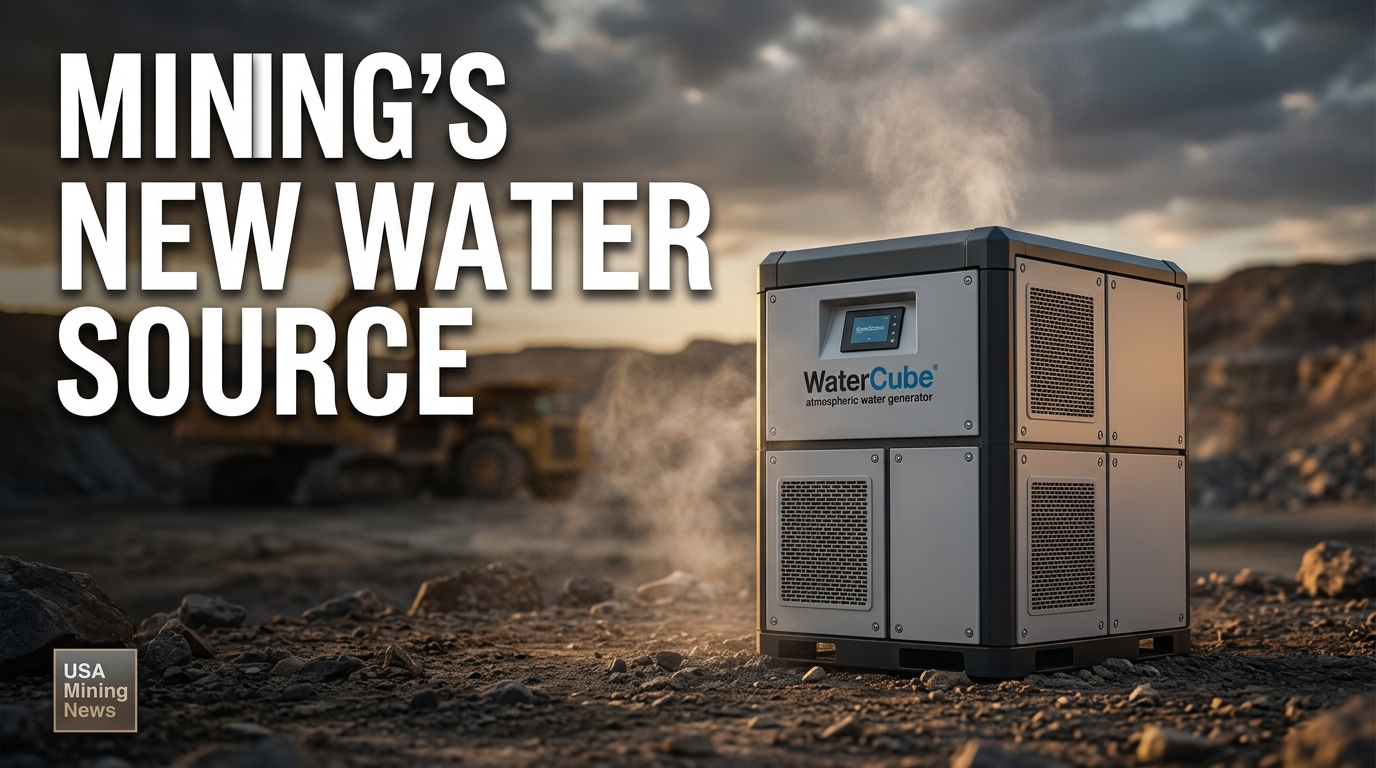
Genesis’ flagship products, the ‘WaterCube’ systems, are engineered to generate potable water directly from the air. Some configurations are capable of producing over 1,000 gallons per day, offering a decentralized water supply solution. A key advantage of these systems is their operational independence from traditional fixed infrastructure like pipelines or electrical grids, making them ideal for remote mining sites or areas lacking robust utilities. Stuckenberg underscored the environmental benefit of this approach: “If we pull water out of the ground, it takes 90 years to 900 years to replenish. The atmosphere replenishes in days.” This speed of replenishment offers a sustainable alternative to depleting finite groundwater reserves.
The viability of Genesis Systems’ technology has already been proven in demanding, real-world environments. Their systems have been successfully deployed in critical disaster response scenarios, providing essential potable water where traditional supplies were disrupted, and in military operations, demonstrating their robustness and reliability under austere conditions.
Strategic Imperatives for the Future of Mining
As the mining industry navigates an era of increasing resource scarcity and environmental scrutiny, proactive and innovative water management will dictate project success and corporate longevity. The emergence of atmospheric water generation technology, championed by companies like Genesis Systems, offers a compelling vision for future mining operations in regions globally, including Africa, Australia, Canada, Latin America, and the USA.
Integrating such technologies could fundamentally reshape project viability by mitigating water-related permitting delays and reducing reliance on vulnerable local water sources. For mining investors and professionals, understanding and embracing these advanced water solutions is no longer an optional consideration but a strategic imperative. The ability to secure a sustainable, independent, and rapidly replenishing water supply will be a significant competitive differentiator, enhancing social license to operate, de-risking financial investments, and ultimately ensuring the continued development of critical mineral resources vital to the global economy.