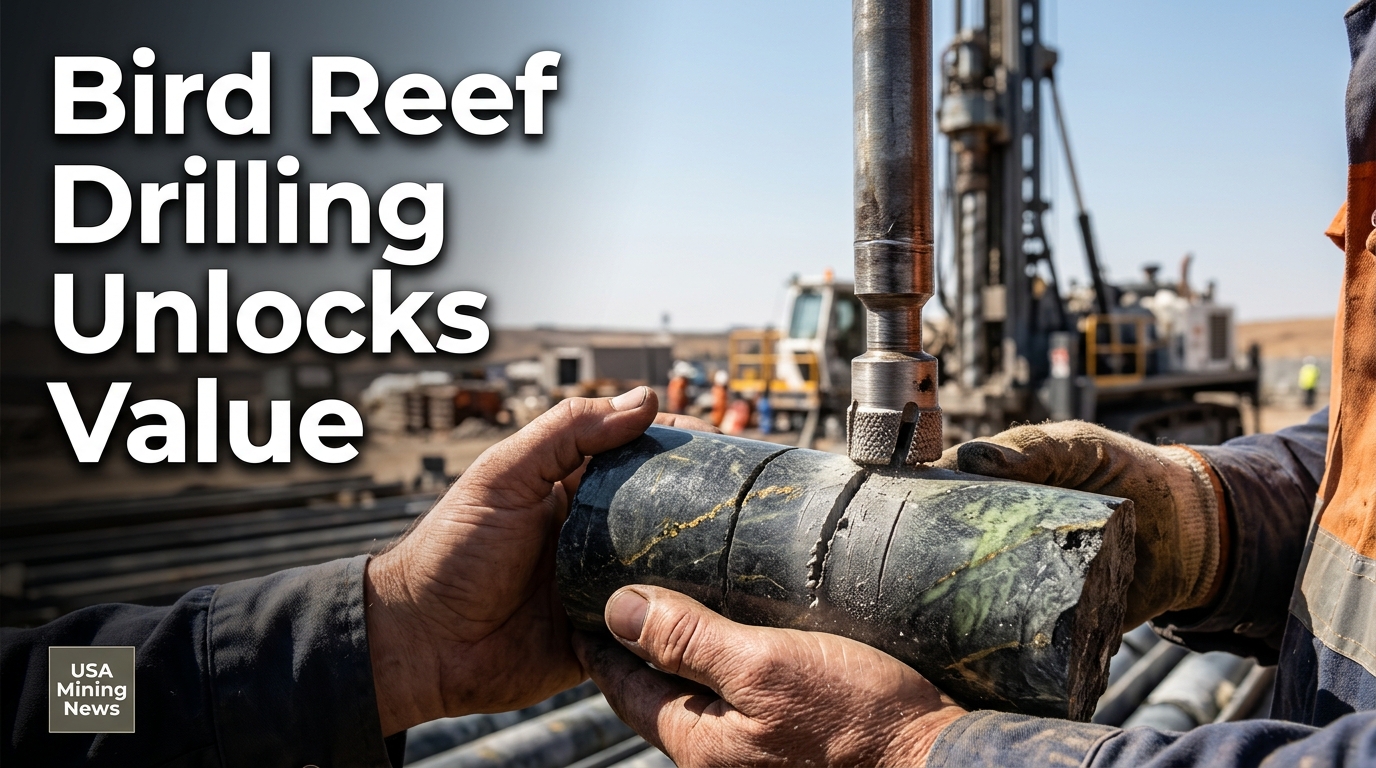
West Wits Mining, an Australian-based explorer and developer with a strategic focus on South Africa's prolific Witwatersrand Basin, has announced an ambitious 17-hole diamond drilling program at its Bird Reef Central project in Johannesburg. This extensive exploration initiative, scheduled to begin by the end of November 2026, marks a pivotal step in assessing the project's significant uranium resource potential while simultaneously working to expand and upgrade its already declared gold mineral resource estimate. For the global mining sector, particularly those watching junior developers in established mining districts, this program underscores the enduring value of brownfield exploration and the strategic advantages of multi-commodity assets.
Strategic Exploration Initiative Unveiled
The core of West Wits' latest endeavor is a targeted 5,750-meter diamond drilling program designed to thoroughly explore a 4-kilometer strike length of the Bird Reef package. This carefully planned campaign will involve 17 individual drill holes, strategically spaced approximately 250 meters apart. The drilling depths are projected to range from 100 meters to 400 meters, allowing for comprehensive geological sampling and data collection across the targeted mineralized horizons. Diamond drilling is a preferred method for resource definition due to its ability to recover intact core samples, which are crucial for detailed geological logging, assaying, and structural analysis. This level of detail is essential for establishing JORC-compliant resource estimates, providing a robust foundation for future economic studies.
The program is structured in three distinct stages, a phased approach that allows for systematic data interpretation and potential adjustments to subsequent drilling. This structured methodology is also reflected in the funding mechanism; West Wits Mining has confirmed that the program will be financed from its existing cash reserves, signaling strong financial health and confidence in the project's prospectivity. Investors and industry observers will be keenly anticipating the progressive release of results from each of these phases, which the company expects to disseminate throughout the first half of 2027. This staged reporting will offer regular updates on the evolving understanding of the Bird Reef Central deposit, providing transparency and continuity in its development narrative.
The Bird Reef Central Prospect: A Dual-Commodity Asset
Bird Reef Central is strategically located within West Wits Mining’s extensive existing Mining Right in Johannesburg, South Africa. This positioning is critical, as possessing an established Mining Right streamlines the permitting process for development and operations, significantly de-risking the project compared to new discoveries in unpermitted areas. The project area is situated approximately 4 kilometers northwest of West Wits' operational Qala Shallows gold mine, which is an integral part of the company's broader Witwatersrand Basin Project. This proximity suggests potential synergies in terms of infrastructure, technical expertise, and logistical support, although Bird Reef Central is being evaluated as a standalone operation.
The prospect boasts an existing JORC (2012) compliant gold Mineral Resource Estimate (MRE) of 1.38 million tonnes at an average grade of 2.66 grams per tonne of gold, containing a total of 117,600 ounces. Notably, approximately 65% of these gold ounces are classified in the higher confidence measured or indicated categories. The JORC Code (Joint Ore Reserves Committee Code) is an internationally recognized standard for reporting mineral resources and ore reserves, providing a framework that ensures transparency, materiality, and competence in public reporting. The high proportion of measured and indicated resources at Bird Reef Central underscores the existing geological confidence, which the new drilling program aims to further enhance.
Beyond gold, Bird Reef Central holds substantial uranium resource potential, currently defined as an Exploration Target. This dual-commodity nature is a key characteristic of many deposits within the Witwatersrand Basin, historically renowned for both its immense gold output and significant uranium by-production. Indeed, historical extraction from the broader Witwatersrand region has yielded approximately 37 million pounds of uranium. Crucially, while the region has a rich history of mining, the specific western section of West Wits’ Mining Right where Bird Reef Central lies has not been subjected to previous mining activities, suggesting untapped potential. The gold and uranium mineralization at Bird Reef Central are found in adjacent reef horizons within the Bird Reef sequence. This geological characteristic is highly advantageous, as it allows for the potential co-extraction of both valuable commodities utilizing shared infrastructure in what could become a single, integrated mining operation. Such operational synergy can lead to significant cost efficiencies and enhanced overall project economics, providing resilience against commodity price fluctuations.
Driving Resource Confidence and Future Feasibility
The primary objectives of the current drilling campaign are twofold: to generate sufficient data to support the declaration of an initial uranium mineral resource estimate and to improve the confidence levels of the existing gold MRE. For the gold resource, increasing confidence in the measured and indicated categories is a critical step. A robust, high-confidence MRE is fundamental for underpinning future feasibility studies, such as Pre-Feasibility Studies (PFS) and Definitive Feasibility Studies (DFS). These comprehensive technical and economic assessments are prerequisites for making informed investment decisions and securing project financing for mine development.
For uranium, establishing an initial MRE would transform Bird Reef Central's uranium potential from an exploration target into a quantifiable asset. In an era of renewed global interest in nuclear energy and potential supply constraints for uranium, defining a new, significant uranium resource could be a substantial value driver for West Wits. The company's decision to self-fund the drilling program from existing cash reserves highlights its belief in the project's potential and its commitment to advancing Bird Reef Central towards development. This financial independence in the early stages of a significant exploration program is often viewed positively by the market, indicating strong corporate liquidity and a disciplined approach to capital allocation.
West Wits' Evolving Portfolio and Strategic Vision
West Wits Mining's CEO and Managing Director, Rudi Deysel, articulated the strategic importance of Bird Reef Central within the company's broader portfolio, stating: "Qala Shallows gives us a producing gold foundation; Bird Reef Central gives shareholders a second, independent growth option within the same Mining Right." This statement underscores a clear corporate strategy to build on its foundational gold production from Qala Shallows by developing additional, independent revenue streams. The ability to diversify operations within the same mining right offers inherent efficiencies and risk mitigation. Furthermore, Deysel highlighted that West Wits already holds the necessary rights to mine both gold and uranium at Bird Reef Central and has both a declared gold MRE and a uranium Exploration Target in place, further de-risking future development.
This intensified focus on Bird Reef Central aligns with recent portfolio adjustments by West Wits. In April 2026, the company divested its Mt Cecelia Project in Western Australia through the complete sale of its subsidiary Northern Reserves to Aventine Resources. This transaction suggests a strategic streamlining of West Wits' asset base, allowing it to concentrate capital and management attention on key projects with clearer pathways to production, such as Bird Reef Central within its Witwatersrand footprint. For investors, such a strategic pivot signals management's commitment to optimizing value creation by focusing on its core competencies and high-potential assets.
Market Implications and Industry Context for Multi-Commodity Projects
The development at Bird Reef Central is set against the backdrop of the Witwatersrand Basin's unparalleled historical significance. This geological formation has been the world's most prolific gold region for over a century, and its uranium endowment has also played a crucial role in global supply. For the mining industry, West Wits' exploration efforts represent a continued belief in the untapped potential of mature mining camps. Modern exploration techniques, coupled with a renewed focus on historical data and overlooked areas, can unlock significant value even in regions that have seen extensive mining for decades.
The dual-commodity nature of Bird Reef Central is particularly relevant in the current global economic climate. Projects capable of producing multiple commodities often benefit from enhanced revenue diversification, which can buffer against the volatility of single-commodity markets. The ability to extract gold and uranium using shared infrastructure offers substantial operational synergies, potentially lowering overall unit costs and improving project economics. This becomes even more critical in an environment where capital expenditure for new mines is escalating, and operational efficiency is paramount. As the world transitions towards greener energy solutions, the demand for uranium, a key component in nuclear power, is projected to strengthen, potentially adding a significant demand driver alongside gold's traditional safe-haven appeal.
Outlook and Next Steps
The successful execution of West Wits Mining's drilling program at Bird Reef Central is poised to be a significant catalyst for the company. With drilling set to commence by the end of November 2026, the industry will closely monitor the progressive release of results throughout the first half of 2027. These results will be instrumental in validating the project's dual-commodity potential and elevating its resource confidence. Should the drilling program successfully establish a robust initial uranium MRE and significantly upgrade the gold MRE, Bird Reef Central could quickly advance towards a feasibility study, outlining its economic viability as a significant, independent mining operation.
The potential for Bird Reef Central to become a second independent production center, complementing the Qala Shallows operation, offers a compelling growth trajectory for West Wits Mining. For shareholders, this represents not only diversification of assets but also a strengthened position in two key commodity markets. Beyond West Wits, the project's development could serve as a model for revitalizing exploration and development within the broader Witwatersrand Basin, showcasing how strategic, targeted programs can unlock considerable value from historically rich but underexplored segments of a globally significant mining district.