Pioneering Exploration: Westar Resources Secures Government Funding for Bunda Creek Project
In a significant boost for early-stage mineral exploration in Australia, Westar Resources has announced the successful acquisition of government funding totaling A$55,689 ($39,395) for an aeromagnetic survey at its Bunda Creek Project. The grant, provided through Round 19 of the Northern Territory Government’s Geophysics and Drilling Collaborations programme, is set to propel Westar's search for sediment-hosted copper and other base metal deposits within the frontier Birrindudu Basin. This strategic investment underscores the growing importance of collaborative efforts between government and industry to unlock the potential of underexplored mineral provinces, particularly as global demand for critical metals continues to escalate.
A Strategic Boost for Frontier Exploration
The grant awarded to Westar Resources forms a critical component of the Northern Territory Government’s broader "Resourcing the Territory" programme, designed to stimulate and de-risk mineral exploration across the region. Participation in the Geophysics and Drilling Collaborations programme is highly competitive, with Westar being one of only 26 successful companies in this particular round. This competitive selection process highlights the perceived merit and strategic importance of Westar's proposed exploration activities at Bunda Creek. The A$55,689 funding is earmarked specifically for a high-resolution aeromagnetic survey, a sophisticated geophysical technique that will provide crucial subsurface data without the need for extensive ground disturbance in the initial stages. Such government backing is often pivotal for junior exploration companies, enabling them to undertake significant investigative work in challenging and underexplored "frontier" areas that might otherwise be deemed too capital-intensive or risky in the early phases.
Unlocking the Birrindudu Basin's Potential
The Birrindudu Basin, located within Australia's Northern Territory, represents one of the nation’s less-explored geological provinces, yet one with increasingly recognized mineral prospectivity. Recent detailed investigations by authoritative bodies such as the Northern Territory Geological Survey, the Commonwealth Scientific and Industrial Research Organisation (CSIRO), and Geoscience Australia have collectively highlighted the basin's significant potential for copper mineralization. These studies have unearthed compelling geological evidence, including indicators of a primary copper source, clear signs that oxidised basinal fluids have effectively leached copper from host rocks, and the confirmed presence of a suitable reductant within the Amos Knob formation. This particular formation is critical as reductants play a vital role in precipitating dissolved metals from mineralizing fluids, leading to the formation of concentrated ore bodies. The consensus from these leading geological institutions has ignited considerable interest in the Birrindudu Basin, positioning it as a key focus for future base metal discoveries globally.
Technical Precision: The Aeromagnetic Advantage
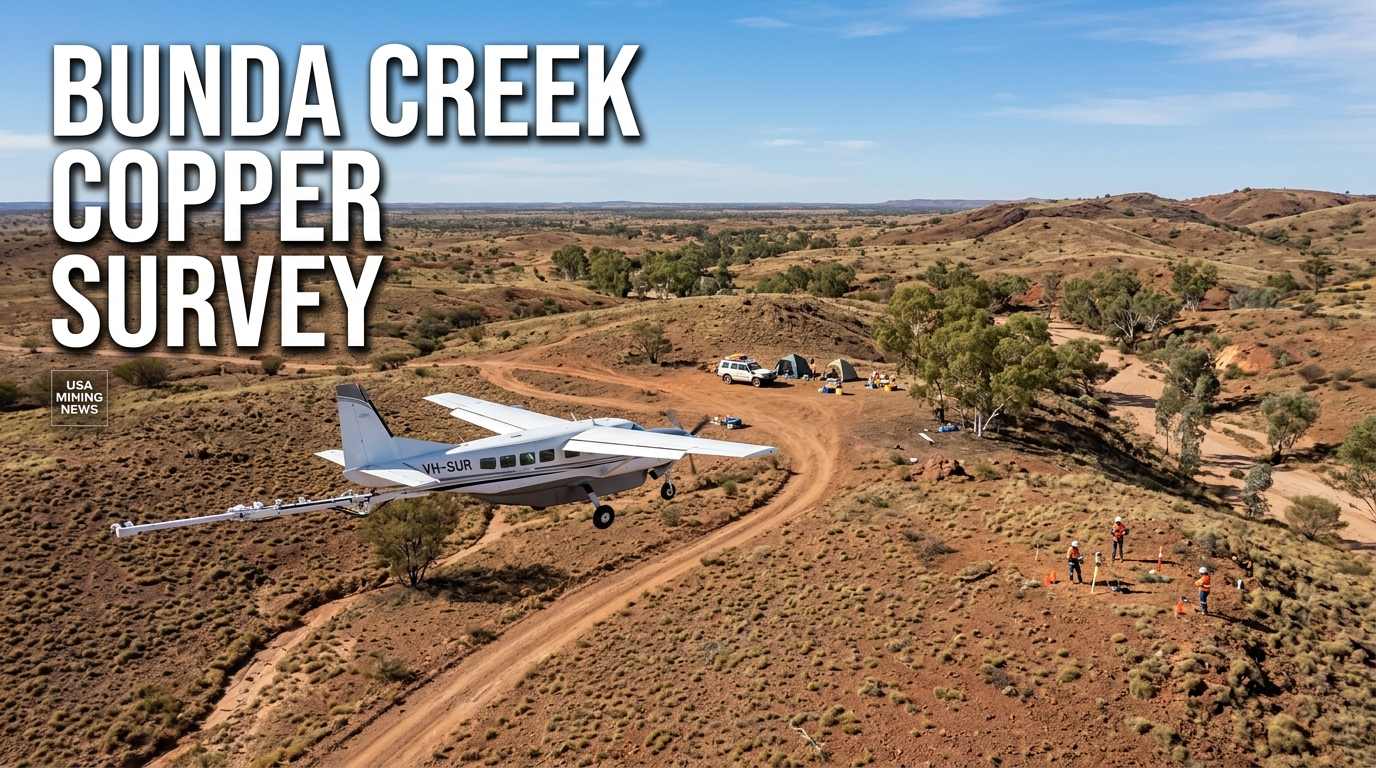
The planned aeromagnetic survey at the Bunda Creek Project is designed to cover approximately 569km², encompassing the granted exploration licence EL34118 and a contiguous application, EL34358. Aeromagnetic surveys involve deploying specialized sensors from aircraft to measure minute variations in the Earth's magnetic field. These variations are influenced by the magnetic properties of subsurface rocks, allowing geophysicists to map geological structures, rock types, and potential alteration zones hidden beneath the surface. Westar’s objective is to collect high-resolution data to meticulously assess the structural setting of the Birrindudu Basin at the project site. Specific goals include identifying deep-seated, basement-tapping faults, which often serve as conduits for mineralising fluids ascending from the Earth's mantle or lower crust. The survey will also focus on pinpointing zones of potential hydrothermal alteration, areas where mineralizing fluids have chemically changed the host rock, a common indicator of mineralization. Furthermore, the initiative seeks to identify complex structural features, areas of localized thinning of rock layers, and regions where the basement geology rises closer to the surface – all critical geological signatures for unraveling mineral prospectivity. Collaboratively, this new survey is expected to be integrated with existing data from a 2013 survey located to the west of Bunda Creek, ultimately providing a comprehensive coverage across roughly 1,200km² of the broader region. This combined dataset will offer an unparalleled regional understanding of the geology and structure, significantly enhancing targeting efforts.
The Quest for Sediment-Hosted Copper
Westar Resources' exploration strategy at Bunda Creek is primarily focused on delineating sediment-hosted copper or other base metal deposits. This specific type of deposit is highly sought after due to its potential for large tonnage, often disseminated mineralization amenable to bulk mining methods, and generally lower environmental footprint compared to some other deposit styles. Sediment-hosted copper deposits, such as those found in Africa's Copperbelt or the Kupferschiefer deposits of Europe, are formed when copper-rich fluids migrate through porous sedimentary rocks and deposit their metal content upon encountering a reducing environment. The geological indicators identified by Westar, referencing the Northern Territory Geological Survey and other research bodies, strongly suggest such a favorable environment exists within the Birrindudu Basin – specifically, the presence of a copper source, evidence of oxidised basinal fluids leaching copper, and the critical "suitable reductant" within the Amos Knob formation. Understanding the precise geometry and distribution of these geological ingredients is paramount to unlocking a potential discovery, making the detailed aeromagnetic survey a cornerstone of Westar's exploration methodology in this promising target region.
Government & Industry Collaboration: A Model for Development
The success of Westar Resources in securing this grant underscores the critical role of government initiatives in fostering mineral exploration and resource development, particularly in remote and underexplored regions. Eddie King, non-executive director of Westar Resources, expressed the company’s gratitude, stating, "We are very grateful to the Northern Territory Government’s Geophysics and Drilling Collaborations programme, under the Resourcing the Territory programme. The co-funding will allow Westar to advance its exploration programme in a sedimentary basin that is unexplored with a favourable geological setting for copper and other base metal deposits." This sentiment reflects a broader industry recognition of such programs as essential catalysts that bridge the gap between geological potential and tangible discovery. By sharing the initial financial burden and providing strategic support, governments can significantly enhance the attractiveness of a region for both junior and major mining companies. This collaborative model is fundamental to maintaining a robust pipeline of new mineral discoveries, which are increasingly vital for meeting the global demand for metals required for electrification, renewable energy infrastructure, and various high-tech applications.
Looking Ahead: Data to Drive Discovery
Following the completion and processing of the aeromagnetic survey data, the next critical step for Westar Resources will involve meticulous interpretation by a team of geophysicists and geologists. This interpretation will aim to translate the magnetic anomalies into a clearer understanding of the subsurface geology, particularly highlighting areas with features indicative of mineralization. Such identified targets will then inform subsequent, more intrusive exploration activities, potentially including ground-based geochemical sampling, detailed geological mapping, and ultimately, exploratory drilling. A successful copper discovery in the Birrindudu Basin would not only represent a significant value add for Westar Resources and its shareholders but could also catalyze further exploration and investment across the broader Northern Territory. The global transition towards a greener economy is driving unprecedented demand for copper, positioning projects like Bunda Creek at the forefront of the industry's strategic priorities. The foundation laid by this aeromagnetic survey is therefore not just about mapping magnetic variations, but about systematically de-risking a frontier basin and paving the way for potential future resource development in a region that Australia and the global mining community are keenly watching.