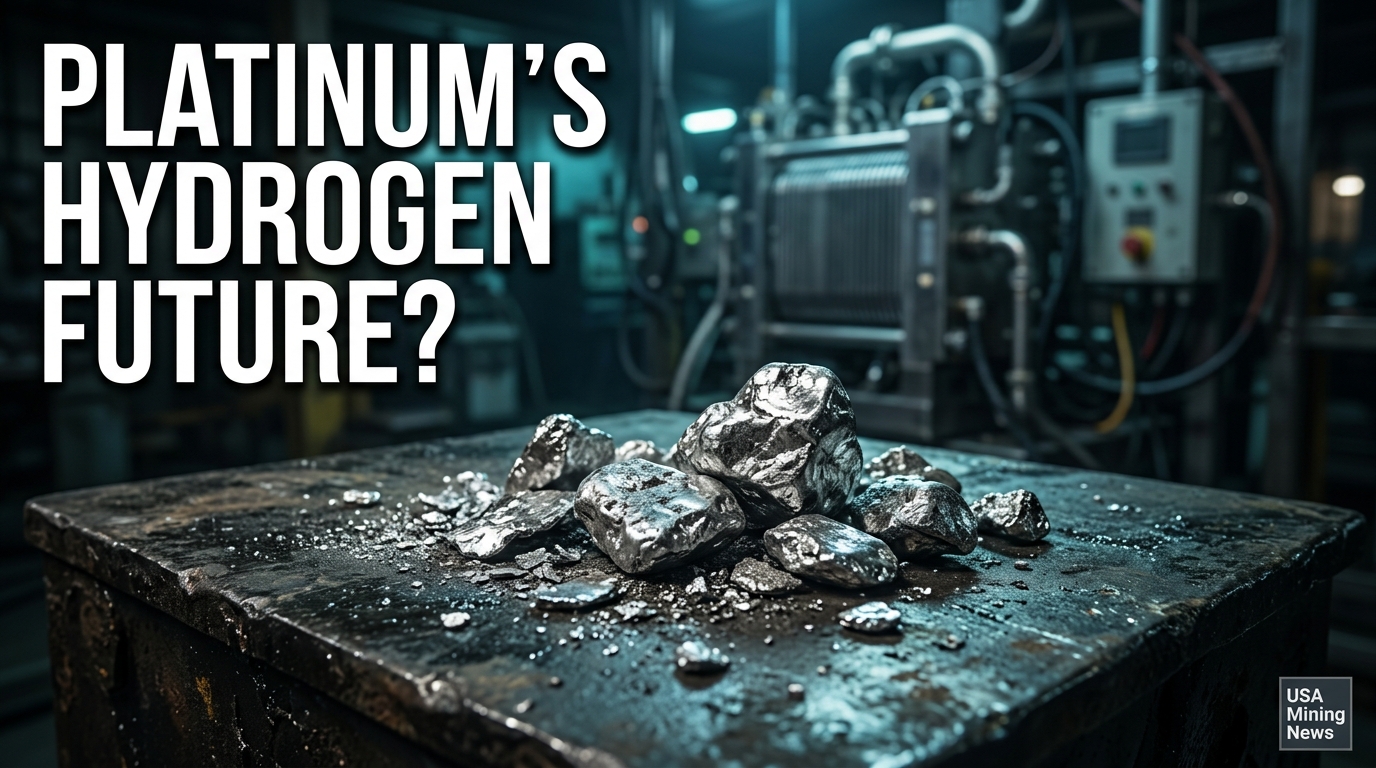
Platinum Navigates a Transformative Era: Hydrogen Emerges as a Critical Demand Driver Amidst Automotive Shifts
The global mining industry is keenly observing a pivotal moment for platinum, a precious metal long considered a cornerstone of industrial applications and investment portfolios. As the world accelerates its transition towards cleaner energy and transport, the traditional demand drivers for platinum are undergoing a fundamental re-evaluation. A significant shift towards battery-electric vehicles (BEVs) is directly threatening the primary end-market for platinum: autocatalysts in internal combustion engines. Simultaneously, an emerging hydrogen economy is presenting a potentially transformative replacement market, driven by proton-exchange membrane (PEM) technologies.
This evolving landscape, and the crucial question of whether the hydrogen sector can scale rapidly enough to offset declining automotive volumes, was the central focus of a recent episode of GlobalData’s Energy Technology podcast. Hosted by mining editor Alejandro Gonzalez, the discussion featured key industry voices including Edward Sterck, director of research at the World Platinum Investment Council (WPIC); Una O’Hara, a researcher specializing in hydrogen technologies; and Sai Dheeraj Karanam, a mining analyst at GlobalData. Their collective insights underscore a complex future for platinum, demanding strategic foresight from producers and investors alike.
The Looming Demand Challenge for Platinum
For decades, automotive catalytic converters have been the bedrock of platinum demand, consuming a substantial portion of the global mine supply. These devices, integral to reducing harmful emissions from gasoline and diesel engines, rely on platinum and other platinum-group metals (PGMs) to catalyze chemical reactions. However, the accelerating adoption of battery-electric vehicles, which do not require these catalytic converters, is creating a structural challenge to this established market.
According to the World Platinum Investment Council (WPIC), automotive platinum demand is forecast to experience a notable decline of 4% in 2026. This projection is set against the backdrop of the council’s base-case outlook, which anticipates a significant 28% global battery-electric vehicle market penetration by 2030. Edward Sterck elaborated on the broader implications, projecting an annual contraction of roughly 1.5% in combined platinum and palladium automotive demand over the next five years. This trend represents a direct impact on a market that has historically been the largest consumer of these vital metals.
The nascent state of hydrogen-related demand highlights the magnitude of the challenge. Sterck provided a stark comparison: “The total market size for platinum, in terms of new demand each year, is at the moment about 7.7 million ounces, and hydrogen demand currently for this year is projected to be 77,000 ounces.” This indicates that hydrogen applications currently represent merely 1% of the overall platinum market. While hydrogen demand is projected to expand by 8% over the same 2026 period, it is undeniably growing from a very small base. Despite the impressive growth rate, the sheer volume difference between the established automotive sector and the emerging hydrogen sector underscores the long road ahead for hydrogen to become a primary demand driver.
Sterck further emphasized the critical role hard-to-abate heavy industries will play in driving green hydrogen demand over the coming decade. Processes such as iron ore reduction in steel production, which traditionally rely on natural gas or coking coal, cannot be electrified directly. Green hydrogen, generated using clean electricity, offers a viable alternative as an energy carrier in these difficult-to-decarbonize sectors, representing a significant future opportunity for platinum.
Platinum's Indispensable Role in Hydrogen Technologies
The promise of the hydrogen economy for platinum lies primarily in proton-exchange membrane (PEM) fuel cells and electrolysers. These technologies are crucial for both producing hydrogen from water (electrolysers) and converting hydrogen into electricity (fuel cells). In both applications, platinum-group metals (PGMs) act as highly efficient catalysts, facilitating the complex chemical reactions required. Platinum's unique properties make it exceptionally well-suited for these demanding roles.
Una O’Hara, a researcher specializing in hydrogen technologies, shed light on platinum's unparalleled suitability. While extensive research continues into finding non-precious alternatives, platinum remains exceedingly difficult to substitute, particularly under the severe operating conditions inherent in hydrogen systems. O’Hara explained, “There’s been quite a lot of study around trying to find alternatives to platinum,” but noted that while other metals might offer some catalytic properties, “the longevity and the resilience of the material isn’t comparable [to platinum] currently.”
Beyond standard durability requirements, hydrogen environments are notoriously harsh. They can induce severe physical and chemical degradation, including phenomena like metal embrittlement and cracking. Platinum, however, possesses inherent characteristics that make it uniquely resilient. O’Hara detailed these critical attributes: “To act within a hydrogen system, it has to be able to be resilient to hydrogen, and platinum is best suited for that because it has a solid binding energy where it is able to hold its own and stay stable.” She further highlighted a crucial property that distinguishes platinum: “It also enables the reaction where hydrogen can stick to the surface and then break off without forming a hydride, which is an incredibly rare property for a material.” The formation of hydrides can compromise material integrity and catalytic efficiency, making platinum’s non-hydride forming characteristic invaluable for the sustained performance and longevity of PEM technologies.
Overcoming Infrastructure and Cost Barriers
Despite the clear technical feasibility and platinum’s vital role, the widespread commercial adoption of hydrogen across heavy transport and industry faces formidable challenges, primarily related to infrastructure and significant capital costs. The hydrogen ecosystem requires an entirely new network for production, storage, and distribution, which represents a massive upfront investment. As Una O’Hara pointed out, “Hydrogen has a lot of infrastructure which is required in order to be used for things like heavy-duty vehicles or transport; this is a big upfront expense.” She added, “The upfront cost associated with even developing the infrastructure is so big that it slows down the process. The science is there in terms of fuel cells and electrolysers.”
Data from the Hydrogen Council underscores the scale of investment already committed, with approximately US$130 billion (equivalent to £97.03 billion) channeled into clean-hydrogen projects. Despite this substantial financial commitment, a significant hurdle remains: supply readiness continues to outpace actual demand. This imbalance is primarily attributed to a lack of firm offtake commitments from end-users, insufficient policy clarity to de-risk investments, and the absence of robust distribution networks. The mining industry, keenly aware of long investment cycles, understands that this foundational infrastructure must be established to unlock large-scale hydrogen demand, which would in turn drive platinum consumption.
The Paradox of "More Hydrogen, Less Platinum" per Unit
As with many evolving technologies, the drive for cost reduction is paramount in the hydrogen sector. Equipment manufacturers are actively working to decrease the precious metal loadings per unit in fuel cells and electrolysers. This phenomenon, known as "thrifting," aims to lower the capital costs of these technologies, thereby accelerating their commercial adoption. Edward Sterck highlighted that this trend mirrors the historical thrifting observed in automotive catalytic converters, where regulatory pressures and cost optimization led to significant reductions in PGM usage over time.
Sterck noted that in the hydrogen space, this thrifting process is somewhat different: “Turning to fuel cells and electrolysers, we expect exactly the same process to occur without the regulatory overlay.” Unlike automotive catalysts, where regulations often mandated performance, thus indirectly influencing PGM content, thrifting in hydrogen applications is driven more purely by economic efficiency. “You do not have new regulations coming in, so it is a bit more of a perpetual thrifting process. But it is a trade-off between longevity and cost,” he explained. This implies that while reducing platinum content can lower upfront costs, it might also impact the operational lifespan or efficiency of the components, presenting a delicate balance for engineers.
Specific projections illustrate this trend: in heavy-duty fuel cell trucks, platinum loadings are anticipated to decline from approximately 50 grams per vehicle today to around 30 grams over the coming decade. This significant reduction means that for overall platinum demand from the hydrogen sector to grow meaningfully, the rate of fuel cell and electrolyser deployment must outpace these thrifting efficiencies. Sai Dheeraj Karanam of GlobalData encapsulated this critical dynamic: “The key question is whether the number of fuel cells and electrolysers being deployed grows faster than the reduction in platinum used in each one.” He concluded, “If deployment wins out, overall platinum demand could still rise, but it is a complex outlook.” This underscores the challenge for platinum miners and investors in forecasting future demand from this emerging sector.
Primary Supply Constraints and Market Implications
Even if the adoption of clean hydrogen technologies accelerates dramatically, the mining industry faces inherent limitations in responding swiftly to a sharp increase in platinum demand. Primary mine production of platinum is heavily concentrated, with South Africa dominating global output. Developing new greenfield assets, particularly the deep, complex PGM mines characteristic of the Bushveld Igneous Complex, is a capital-intensive and time-consuming endeavor. The lead time for bringing a new mine into production can extend up to 10 years, a reality that makes rapid supply adjustments nearly impossible.
This inelasticity of supply has significant implications for the platinum market. As Karanam noted, “If hydrogen demand rises sharply, it is more likely to add pressure to an already tight market than to trigger a rapid increase in mine supply.” This scenario suggests that significant growth in hydrogen-related platinum demand, if it materializes faster than current projections, could lead to elevated platinum prices as demand outstrips the industry's ability to boost production. For mining companies, this presents a strategic dilemma: investing in long-term expansion projects requires confidence in sustained demand growth, yet the hydrogen market’s trajectory remains somewhat uncertain and contingent on broader infrastructure development and policy support.
Conclusion
The journey for platinum through the energy transition is undoubtedly complex, marked by both formidable challenges and significant opportunities. The impending decline in automotive platinum demand, driven by the global pivot to battery-electric vehicles, necessitates the rapid emergence of new, substantial end-markets. The hydrogen economy, with its reliance on platinum in PEM technologies, offers a compelling future for the metal. However, its current nascent stage, coupled with substantial infrastructure and capital barriers, means it cannot immediately absorb the anticipated automotive losses.
Furthermore, the inherent drive for cost reduction in hydrogen technologies through "thrifting" adds another layer of complexity, requiring exponential growth in deployment to translate into meaningful increases in overall platinum demand. For mining industry professionals and investors, understanding this intricate balance between declining traditional markets, the potential of new applications, the pace of technological development, and the long lead times of mine supply is paramount. The coming years will reveal whether the hydrogen economy can indeed become platinum's next big market, ensuring the metal’s continued strategic importance in a decarbonized world.