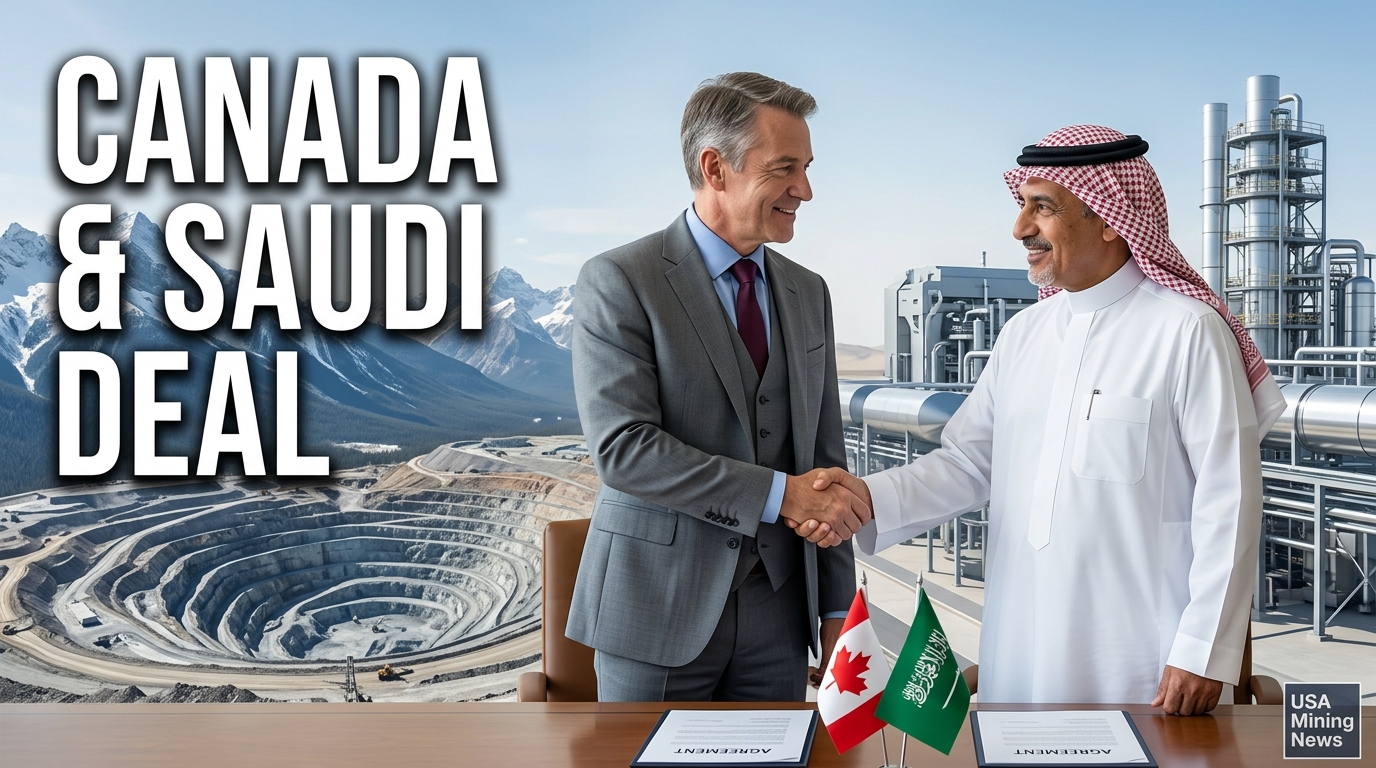
JEDDAH, Saudi Arabia – In a move set to redefine bilateral economic relations and significantly impact the global mining and energy landscapes, Canadian Prime Minister Mark Carney has spearheaded a series of agreements with Saudi Arabia, unlocking more than C$1 billion ($710 million) in commercial deals. This strategic diplomatic and economic initiative, culminating in agreements signed on July 9, 2026, during Carney’s visit to Jeddah, underscores a mutual commitment to leveraging each nation's strengths in a rapidly evolving global economy.
Prime Minister Carney, the first Canadian leader to visit Saudi Arabia in 26 years, held extensive discussions with Crown Prince Mohammed bin Salman. The dialogue solidified a path for deeper cooperation across an impressive array of sectors, including mining, critical minerals, energy, artificial intelligence (AI), defense, health care, and education. This expansive partnership is designed to foster shared growth, particularly by positioning Canada as a key partner in Saudi Arabia’s ambitious economic diversification under its Vision 2030 strategy.
A Diplomatic Re-engagement and Economic Imperative
The recent agreements represent a further thawing of relations between Ottawa and Riyadh, building upon the full restoration of diplomatic ties in 2023. This restoration followed a five-year dispute centered on human rights issues, and the current rapprochement signals a renewed focus on economic collaboration and strategic alignment. For Canada, the partnership forms a crucial component of a broader national strategy aimed at diversifying its trade relationships and reducing an over-reliance on the United States market, especially in light of potential tariffs on key Canadian exports.
Saudi Arabia, with its formidable economic statistics, presents an exceptionally attractive partner. As the Middle East’s second-largest economy, boasting an estimated Gross Domestic Product (GDP) of $1.8 trillion, and a sovereign wealth fund exceeding $1 trillion, Saudi Arabia is actively pursuing major investments globally to achieve its Vision 2030 objectives. This diversification strategy is designed to lessen the Kingdom's traditional dependence on oil revenues and build robust non-oil sectors, including a burgeoning domestic mining industry and advanced technology ecosystems.
Prime Minister Carney emphasized the synergy between the two nations' economic ambitions, stating, "Canada and Saudi Arabia have both embarked on ambitious new missions to transform their economies. We are harnessing each other’s strengths across minerals and mining, technology, energy, and commerce. Canada has what the world wants." This statement encapsulates the core premise of the partnership: Canada's rich endowment of natural resources and technological expertise aligning with Saudi Arabia’s capital and drive for economic transformation.
Bolstering the Mining and Critical Minerals Sector
At the heart of the new agreements is a significant focus on mining and critical minerals — a sector of paramount importance for the global transition to green energy and advanced technologies. The 13 commercial agreements and memorandums of understanding (MOUs) signed or initiated during the visit are strategically positioned to allow Canadian companies to actively participate across Saudi Arabia’s ambitious plans in mining, critical minerals, infrastructure, and clean energy projects.
The Canadian mining industry, renowned for its technical expertise, environmentally responsible practices, and leading-edge exploration technologies, is particularly well-suited to contribute to Saudi Arabia's burgeoning mining sector. The Kingdom has identified vast untapped mineral resources, including key critical minerals such as copper, gold, phosphate, and bauxite, which are essential for electric vehicles, renewable energy infrastructure, and defense applications. For Canada, this collaboration could lead to new market opportunities for its mining service and supply companies, while also potentially securing off-take agreements for critical minerals identified as strategic assets.
The explicit mention of critical minerals like graphite, nickel, and rare earths in the context of this partnership highlights the strategic foresight of both nations. Canada holds significant reserves of these essential elements, which are vital components in batteries for electric vehicles, high-tech electronics, and specialized industrial applications. By collaborating with Saudi Arabia, Canada aims to strengthen global supply chains for these minerals, reducing reliance on single or unstable sources and enhancing overall energy security for Western allies. The Saudi Mining Minister's reported view of "no obstacles to dealmaking in Canada" further underscores the positive outlook for Canadian investment and participation in the Kingdom's mining future.
Expanding Energy Cooperation and Technology Fronts
Beyond traditional mining, the agreements also expand cooperation into advanced energy solutions and cutting-edge technology. This includes:
- Liquefied Natural Gas (LNG) and Hydrogen: Canadian expertise in LNG production and its emerging prowess in hydrogen development align perfectly with Saudi Arabia's goals for diversifying its energy exports and investing in future fuels.
- Renewable Energy and Carbon Capture: Both nations recognize the imperative of transitioning to cleaner energy sources. Canadian innovation in renewable energy technologies and carbon capture, utilization, and storage (CCUS) solutions could play a vital role in Saudi Arabia’s green initiatives.
- Artificial Intelligence (AI): The digital economy received a significant boost with the announcement that Canadian AI company Cohere entered into a strategic computing partnership with Saudi Arabia’s HUMAIN. This collaboration is indicative of a broader intent to integrate advanced digital capabilities into both economies.
- Secure Communications and Industrial Technology: BlackBerry, a Canadian tech stalwart, and Aramco Digital began exploring opportunities in secure communications and industrial technology. This venture highlights the importance of robust and secure digital infrastructure for critical national industries, including mining and energy.
Prime Minister Carney also met with Saudi Aramco chief executive Amin Nasser, signaling a shared interest in fostering closer energy cooperation. Aramco, a global energy giant, could find valuable partners in Canadian energy firms looking to expand their international footprint and contribute to Saudi Arabia's ambitious energy transition projects.
Financial Commitments and Investor Outlook
The immediate C$1 billion ($710 million) in commercial agreements is just the initial wave of a potentially much larger financial exchange. To facilitate further investment and ensure long-term stability for businesses, both governments committed to negotiating a foreign investment protection agreement by the end of 2027. Additionally, talks will commence on a double-taxation treaty, which would provide greater clarity and protection for institutional and corporate investors from both countries.
Underscoring the depth of Canada’s commitment to this economic partnership, Prime Minister Carney announced plans to lead a delegation of Canadian pension funds to Saudi Arabia. These pension funds, known for their significant balance sheets and long-term investment horizons, represent a substantial pool of capital that could be deployed across Saudi Arabia’s infrastructure, energy, and mining projects. This move is particularly strategic given Saudi Arabia's vast sovereign wealth fund, which, when combined with Canadian institutional capital, could unlock unprecedented investment opportunities.
Further demonstrating Canada's commitment to strengthening ties beyond mere economics, Prime Minister Carney confirmed Canada's participation at Expo 2030 in Riyadh and declared that Canada would establish a resident defense attaché in the Saudi capital. These actions reinforce the multifaceted nature of the relationship, spanning economic, cultural, and security dimensions.
Strategic Implications for Global Supply Chains
For the global mining industry, this burgeoning partnership holds significant implications, particularly in the critical minerals space. As nations worldwide grapple with securing reliable and ethical supplies of minerals essential for the energy transition and advanced manufacturing, collaborations like the one between Canada and Saudi Arabia can help de-risk supply chains. Canada's robust regulatory environment and expertise in environmentally sound mining practices, combined with Saudi Arabia’s strategic location and capital, could create a formidable force in the critical minerals market.
This move also aligns with broader geopolitical shifts where Western nations are actively seeking to diversify their critical mineral sources away from dominant players. By fostering a direct and strategic partnership, Canada and Saudi Arabia are positioning themselves as important nodes in future global supply networks for minerals like graphite, nickel, and rare earths, which are fundamental to next-generation technologies. This partnership illustrates how new alliances are being forged based on shared economic interests and strategic imperatives in an increasingly complex and interconnected world.
Outlook on Future Growth
The agreements forged during Prime Minister Carney's visit lay a robust foundation for sustained growth and cooperation between Canada and Saudi Arabia. The specified timelines for negotiating a foreign investment protection agreement by the end of 2027 and initiating talks on a double-taxation treaty indicate a clear intent for long-term engagement. As Canadian companies, from mining to AI, begin to deeply integrate into Saudi Arabia’s Vision 2030 projects, the partnership is expected to yield substantial economic benefits for both nations while contributing to greater stability and diversification in critical global supply chains. The coming years will reveal the full extent of this landmark re-engagement, but the initial signals are clear: Canada and Saudi Arabia are embarking on a strategic alliance with far-reaching implications for the mining, energy, and technology sectors.