A Pivotal Shift: U.S. Ends Three Decades of Wind and Solar Subsidies
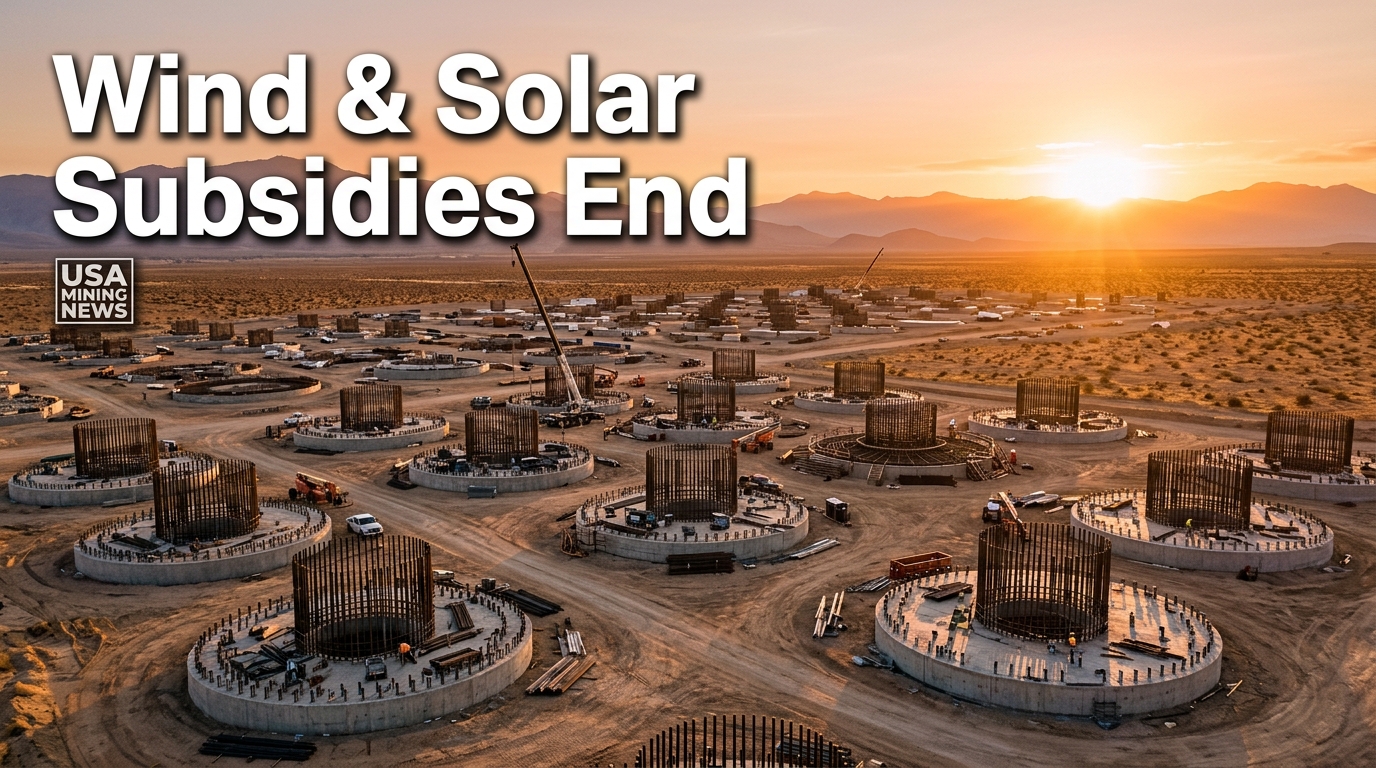
WASHINGTON D.C. – A significant re-calibration of U.S. energy policy is underway, with the federal government announcing the end of long-standing tax credit subsidies for new wind and solar projects. U.S. Secretary of Energy Chris Wright confirmed the July 4, 2026, deadline for these federal incentives, a move attributed to the Working Families Tax Cut legislation. For the mining industry, a sector intrinsically linked to energy infrastructure and production, this development heralds a potentially transformative shift in commodity demand and strategic investment.
The announcement, made on July 2, 2026, marks the conclusion of a policy framework that has supported wind and solar energy generation for more than three decades, approximately 35 years. Effective July 4, 2026, federal tax credits will no longer be available for new wind and solar projects not already under construction. This policy change reflects a determined effort by the current administration to reshape the national energy landscape and address what it identifies as inefficiencies and economic burdens associated with renewable energy support.
The End of an Era: Over Three Decades of Subsidies Conclude
The federal government's support for wind and solar energy through tax credits has been a cornerstone of renewable energy development in the United States for generations. These incentives, designed to accelerate the adoption and deployment of cleaner energy technologies, have played a role in the growth of the wind and solar sectors. Over these decades, the intermittent nature of wind and solar power, coupled with the capital intensity of infrastructure development, has often necessitated financial backing to ensure project viability and competitiveness against traditional baseload power sources.
Secretary Wright’s statement unequivocally signals an end to this particular era of support. "I'm thrilled to report that after about 35 years, on July 4th, we will end the subsidies for wind and solar, thanks to the Working Families Tax Cut," Wright stated. This definitive deadline means that developers planning new wind and solar installations must ensure their projects are demonstrably under construction before the national holiday, or face the prospect of proceeding without federal tax credit assistance. The legislation initiating this change, the Working Families Tax Cuts Act, was celebrated one year prior to this announcement by the Energy Dominance Financing Office, indicating a broader strategic intent to foster a different energy paradigm.
Secretary Wright's Critique: Economic and Operational Challenges
Central to the administration's decision are specific critiques articulated by Secretary Wright regarding the perceived drawbacks of heavily subsidized wind and solar energy. These concerns touch upon land use, material intensity, grid infrastructure, and the inherent characteristics of these energy sources:
- Land Use Intensity: Wright emphasized, "Wind and solar take a lot of land, 100 times more land for a similar amount of energy." This significant footprint is a recurring concern in land-constrained regions and agricultural areas, raising questions about competing land uses and environmental impact beyond emissions. For large-scale utility projects, vast tracts of land are required for turbine arrays or solar farms, as well as buffer zones and access roads.
- Material Demands: The Secretary highlighted the "enormous amount of materials, energy intensive materials like steel and cement and polysilicon" required for these projects. This point directly impacts the mining and heavy industries, underscoring the substantial resource extraction and manufacturing processes tied to renewable energy deployment. The energy consumed in producing these materials, particularly steel and cement, is also a factor in the overall lifecycle assessment of renewable technologies.
- Transmission Infrastructure: Wright pointed to the need for "enormous amount of additional transmission lines to connect their large land, far flung production back to where there's demand centers." The often remote locations of prime wind and solar resources necessitate extensive, costly, and often contentious transmission line development to bring power to urban and industrial load centers. This infrastructure build-out requires significant volumes of specific metals.
- Intermittency and Value: A core operational challenge, intermittency, was addressed directly: "what do we get for all that is a relatively small amount of low value energy. It's low value because the wind doesn't always blow and the sun doesn't always shine." This refers to the variable output of wind and solar, which often does not align with peak demand unless coupled with expensive energy storage solutions or backed up by dispatchable power sources. Such intermittency places strain on grid management and can necessitate maintaining conventional power plants online to ensure reliability.
- System Costs and Electricity Prices: Ultimately, Wright asserted that these factors "drive up the system costs and increase Americans' electricity prices." The argument is that while the fuel cost for wind and solar is zero, the combined costs of land, materials, transmission, grid integration, and backup generation translate into higher overall system expenditures, eventually passed on to consumers. "Enough of raising electricity prices. We're going to drive them down," Wright declared, framing the subsidy removal as a move towards more affordable energy.
Market Context: Wind and Solar's Current Contribution to U.S. Energy
Despite three decades of support, wind and solar's contribution to the U.S. energy mix remained relatively modest in 2025. According to the Secretary's statement, these sources collectively accounted for "approximately three percent of total U.S. primary energy consumption." It is critical for industry stakeholders to understand the distinction between electricity generation and primary energy consumption.
While wind and solar have grown significantly in electricity generation (contributing a larger percentage to the electricity grid), primary energy consumption encompasses all energy forms across all sectors—residential, commercial, industrial, and transportation. This includes fossil fuels used directly for heating, industrial processes, and vehicle propulsion. Therefore, the "three percent" figure means that wind and solar constituted a small fraction of the nation's total energy appetite, which continues to be dominated by fossil fuels (petroleum, natural gas, and coal) across these diverse applications.
The relatively small share of primary energy consumption, despite the cumulative investment, fuels the administration's argument that the return on subsidy investment has not justified its cost to taxpayers, especially given the complexities and additional system costs highlighted by Secretary Wright.
Implications for the Mining Industry: A Shifting Demand Landscape
For the global mining industry, the cessation of federal wind and solar subsidies in the U.S. carries substantial implications, particularly concerning demand for specific commodities, capital allocation, and strategic planning. Secretary Wright's direct critique of the "enormous amount of materials" needed for these projects directly points to several key mined commodities:
- Steel: Wind turbine towers, foundations, and frames, as well as solar panel racking systems, are highly steel-intensive. A slowdown in new wind and solar construction could temper domestic demand for iron ore, metallurgical coal (coking coal), and limestone, which are critical inputs for steel production. Conversely, if policy shifts favor traditional infrastructure or other energy sources, demand for steel could pivot to alternative applications.
- Cement: Massive concrete foundations are essential for large-scale wind turbines and, to a lesser extent, ground-mounted solar arrays. Reduced construction of these projects would consequently lessen demand for limestone, clay, and gypsum, the primary raw materials for cement manufacturing.
- Polysilicon: This high-purity silicon material is the fundamental building block for most photovoltaic (PV) solar cells. Polysilicon production relies on metallurgical-grade silicon, which is derived from quartz sand or quartzite. A decrease in new solar installations will directly impact demand for high-purity quartz mining and subsequent processing.
- Copper and Aluminum: The "enormous amount of additional transmission lines" highlighted by Wright directly correlates to demand for copper and aluminum. These metals are the primary materials for electrical conductors in high-voltage transmission and distribution lines. While some transmission projects may still proceed for grid modernization or other energy sources, the specific driver of connecting geographically dispersed renewable generation centers will diminish. This shift could impact long-term outlooks for major copper and aluminum producers.
- Rare Earth Elements (REEs) and Other Specialty Metals: Although not explicitly mentioned by Secretary Wright, certain advanced wind turbine designs (e.g., direct-drive turbines) utilize permanent magnets made with Neodymium and Praseodymium, critical rare earth elements. Similarly, some thin-film solar technologies utilize metals like cadmium, tellurium, and indium. A change in policy direction away from rapid renewable expansion could reduce the growth trajectory for demand in these specialty mining sectors, particularly if the U.S. pivots towards technologies with different material requirements.
Beyond specific commodities, the broader implication for the mining sector lies in the potential redirection of U.S. energy strategy. If the policy emphasis shifts away from subsidized renewables towards other forms of energy — such as natural gas, nuclear power, or potentially even coal with carbon capture technologies — the demand landscape for associated mined commodities would change. This could mean renewed interest in thermal coal, uranium, or materials for advanced nuclear reactor development. Furthermore, if the stated goal of "driving down electricity prices" is achieved, it would lead to lower operating costs for mining operations, which are inherently energy-intensive.
The Working Families Tax Cut Act: A Broader Policy Framework
The elimination of these subsidies is framed within the context of the Working Families Tax Cut Act, legislation whose passage was celebrated a year prior by the curiously named "Energy Dominance Financing Office." This framing suggests that the policy goes beyond merely ending specific tax credits; it is part of a larger legislative effort aimed at realigning fiscal priorities and promoting what the administration views as "energy dominance." The intent appears to be a systemic re-evaluation of how federal funds are allocated within the energy sector, prioritizing forms of energy deemed more efficient, reliable, or economically sound without direct federal credit intervention.
Outlook: Navigating a Post-Subsidy Energy Future
The immediate impact of the July 4, 2026, deadline will undoubtedly be a contraction in the pipeline for new, unscheduled wind and solar projects across the U.S. Developers will need to re-evaluate project economics, seeking alternative financing mechanisms or adjusting future investment strategies. This could lead to a consolidation within the renewable energy development sector and a slowdown in the pace of new installations.
For the mining industry, this calls for careful analysis of market signals. While existing projects will continue to source materials, the long-term growth forecasts for specific metals linked primarily to wind and solar expansion in the U.S. may need revision. Furthermore, the administration's stated focus on grid stability, as evidenced by accompanying press releases like "Energy Secretary Secures Carolinas’ Grid Amid Period of Hot Weather" (July 2, 2026), suggests an increased emphasis on reliable, dispatchable power sources. This could potentially favor commodities associated with traditional thermal power generation or nuclear energy, prompting miners to consider diversifying their commodity exposure or recalibrating their projections for different end-use markets.
Conclusion: Reshaping the U.S. Energy and Mining Landscape
The decision to end federal subsidies for new wind and solar projects not under construction by July 4, 2026, represents a significant policy inflection point in the U.S. energy sector. Secretary Chris Wright's rationale, citing concerns over land use, material intensity, transmission needs, intermittency, and electricity prices, directly challenges the economic model that has driven renewable expansion for decades. While the full ramifications will unfold over time, the mining industry must remain agile and vigilant. This shift not only redefines the growth trajectory for certain "green" commodities but also signals a potential re-emphasis on other energy sources, reshaping demand patterns for a wide array of mined materials critical to the nation's evolving energy infrastructure. Industry stakeholders will be watching closely to see how the U.S. navigates this post-subsidy energy future and what new opportunities or challenges emerge for the foundational mining sector.