District Metals Initiates High-Priority Diamond Drilling at Sweden’s Viken Property, Targeting Expansive Uranium and Critical Metals Potential
October 7, 2026 – District Metals Corp., a Vancouver-based resource company, has announced the commencement of a pivotal diamond drilling campaign at its Viken Property, strategically located in central Sweden’s Jämtland County. This targeted exploration effort is designed to unlock the full potential of what the company asserts is the largest undeveloped uranium resource globally, while also investigating significant co-product mineralization of vanadium, molybdenum, nickel, copper, and zinc. The initiation of drilling marks a significant step in de-risking and advancing this multi-commodity project within Europe's rapidly evolving energy and critical raw materials landscape.
Strategic Exploration Commences at Viken Property
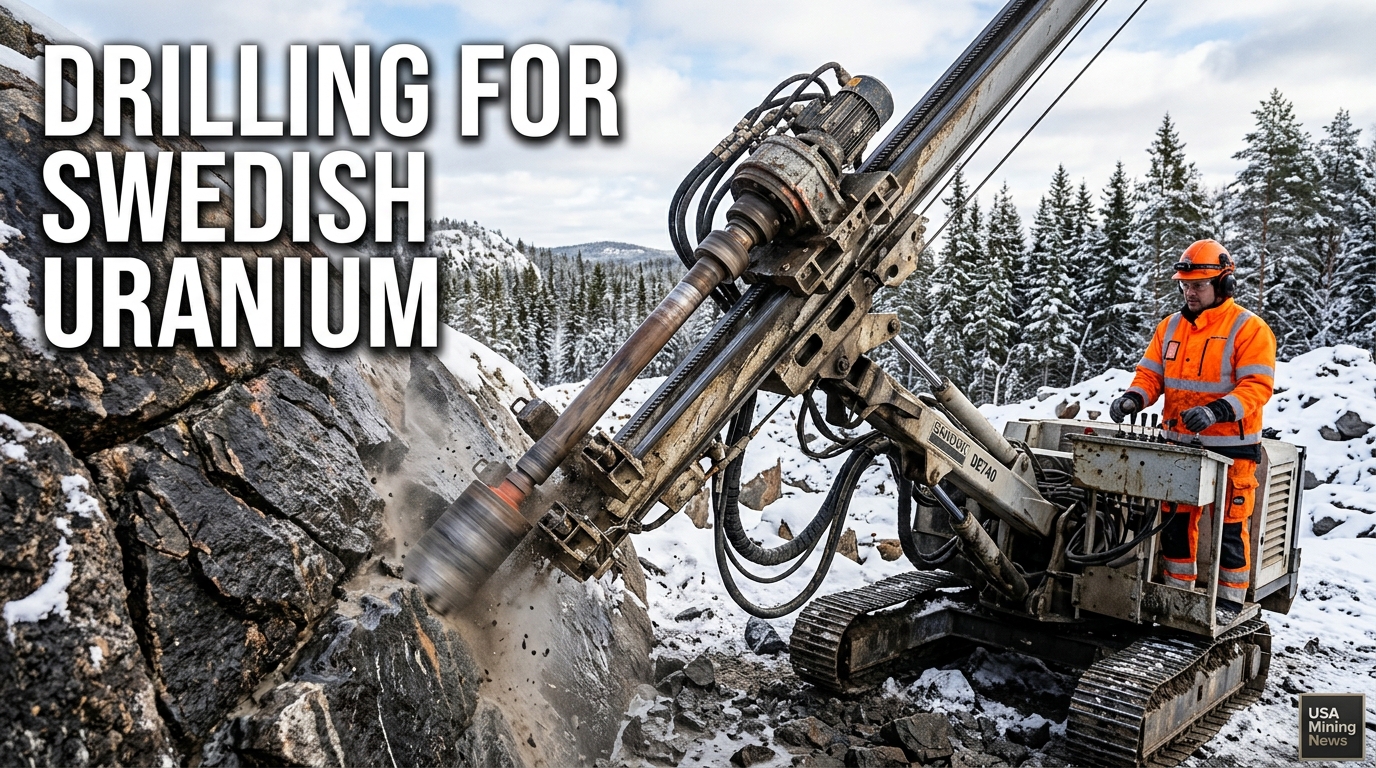
The drilling operations, which began on October 7, 2026, are being executed by Arctic DS, the Swedish subsidiary of Arctic Drilling, leveraging local expertise with crews predominantly drawn from Sweden’s Jämtland and Västerbotten counties. This localized approach not only supports regional employment but also ensures a workforce familiar with the specific geological and environmental conditions prevalent in central Sweden.
The current drill program is a focused endeavor, targeting two distinct zones within the Viken Property, identified as Target Areas A and B. These areas were selected based on compelling geophysical data and a re-evaluation of historical exploration work, representing high-priority targets that have remained largely untested by modern exploration techniques. The logistical and operational aspects of this campaign are crucial, as successful execution will pave the way for a more comprehensive understanding of the Viken deposit's lateral and depth extensions.
Targeting Untested High-Priority Anomalies
The decision to focus on Target Areas A and B stems from comprehensive insights gathered during an airborne MobileMT (Mobile Magnetotelluric) survey completed in 2025. This advanced geophysical survey highlighted large conductive anomalies within these zones, indicative of potential subsurface mineralization. Notably, District Metals reported that both Target Areas A and B exhibit a stronger and larger conductive response compared to the main Viken Energy Metals Deposit itself, suggesting a potentially more extensive or higher-grade mineralization footprint. Target Area A is situated approximately 1.7 kilometers north of the main Viken Deposit, while Target Area B lies about 7.5 kilometers to the north-west, indicating a broad district-scale mineralized system.
Further supporting the exploration rationale, earlier drilling conducted in 2008, though limited to the outer edges of these target zones, intersected significant intervals of mineralized alum shale. Alum shale is a known host rock for uranium and other critical metals in Scandinavia, lending strong geological support to the current, more systematic drilling approach. Garrett Ainsworth, CEO of District Metals, emphasized this rationale, stating: "We are excited to commence drilling at Target Areas A and B, which represent some of the most compelling untested targets identified at the Viken Property. The combination of large and strong conductive anomalies from our 2025 MobileMT survey and the presence of peripheral mineralized alum shale from historical drilling provides a strong geological rationale for testing these areas laterally and at depth." This strategic targeting is critical in a complex geological environment like the Swedish alum shales, where mineralization can be disseminated and challenging to delineate without precise geophysical guidance.
The Viken Deposit: A Global Uranium Hotspot with Diversified Potential
The Viken Property is already globally recognized for its substantial indicated mineral resource estimate within the main Viken Energy Metals Deposit. This established resource stands at an impressive 456 million tonnes grading 175 parts per million (ppm) triuranium octoxide (U3O8), translating to a substantial 176 million pounds of triuranium octoxide. District Metals asserts that this makes Viken the largest undeveloped resource estimate of uranium globally. This designation positions Viken as a potential game-changer in the global uranium supply chain, especially given the renewed interest in nuclear power as a cornerstone of clean energy generation.
Beyond its uranium endowment, the Viken Deposit is also noted for containing significant quantities of other strategically important raw materials. These include vanadium, molybdenum, nickel, copper, zinc, and various other critical elements. This multi-commodity nature significantly enhances the project's economic viability and strategic importance. In an era where supply chain resilience and diversification are paramount, particularly for battery metals and critical minerals essential for renewable energy technologies and electrification, a deposit offering such a diverse suite of metals presents a compelling investment proposition. The co-occurrence of these metals can lead to lower overall production costs for individual commodities, as the infrastructure and processing facilities can be leveraged across multiple revenue streams.
Broader Swedish Exploration Strategy
The current drilling program at Viken is an integral component of District Metals’ approved 2026 exploration agenda. This ambitious program encompasses roughly 5,000–7,000 meters of drilling across both the Viken and Alum Shale properties within Sweden. This comprehensive approach underscores the company's commitment to systematically exploring and delineating the mineral potential across its significant land package in north-central Sweden.
Further demonstrating this broader strategy, in July 2026, District Metals engaged Expert Geophysics Surveys to undertake a helicopter-borne geophysical survey at its Alum Shale Properties. This parallel exploration effort highlights the company's belief in the prospectivity of the entire region for similar styles of polymetallic mineralization hosted within the extensive alum shale formations. Such regional exploration campaigns are crucial for understanding the geological controls on mineralization and identifying additional high-priority targets for future drilling, thereby building a robust project pipeline.
Operational Details and Future Outlook
The operational flexibility built into the current drilling campaign is a key aspect of its design. The total number of drill holes and the aggregate meters drilled will be dynamically adjusted based on real-time geological observations and uranium-specific radiometric data gathered during the work. This adaptive approach allows the exploration team to optimize the drilling effort, maximizing data acquisition efficiency and ensuring that resources are deployed to areas demonstrating the highest prospectivity. Following the completion of drilling, cores will undergo detailed geological logging, sampling, and assaying, providing precise data on metal grades and mineralogical characteristics. This data will then be instrumental in updating geological models and potentially expanding the existing resource estimates.
The successful delineation of these new target areas could significantly augment the Viken project’s overall resource base, potentially enhancing its attractiveness for development. As global demand for uranium continues to strengthen—driven by the expansion of nuclear energy programs worldwide in response to climate change imperatives and energy security concerns—projects like Viken gain increasing strategic importance. Moreover, the co-production of critical battery and specialty metals like vanadium, molybdenum, nickel, copper, and zinc positions Viken as a key potential supplier to the rapidly growing green technology sector.
Implications for the Uranium Market and Energy Transition
The Viken Property’s advancement comes at a critical juncture for the global mining industry. Uranium prices have seen a resurgence in recent years, fueled by a renewed global commitment to nuclear power as a stable, low-carbon energy source. Governments and utilities worldwide are re-evaluating their energy strategies, with nuclear energy playing a crucial role in achieving net-zero emissions targets. A large, undeveloped resource like Viken offers a potential long-term, stable supply of uranium, which is vital for the sustainability of this clean energy pathway.
Beyond uranium, Sweden has explicitly identified the need to secure domestic supplies of critical raw materials to support its own industrial base and the broader European Union's ambitions for strategic autonomy in key supply chains. The polymetallic nature of the Viken deposit aligns perfectly with these broader strategic goals, positioning District Metals as a significant potential contributor to the supply of multiple metals essential for the energy transition. The ongoing exploration at Viken is not just a corporate endeavor; it is a strategic investment in the future of sustainable energy and critical mineral supply in Europe.
In conclusion, District Metals' diamond drilling program at the Viken Property represents a crucial exploration milestone for one of the world's most significant undeveloped uranium and critical metals deposits. The systematic exploration of high-priority targets, guided by advanced geophysics and historical data, holds the potential to significantly enhance the project’s profile. With the global shift towards cleaner energy and increased demand for raw materials, the Viken project in central Sweden is poised to play an increasingly important role in securing the resources necessary for a sustainable future.