Sirios Resources Initiates Critical 1,800m Drill Program at Aquilon Gold Project in Quebec
Introduction: Drilling Underway at Aquilon
In a significant development for gold exploration in Canada, Sirios Resources announced on September 28, 2026, the commencement of a 1,800-meter diamond drilling program at its Aquilon gold project. Located in the prospective Eeyou Istchee James Bay region of Quebec, this targeted drilling campaign is designed to delineate the lateral and depth extensions of a substantial gold halo identified during prior exploration activities in 2025. The program represents a pivotal step in advancing the Aquilon project, a joint venture between Sirios Resources, which holds a 49% interest and serves as operator, and Sumitomo Metal Mining Canada, which holds the majority 51% stake and provides significant funding. The renewed focus on Aquilon underscores the project's potential in one of the world's most stable and geologically endowed mining jurisdictions.
Project Overview: The Aquilon Gold Project
The Aquilon gold project is strategically positioned in the heart of Quebec's burgeoning Eeyou Istchee James Bay territory, a region increasingly recognized for its significant mineral potential. The project is governed by a joint venture agreement where Sirios Resources acts as the operator, contributing its regional expertise and operational acumen, while Sumitomo Metal Mining Canada, a global mining conglomerate, provides the majority financial backing and strategic oversight. The joint venture holds 140 exclusive exploration rights, encompassing a substantial area of 68 square kilometers.
A key advantage for the Aquilon project is its excellent infrastructure. It is situated just 10 kilometers south of the Laforge-1 hydroelectric power station, a critical energy asset that provides reliable, low-cost power, a significant benefit for any potential future mining operation. Furthermore, the property boasts year-round accessibility by road, an invaluable asset in a region where logistics can often be challenging and costly. The presence of established infrastructure not only reduces initial capital expenditures but also lowers operating costs, making the project more attractive for long-term development. Historically, the Aquilon property has demonstrated strong prospectivity, with 32 gold showings documented across the expansive claim block since exploration first began.
The Current Drilling Campaign: Objectives and Scope
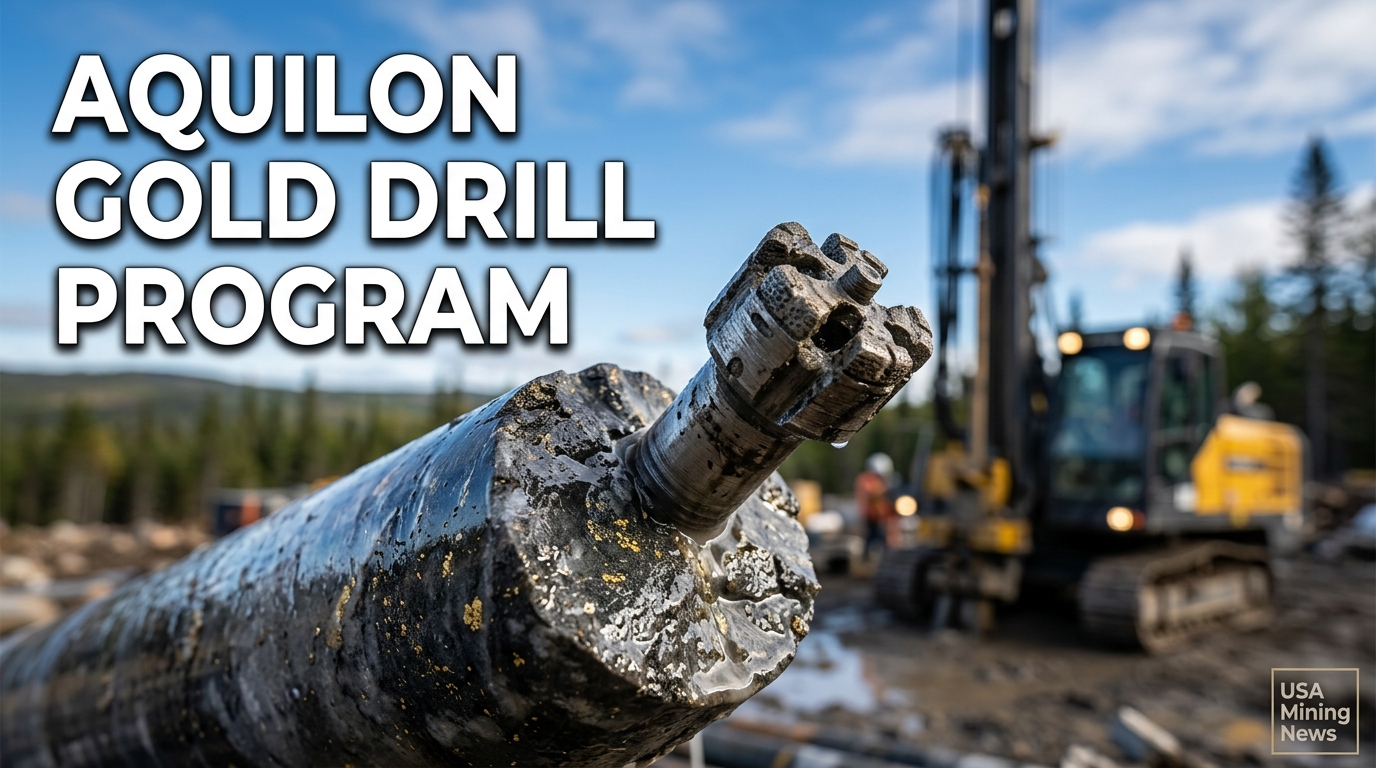
The 1,800-meter diamond drilling program currently underway is a carefully planned initiative designed to build upon and further characterize the encouraging results from previous exploration efforts. The program comprises two main components: the drilling of three entirely new drill-holes and the extension of two existing holes. This strategic approach allows the exploration team to both test new targets and gain deeper insights into previously identified mineralization. Given the potentially rugged or remote nature of specific target areas within the 68 km² property, the drilling is being executed using a helicopter-supported drill rig, a common and effective method for accessing challenging terrain in Canadian exploration.
The primary objective of this program, as stated by Sirios, is to confirm the lateral and depth continuity of a significant gold halo that was initially identified during exploration in 2025. Sirios CEO Jean-Félix Lepage commented on the significance of the program, stating, "While results from our summer exploration at Cheechoo are starting to come in, we are excited to resume drilling at Aquilon. Aquilon has yielded some of the highest-grade drill intercepts ever obtained in Quebec, including 12,906.5 g/t gold over 0.2m in the Lingo zone. This new programme will allow us to better determine the size of the gold halo that was discovered in last year’s programme." Mr. Lepage’s statement highlights the company's dual focus on both high-grade targets and the potential for a larger, bulk-tonnage style deposit, emphasizing the strategic importance of understanding the full extent of the gold halo.
Building on Past Success: The 2025 Exploration Results
The impetus for the current drilling campaign at Aquilon stems directly from compelling results generated during the 2025 exploration season. These prior efforts successfully identified a significant near-surface gold halo, a geological feature indicative of widespread, lower-grade gold mineralization that often forms the basis for large-scale, open-pit mining operations. This halo extends over an impressive 700 meters from south to north and boasts a width exceeding 300 meters, dipping eastward. Such dimensions suggest a substantial mineralized system, warranting extensive follow-up to determine its full economic potential.
A particularly noteworthy drill interval reported from the 2025 program included 298.2 meters grading 0.26 grams per tonne (g/t) gold. While a grade of 0.26 g/t gold may appear modest in isolation, its occurrence over such a remarkable length, almost 300 meters, is highly significant. This type of mineralization is often characteristic of bulk-tonnage deposits, where large volumes of rock, even at lower grades, can be economically viable due to economies of scale in mining and processing. The near-surface nature of this halo further enhances its attractiveness, as it typically translates to lower stripping ratios and reduced mining costs compared to deeper deposits.
Adding to the project's allure are the remarkable high-grade gold intercepts previously discovered within the Aquilon property. The newly targeted drilling area for the halo lies less than 2 kilometers from the highly prospective Lingo zone and 3 kilometers from the Moman zone. These zones have yielded some of the most spectacular gold assays ever recorded in Quebec, including an astounding 12,906.5 g/t gold over 0.2 meters at the Lingo showing and 3,527.4 g/t gold over 0.4 meters at Moman. These bonanza-grade intercepts, while representing narrower vein-style mineralization, underscore the presence of extremely rich gold systems within the broader Aquilon property. The coexistence of a widespread, lower-grade gold halo with discrete, ultra-high-grade veins presents an exciting dual-target exploration strategy, offering potential for both large-scale, bulk mining and high-value, selective mining opportunities.
Strategic Implications for Sirios and Sumitomo
The Aquilon project represents a strategically important asset for both Sirios Resources and Sumitomo Metal Mining Canada. For Sirios, operating the project with its 49% interest solidifies its position as a technically capable and proactive junior explorer in Quebec. The company's ability to attract and partner with a major global player like Sumitomo speaks volumes about the perceived quality and potential of its projects. Successful delineation of the gold halo and further advancement of Aquilon would significantly enhance Sirios's asset portfolio and market valuation.
Sumitomo Metal Mining Canada's 51% interest and substantial investment highlight its confidence in the Aquilon project and the broader prospectivity of the Eeyou Istchee James Bay region. As a major international mining company, Sumitomo's participation provides not only crucial funding but also access to extensive technical expertise, global market insights, and potential pathways for future development and financing. Major miners often partner with junior explorers in grassroots exploration to diversify their project pipeline, leverage local knowledge, and mitigate the inherent risks of early-stage discovery. The Aquilon JV aligns with Sumitomo's strategy to secure long-term commodity supply in stable and favorable mining jurisdictions like Canada.
The joint venture structure effectively shares both the risks and the potential rewards of exploration. While exploration is inherently capital-intensive and uncertain, a strong partnership can de-risk the process and accelerate the project's progress. Positive drill results from this program would likely generate significant investor interest, potentially leading to increased capital flows for further exploration and development, and could have a positive impact on the share prices of both companies.
Broader Industry Context: Gold Exploration in Quebec
Quebec has long been recognized as a premier mining jurisdiction globally, consistently ranking among the top regions for investment attractiveness due to its rich geological endowment, stable political environment, and robust regulatory framework. The province's legacy of gold discovery, particularly in the famed Abitibi Greenstone Belt, is now being complemented by emerging frontiers such as the Eeyou Istchee James Bay region, where new discoveries like Aquilon demonstrate the potential for significant, underexplored mineral belts. The government of Quebec is generally supportive of mineral exploration and development, offering various incentives and maintaining a predictable permitting process, which reduces operational uncertainties for mining companies.
The global mining industry is in a perpetual state of searching for new gold deposits to replenish diminishing reserves and meet steady demand. Projects like Aquilon are crucial in this context. New discoveries, especially those with both bulk-tonnage and high-grade potential, are vital for ensuring the long-term sustainability of the gold supply chain. However, exploration remains a challenging endeavor, demanding substantial capital, advanced technical expertise, and a resilient approach to risk. Companies must navigate complex geological challenges, secure social license to operate, and contend with the inherent volatility of commodity markets.
The trend of major mining companies forming joint ventures or farm-in agreements with junior explorers, as seen with Sumitomo and Sirios at Aquilon, is a well-established strategy in the industry. It allows major players to gain exposure to promising grassroots projects without incurring the full upfront exploration costs and allows juniors to access the capital and technical resources required to advance their discoveries. This collaborative model is particularly effective in regions like Quebec, where extensive land packages and complex geology often necessitate a phased and well-funded exploration approach.
Future Outlook: What's Next for Aquilon?
The current 1,800-meter drilling program is a critical phase in the ongoing evaluation of the Aquilon gold project. The results from these five drill holes will be eagerly anticipated by both Sirios and Sumitomo, as well as by the broader mining investment community. Upon receipt and interpretation of the assay results, the next steps for the project will be determined. If the drilling successfully confirms the lateral and depth continuity of the gold halo, it would likely trigger a more extensive infill drilling program aimed at defining a maiden mineral resource estimate.
Further exploration efforts could also include detailed metallurgical studies to determine the optimal processing methods for the varied styles of gold mineralization identified, as well as environmental and social baseline studies. The ultimate goal for a project of this nature is to progress through the stages of exploration, resource definition, preliminary economic assessment (PEA), pre-feasibility study (PFS), and feasibility study (FS), gradually de-risking the project and demonstrating its economic viability. Aquilon holds the potential to evolve from an exciting exploration target into a significant development asset, contributing to Canada's robust gold production profile.
For Sirios Resources, the success at Aquilon would further validate its exploration strategy and expertise, complementing its other active projects, such as Cheechoo, which is also yielding results. The long-term vision for the Aquilon project aligns with the growing demand for gold and the strategic importance of securing resources in politically stable and infrastructure-rich regions. As the drills continue to turn in Eeyou Istchee James Bay, the mining industry will be closely watching for the outcome, which could mark the next significant gold discovery in Quebec.