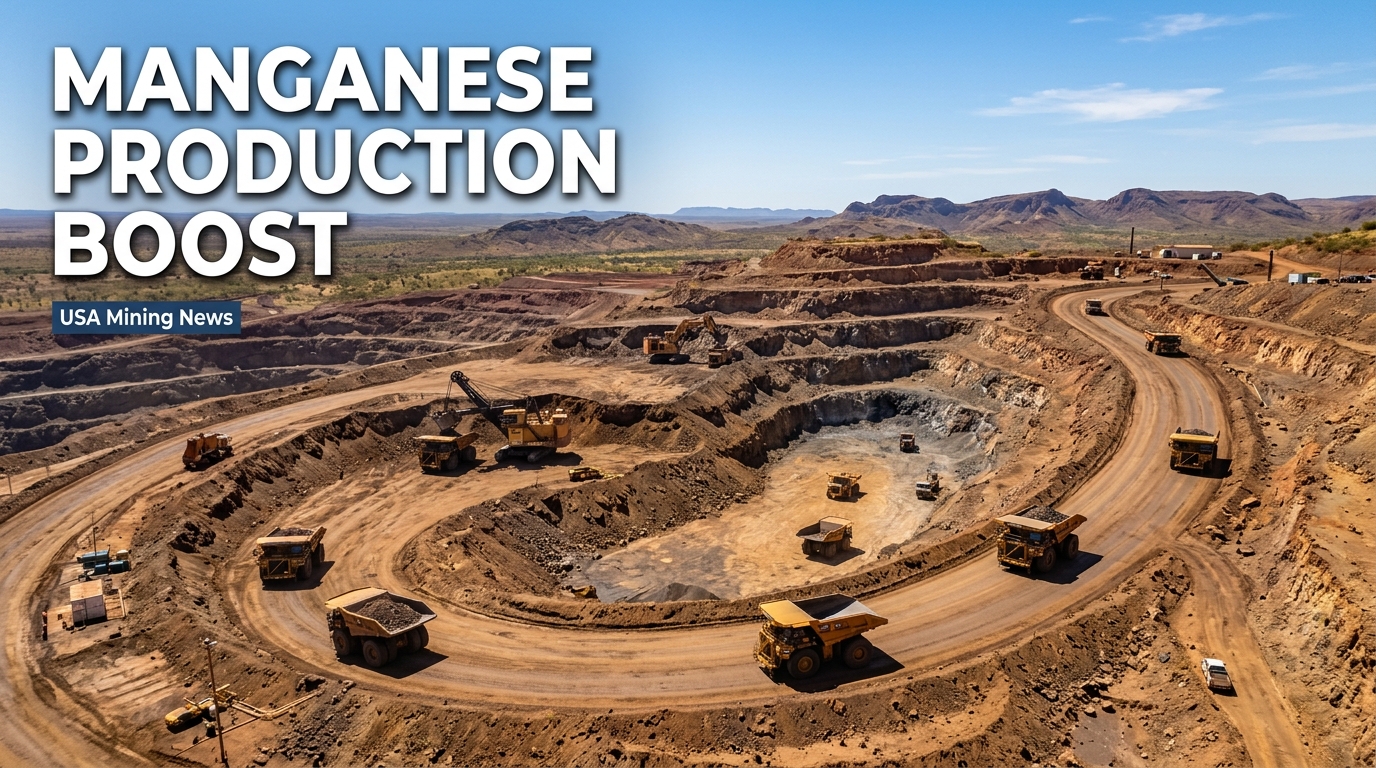
Element 25 Advances Butcherbird Expansion with Integrated Mining and Haulage Contracts
Perth, Western Australia – May 27, 2026 – Element 25 Limited (ASX: E25), a prominent Australian manganese explorer and developer, has taken a significant stride in the expansion of its Butcherbird Manganese Mine in the Pilbara region of Western Australia. The company officially announced the execution of new long-term mining services and ore haulage services agreements with Regroup Australia. These pivotal agreements are central to Element 25’s strategic objective of increasing manganese concentrate production at Butcherbird to a substantial 1.1 million tonnes per annum (Mtpa), a target outlined in an updated feasibility study completed in January 2025. The news, reported by Shree Mishra, underscores Element 25's commitment to de-risking its supply chain and advancing toward full-scale operations.
The Butcherbird Expansion: A Strategic Imperative
The Butcherbird Manganese Project is positioned as a globally significant, long-life asset, critical for both traditional industrial applications and the emerging battery materials sector. Element 25's decision to significantly ramp up production capacity is driven by burgeoning global demand for manganese, which is indispensable in steelmaking and increasingly vital for advanced battery chemistries. The updated feasibility study in January 2025 provided the economic and technical roadmap for this expansion, detailing the capital and operational expenditures required to achieve the 1.1 Mtpa production target.
The project boasts a robust resource base, with the latest ore reserve standing at an impressive 101.4 million tonnes (Mt) grading 10.4% manganese. This substantial reserve underpins an expected mine life exceeding 18 years at the planned increased output rate, providing long-term supply security for Element 25’s downstream ambitions. Such a considerable mine life is a compelling factor for investors and offtake partners, ensuring reliability in a commodity market that demands consistent supply.
The strategic importance of the Butcherbird output extends to dual markets. Primarily, the manganese concentrate will supply established ferroalloy markets, which are critical for the global steel industry. Manganese acts as a deoxidizer and desulfurizer and enhances the strength, toughness, and workability of steel. Concurrently, a significant portion of the concentrate is earmarked as feedstock for Element 25’s planned high purity manganese sulphate monohydrate (HPMSM) facility in Louisiana, US. The development of a domestic HPMSM facility in the United States represents a strategic move to localize portions of the electric vehicle (EV) battery supply chain, reducing reliance on overseas processing and enhancing supply resilience, aligning with broader national security and industrial policy objectives.
Integrated Operations: The Regroup Australia Partnership
A key aspect of Element 25's strategy to achieve its ambitious production targets is the appointment of Regroup Australia as a single, integrated contractor for both mining operations and ore haulage. Regroup Australia will be responsible for managing all aspects of the mining activities at the Butcherbird site, from extraction to loading, and subsequently for transporting the ore from the mine to the Utah Point port facility in Port Hedland. This port is a vital export hub in Western Australia, known for its bulk materials handling capabilities.
This integrated operating model represents a continuation of the successful collaboration between Element 25 and Regroup Australia. By consolidating these two critical functions under a single contractor, Element 25 aims to:
- Improve Productivity: Streamlining communication and coordination between mining and logistics functions can lead to more efficient scheduling and execution.
- Contain Costs: An integrated approach can unlock synergistic efficiencies, reduce overheads, and potentially leverage economies of scale in equipment and personnel deployment.
- Reduce Commercial Interface Risks: Minimizing the number of contractual interfaces mitigates risks associated with coordination failures, disputes, and accountability gaps that can arise when multiple contractors are involved in interconnected services.
Commenting on the significance of these agreements, Element 25 Managing Director Justin Brown stated, “Execution of the mining services and ore haulage agreements represents a key milestone for the Butcherbird Expansion Project. Securing long-term, dedicated mining and logistics capacity and capability is fundamental to delivering a reliable and efficient pit-to-port supply chain, and these agreements represent two key steps in advancing Butcherbird toward construction.” This statement underscores the company's focus on operational reliability and supply chain integrity, which are paramount for any large-scale mining venture.
Contractual Framework and Risk Mitigation
The agreements with Regroup Australia are structured to align incentives and manage project risks effectively. They feature a variable cost structure, which offers a degree of flexibility in operational expenditure based on production volumes. Specifically, the mining services component includes a monthly minimum commitment, ensuring a baseline level of activity and contractor engagement. For haulage services, a scalable take-or-pay commitment has been implemented, guaranteeing a certain volume of work for Regroup Australia while allowing for adjustments based on actual ore movements.
Crucially, the contracts incorporate cross-default provisions. These clauses mean that if one party defaults on a particular part of the contract (e.g., underperformance in mining or haulage), it can trigger a default across the entire agreement. This mechanism is designed to incentivize holistic performance and ensure accountability across the integrated scope of work, providing Element 25 with stronger contractual leverage.
Naturally, these agreements remain subject to conditions precedent and termination clauses common in contracts of this nature. A particularly significant condition precedent is their connection to the financial close under Element 25’s funding arrangement with the Northern Australia Infrastructure Facility (NAIF). NAIF is a financer for infrastructure projects across northern Australia, and securing its funding is critical for de-risking the Butcherbird Expansion Project's capital expenditure. This link ensures that the operational contracts are firmly tied to the project’s overarching financial viability and funding certainty.
Manganese Market Dynamics and Strategic Offtake
The global manganese market is characterized by its dual demand drivers: the mature ferroalloy sector and the high-growth battery sector. For decades, manganese has been a cornerstone of steel production, with demand correlating closely with global industrial output. However, the rise of electric vehicles and renewable energy storage has introduced a new, rapidly expanding demand segment for high-purity manganese products, particularly HPMSM, which is a key component in nickel-manganese-cobalt (NMC) cathodes used in lithium-ion batteries.
Element 25’s strategy to serve both these markets is prudent, diversifying its revenue streams and insulating it from fluctuations in a single commodity segment. The plans for a HPMSM facility in Louisiana, US, are particularly noteworthy, as they represent a commitment to participation in the high-value battery materials supply chain. This move aligns with global trends toward developing regionalized and secure supply chains for critical battery minerals, driven by geopolitical considerations and the accelerating transition to clean energy.
The company is also actively working to secure its market position on the sales front. The source material notes that other key commercial contracts for the expansion are close to finalization, including critical offtake agreements. These agreements are paramount for ensuring market access and revenue certainty for the greatly increased production capacity. Furthermore, camp services arrangements are also nearing finalization, highlighting the comprehensive planning being undertaken for the expanded workforce required during the construction and operational phases.
Project Development Milestones and Future Outlook
The Butcherbird Expansion Project is progressing deliberately through its various development stages. With the mining and haulage contracts now in place, Element 25 has completed a major de-risking step. Construction tenders have already been issued to selected bidders, and evaluations are currently underway, indicating that the physical build-out of the expanded facility is imminent. A crucial aspect enabling this timeline is the state of regulatory approvals: all required permits for construction are in place. This significantly reduces the risk of delays that can often plague major mining projects due to lengthy environmental or development approval processes.
Looking ahead, Element 25 anticipates achieving mechanical completion and commissioning of the Butcherbird Expansion Project in the first quarter of calendar year 2027. This timeline suggests an aggressive but achievable construction schedule, contingent on the timely financial close with NAIF and the successful execution of remaining commercial contracts. The period leading up to Q1 2027 will be critical for managing construction, ensuring safety, and integrating new infrastructure and operational systems.
Broader Implications for the Manganese Sector
Element 25’s Butcherbird expansion holds significant implications for the wider manganese mining industry and the critical minerals sector at large. Firstly, it underscores the growing confidence in sustained, strong demand for manganese, both from traditional industries and the rapidly expanding battery market. Projects of this scale, targeting over 1 Mtpa, contribute substantially to global supply and are watched closely by analysts and investors.
Secondly, the integrated contracting model adopted with Regroup Australia offers a blueprint for other developers seeking to optimize supply chain efficiency and mitigate project risks. The focus on a single, strong partner for interconnected services can set a precedent for future large-scale developments where pit-to-port logistics are critical to competitive positioning.
Finally, Element 25's strategy to feed a planned high-purity manganese facility in the United States highlights a broader industry trend toward establishing more secure, regional supply chains for battery materials. As global geopolitical landscapes shift and the push for decarbonization intensifies, projects like Butcherbird that can reliably supply critical raw materials for downstream processing in strategic locations, such as the US, will become increasingly vital. This move by Element 25 not only enhances its own value proposition but also contributes to the robustness of the Western supply chain for essential battery components, resonating deeply with the objectives of USA Mining News readers concerned with national resource security and industrial growth.