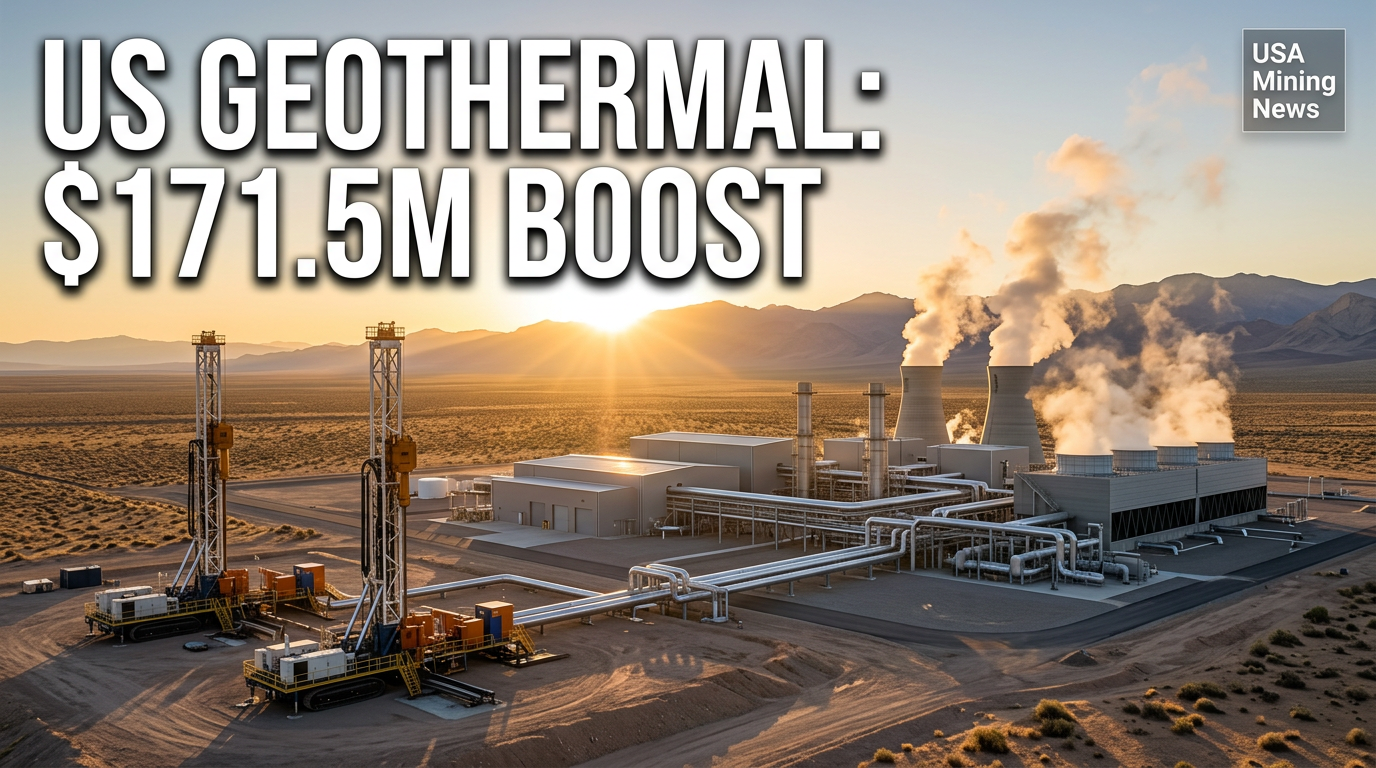
The U.S. Department of Energy (DOE) has announced a significant $171.5 million funding opportunity to catalyze the expansion of next-generation geothermal energy across the nation. This investment aims to support critical field-scale tests for both electricity generation and advanced exploration drilling, thereby derisking promising geothermal prospects and encouraging private sector engagement to help achieve a potential 300 gigawatts of geothermal power by 2050. The initiative underscores a strategic push for domestic energy security, innovation, and economic growth under President Trump's "America First Energy Agenda."
U.S. Department of Energy Unveils $171.5 Million Investment to Propel Geothermal Energy Expansion
**WASHINGTON D.C. – February 25, 2026** – The U.S. Department of Energy (DOE) has announced a substantial funding opportunity totaling $171.5 million, marking a potent commitment to accelerate the development and deployment of next-generation geothermal energy technologies across the United States. This significant investment is earmarked for critical field-scale tests aimed at advancing electricity generation capabilities and supporting rigorous exploration drilling to characterize and potentially confirm promising geothermal prospects nationwide. This strategic move is poised to inject new momentum into an often-underestimated cornerstone of the nation’s energy portfolio, with profound implications for energy independence, technological innovation, and the mining industry's role in supplying essential materials and expertise.
The funding initiative, officially announced from Washington, underscores a concerted effort to realize the immense, untapped potential of geothermal energy, which offers a reliable, around-the-clock power source independent of weather conditions. It directly supports President Trump’s Executive Order, "Unleashing American Energy," signaling a directive to advance geothermal technology, foster innovation, and intensify exploration efforts toward securing an affordable, reliable, and domestically sourced electricity supply for American homes and businesses.
"Work under this opportunity will directly support our commitments to advance energy addition, reduce energy costs for American families and businesses, and unleash American energy dominance and innovation," stated Kyle Haustveit, DOE Assistant Secretary of the Hydrocarbons and Geothermal Energy Office. "Thanks to President Trump's America First Energy Agenda, these demonstrations and drilling activities will help us realize the enormous potential of geothermal to spur domestic manufacturing, enable data center growth, and provide affordable, reliable, and secure energy solutions nationwide.” This statement highlights not only a commitment to energy security but also a vision for broader economic benefits, from job creation in manufacturing to sustainable energy solutions for burgeoning sectors like data centers.
Strategic Focus: Field-Scale Tests and Exploration Drilling
The $171.5 million funding opportunity is structured across six distinct topics, designed to address various facets of geothermal development. For the initial application round, the DOE has opened two pivotal topics, directing immediate attention to key areas:
* **Field Tests for Enhanced Geothermal Systems (EGS):** This topic focuses on demonstrating the efficacy and economic viability of EGS technologies. EGS involves engineering subsurface reservoirs by stimulating hot, dry rock formations at depth to create fracture networks through which fluids can circulate and extract heat. Unlike conventional hydrothermal systems that rely on naturally occurring hot water or steam, EGS broadens the geographic applicability of geothermal energy significantly, making vast, previously inaccessible heat resources viable for power generation. These field tests are critical for proving the scalability and long-term performance of EGS technologies, which have historically faced challenges related to drilling complexity, reservoir creation, and induced seismicity.
* **Drilling for Next-Generation and Hydrothermal Resource Characterization/Confirmation:** This thrust is dedicated to de-risking the geological uncertainties inherent in geothermal exploration. It targets both advanced hydrothermal resources (conventional geothermal reservoirs) and next-generation systems by funding exploration drilling. This drilling will be crucial for gathering subsurface data, verifying resource temperatures and permeability, and confirming reserv-oired capacity, thereby transforming speculative prospects into confirmed, viable projects. For the mining industry, this specifically leverages expertise in geological surveying, geophysical interpretation, drilling methodologies, and resource modeling—skills directly transferable from mineral exploration.
The DOE’s phased approach to opening these topics reflects a tactical allocation of resources, prioritizing foundational advancements that can unlock broader industry growth. Letters of Intent for this opportunity are due by **March 27, 2026**, with full applications required by **April 30, 2026**.
Geothermal's Untapped Promise: De-risking and Driving Investment
While the United States currently stands as the global leader in geothermal electricity capacity, boasting approximately four gigawatts (GW), DOE analysis points to a staggering potential, indicating that at least 300 GW of reliable, flexible geothermal power could be integrated into the U.S. grid by 2050. To put this in perspective, 300 GW represents roughly 25-30% of the current total installed electricity generation capacity in the U.S., highlighting geothermal's potential to be a significant baseload power contributor.
However, realizing this ambitious potential necessitates overcoming substantial upfront capital costs and perceived geological risks inherent in deep drilling and reservoir development. This is precisely where the DOE's funding opportunity plays a transformative role. By investing in field-scale demonstrations and exploration drilling, these projects are expected to:
* **De-risk Geothermal Development:** Government-backed projects that validate specific technologies or confirm the presence of viable resources reduce the financial and technical uncertainties for future private investment. This derisking is crucial for attracting venture capital, private equity, and institutional investors who seek lower-risk profiles for large-scale infrastructure projects.
* **Encourage Private Investment:** Successful demonstrations and confirmed resources provide tangible proof of concept, enabling private companies to justify larger capital outlays. This can unlock syndicated loans and project finance for subsequent commercial-scale developments.
* **Spur Industry Growth:** An influx of validated projects will stimulate demand for specialized drilling equipment, engineering services, manufacturing of power plant components, and a skilled workforce, fostering a robust domestic supply chain and job creation.
* **Support Domestic Manufacturing:** The demand for components such as turbines, heat exchangers, pumps, pipes, and control systems needed for geothermal plants can drive growth in U.S. manufacturing capabilities, aligning with the "America First" agenda's emphasis on domestic production.
* **Enable Data Center Growth:** Energy-intensive industries, like data centers, require constant, reliable, and often carbon-neutral power sources. Geothermal's continuous baseload generation profile makes it an ideal fit, supporting expansion without additional strain on existing grid infrastructure or reliance on intermittent renewable sources.
Implications for the Mining Industry
The push for geothermal expansion carries direct and significant implications for the mining and extractive industries. Geothermal energy, at its core, is a subsurface resource that demands specialized knowledge and equipment typically found within the mining sector:
* **Advanced Drilling Technologies:** The exploration and development of geothermal resources—especially deep EGS and superhot rock systems—require cutting-edge drilling techniques capable of operating in extreme temperatures and pressures. Mining equipment manufacturers, drilling contractors, and service providers are uniquely positioned to adapt and supply these sophisticated tools, including ultra-hard drill bits, high-temperature casing, and specialized fluids.
* **Subsurface Characterization and Modeling:** Geothermal exploration mirrors mineral exploration in its reliance on geological and geophysical surveys (seismic, gravity, magnetics), remote sensing, and advanced 3D subsurface modeling to identify and characterize viable reservoirs. Expertise in geological mapping, structural analysis, and resource estimation, fundamental to mining, is directly transferable.
* **Critical Mineral Demand:** While not as directly mineral-intensive as some battery technologies, geothermal plants still require significant quantities of raw materials. Components like copper for electrical systems, steel and specialty alloys for piping and turbines, and potentially rare earth elements in advanced sensors or drilling technologies all stem from the mining sector. Further research into extracting co-produced minerals from geothermal brines (e.g., lithium, zinc, manganese) could also open new avenues for the mining industry.
* **Environmental Technology and Permitting:** Geothermal projects demand rigorous environmental assessments and permitting processes, an area where mining companies often have extensive experience. Managing water resources, mitigating seismic risk, and ensuring responsible land use are shared challenges.
* **Workforce Development:** The skilled workforce required for drilling, geological interpretation, reservoir engineering, and operational management in geothermal fields overlaps significantly with the talent pool in mining and oil & gas. This investment can help foster cross-training and create new career opportunities.
Future Outlook: A Path to Energy Dominance
This $171.5 million funding opportunity is more than just a financial injection; it is a strategic blueprint for unlocking a vital domestic energy source. By targeting both advanced EGS and conventional hydrothermal resources through field tests and exploration drilling, the DOE is laying the groundwork for transforming the U.S. energy landscape.
The emphasis on derisking initial development phases is crucial for catalyzing the larger-scale private investment necessary to bridge the gap from 4 GW to 300 GW by 2050. Achieving this ambitious goal would not only solidify the U.S.'s position as a global leader in clean, baseload energy but also provide profound economic benefits through job creation, domestic manufacturing, and reliable power for essential industries like data centers.
As the industry moves forward with Letters of Intent due by March 27, 2026, and full applications by April 30, 2026, the coming years will be pivotal in demonstrating the potential of these next-generation geothermal technologies. Success in these initial projects promises to provide a powerful catalyst for a new era of geothermal development, positioning the U.S. for enhanced energy security and technological leadership in a rapidly evolving global energy market. For the mining industry, adapting and contributing expertise to this burgeoning sector represents a significant opportunity for growth and diversification in the coming decades.