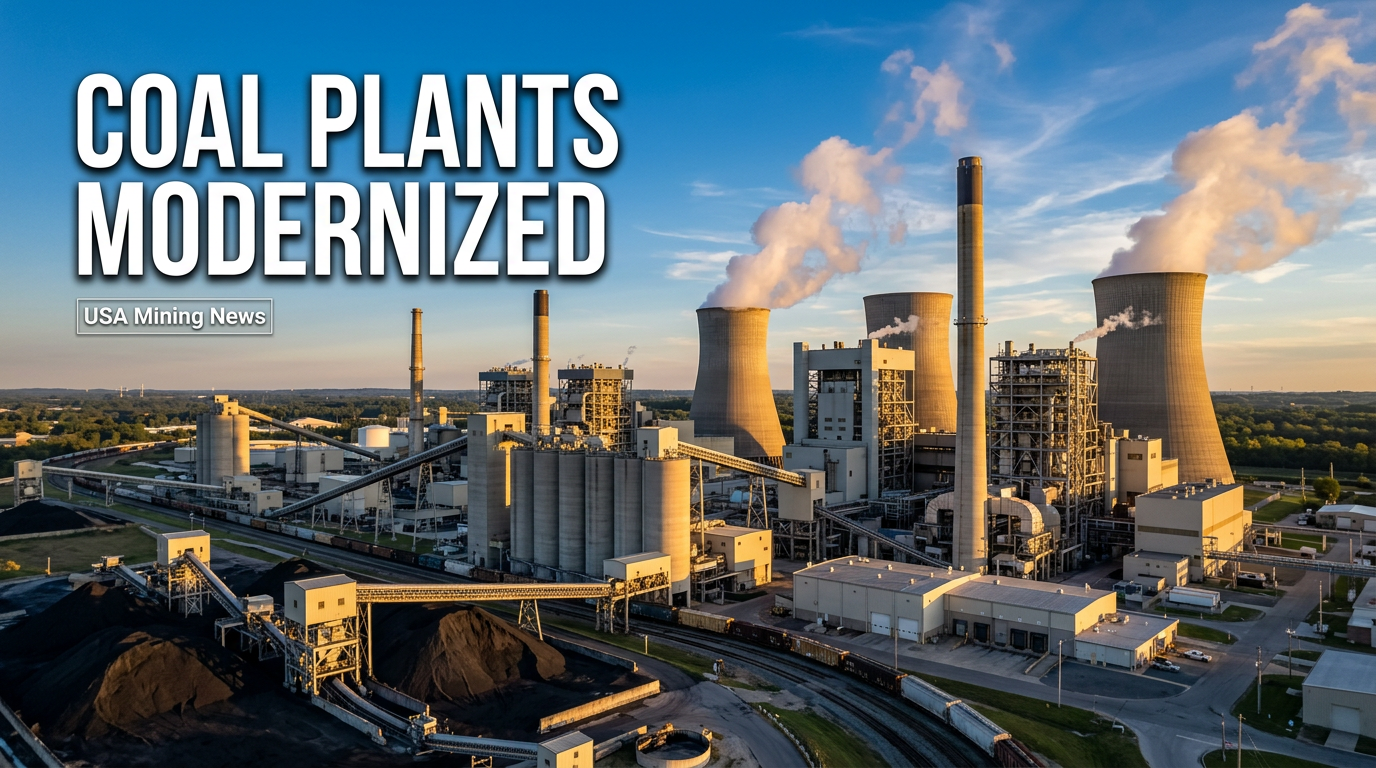
Washington D.C. – February 11, 2026 – In a move set to reverberate through the U.S. energy and mining sectors, the U.S. Department of Energy (DOE) today announced a substantial $175 million in funding. This allocation is designated for six critical projects focused on modernizing, retrofitting, and extending the useful life of existing coal-fired power plants. These facilities, often serving vital rural and remote communities across the United States, are deemed essential for maintaining dependable energy sources, strengthening grid reliability, and ensuring affordable electricity for American families and businesses.
This initial round of funding represents a key component of a larger $525 million departmental effort. The overarching goal is to expand and reinvigorate America’s coal fleet through targeted upgrades that promise to increase efficiency, prolong plant operational life, and add dependable capacity by leveraging existing infrastructure. For the U.S. coal mining industry and its stakeholders, this represents a significant policy reversal and a potential stabilization of domestic demand in a landscape that has seen numerous coal plant retirements over the past decade.
A Strategic Reversal: Prioritizing Coal for Grid Stability
The announcement from Energy.gov underscores a clear shift in federal energy policy, championed by the current administration. U.S. Secretary of Energy Chris Wright articulated this change, stating, “For years, previous administrations targeted America’s coal industry and the workers who power our country, forcing the premature closure of reliable plants, and driving up electricity costs.” Secretary Wright emphasized that "President Trump has ended the war on American coal and is restoring common-sense energy policy. These investments will keep America’s coal plants operating, keep costs low for Americans, and ensure we have the reliable power needed to keep the lights on and power our future.”
This directive aligns with President Trump’s Executive Orders, specifically "Reinvigorating America’s Beautiful Clean Coal Industry" and "Strengthening the Reliability and Security of the United States Electric Grid." These orders signaled a commitment to prioritize dependable power, affordability, and American energy workers. For the mining sector, particularly coal producers, this means a renewed focus on maintaining existing market share and potentially slowing the decline of domestic demand that has impacted balance sheets and employment figures across coal-producing regions.
The rationale behind these investments is rooted in the growing electricity demand across the nation. Dependable, around-the-clock generation—often referred to as baseload power—is considered essential for maintaining a reliable and affordable power system. By bolstering existing coal facilities, the DOE aims to reinforce the backbone of America's power grid, ensuring communities have access to secure, reliable energy when they need it most. This strategy leverages existing capital investments in infrastructure, promising a faster and more cost-effective path to enhance grid stability compared to entirely new construction.
The Broad Agency Announcement: Initial Beneficiaries and Future Prospects
The $175 million in funding is strategically distributed across six projects, primarily impacting regions with strong historical ties to coal production and consumption, notably the Appalachian states. These projects are designed to implement comprehensive upgrades that aim to improve operational efficiency, extend service life, and enhance the overall reliability of these critical generating assets.
The selected projects and their planned upgrades are:
- Appalachian Power Company (Letart and Winfield, West Virginia): This company will undertake significant upgrades at two of its pivotal coal-fired plants in West Virginia: the Mountaineer Power Plant in Letart and the John E. Amos Power Plant in Winfield. These facilities are key baseload generators for the region.
- Buckeye Power Inc. (Brilliant, Ohio): Buckeye Power Inc. will execute a comprehensive suite of upgrades targeting critical systems at Units 1 and 2 of its Cardinal Plant coal-fired station. Such comprehensive efforts typically involve a range of enhancements from boiler and turbine components to environmental control systems.
- Duke Energy Carolinas LLC (Sauratown Township, North Carolina): Duke Energy will focus on upgrading two coal-fired units at its Belews Creek Steam Station. Belews Creek has historically been one of the largest coal-fired power plants in the southeastern United States, making its modernization a significant contribution to regional grid stability.
- Kentucky Utilities Corporation (Ghent, Kentucky): Kentucky Utilities Corporation will implement changes to increase the annual capacity factor of Unit 2 of the coal-fired Ghent Generating Station. An increased capacity factor means the plant can operate at a higher output for more hours in a year, delivering more consistent baseload power.
- Monongahela Power Company (Maidsville, West Virginia): Monongahela Power Company is slated to upgrade the Fort Martin Power Station, which comprises two coal-fired generating units. This station is another critical asset in the Appalachian energy landscape.
- Ohio Valley Electric Corporation (Cheshire, Ohio): Ohio Valley Electric Corporation will upgrade all five coal-fired generating units at the Kyger Creek Station. This multi-unit upgrade signifies a substantial investment in a major regional power provider.
The DOE has indicated that these are initial selections under the Broad Agency Announcement’s program. Further selections under the remaining Topic Area are expected to be announced at a later date, suggesting potential for additional investments and a continuing commitment to the coal fleet.
Industry Implications: A Stabilizing Factor for Coal Mining
For the U.S. coal mining industry and its investors, this funding represents a crucial political and economic signal. The last decade has been marked by significant headwinds, including environmental regulations, competition from cheaper natural gas, and the rise of renewable energy sources, leading to numerous coal mine closures and reduced demand for thermal coal. The DOE's announcement directly addresses the longevity of existing coal-fired power plants, which are the primary domestic consumers of thermal coal.
Key implications include:
- Stabilized Domestic Demand: By extending the life and enhancing the operational efficiency of existing plants, the initiative aims to maintain a steady demand for domestically mined coal. This is especially pertinent for Appalachian coal producers, whose proximity to these plants provides a logistical advantage.
- Preservation of Energy Jobs: The modernization efforts are explicitly linked to preserving high-wage energy jobs, both at the power plants and implicitly within the coal mining sector that supplies them. This economic stability is vital for communities in states like West Virginia, Kentucky, and Ohio, which have long relied on the coal industry.
- Investment Certainty: For coal mining companies, a sustained market for thermal coal in the U.S. can provide a stronger basis for operational planning and capital investment. While not a boom, it mitigates some of the uncertainty that has plagued the sector.
- Technological Advancement: Although the source material does not detail specific technologies, "modernization" and "retrofit" often involve upgrades to reduce emissions, improve combustion efficiency, and enhance overall plant performance. While environmental regulations remain a factor, these investments could make coal plants more competitive and compliant.
- Reinforcing Baseload Power: In an era of increasing intermittent renewable energy additions to the grid, the consistent, 24/7 power output of coal plants is valued for grid stability. Maintaining and enhancing these baseload capabilities is critical for preventing blackouts and ensuring overall energy security.
The sustained operation of these plants, particularly by increasing capacity factors as seen with Kentucky Utilities Corporation’s Ghent station, directly translates to increased or maintained demand for coal over a longer period. This offers a counterbalance to the pressures from other energy sources and policy shifts.
Technical Aspects of Modernization and Life Extension
The terms "modernize, retrofit, and extend the useful life" encompass a range of technical interventions within a power plant. While precise details for each project are not provided, these generally include:
- Efficiency Upgrades: Implementing advanced combustion controls, turbine upgrades, and heat rate improvements to reduce fuel consumption per unit of electricity generated. This not only lowers operating costs but also reduces emissions per MWh.
- Component Life Extension: Replacing or refurbishing critical components like boilers, turbines, generators, and auxiliary systems that are nearing the end of their design life. This ensures continued safe and reliable operation without requiring a full plant rebuild or closure.
- Environmental Performance Enhancements: While not explicitly stated as a primary goal of this particular funding, modernization often includes upgrades to existing pollution control systems (e.g., scrubbers, selective catalytic reduction systems) or the installation of new ones to meet evolving environmental standards.
- Digitalization and Automation: Integrating advanced control systems, sensors, and data analytics to optimize plant operations, improve fault detection, and enable more efficient maintenance scheduling.
- Grid Integration Improvements: Enhancing the plant's ability to respond to grid demands, including faster ramp rates and improved grid synchronization capabilities, which become increasingly important with higher penetration of variable renewable energy sources.
By leveraging existing infrastructure, these types of upgrades offer a relatively quick and cost-effective pathway to enhance energy output and reliability, avoiding the significant lead times and capital costs associated with constructing entirely new power generation facilities.
Broader Energy Landscape and Future Outlook
The DOE's initiative arrives at a time when the U.S. electricity grid faces complex challenges, including rising demand, extreme weather events stressing infrastructure, and the ongoing transition in the energy mix. Electricity demand is projected to continue growing, driven by factors such as electrification of transport and industry, and the proliferation of data centers. Maintaining a diverse and robust energy portfolio, including dispatchable baseload sources like coal, is increasingly viewed as crucial for overall grid resilience.
The announcement also hints at further governmental commitment, with DOE planning to make additional selections under the Broad Agency Announcement’s remaining Topic Area. This suggests a sustained effort to reinforce the role of coal in the U.S. energy strategy in the medium to long term.
Conclusion
The U.S. Department of Energy’s allocation of $175 million to modernize coal-fired power plants marks a pivotal moment for the American energy landscape and, critically, for the domestic coal mining industry. This action, driven by a pronounced shift in federal policy, aims to secure grid reliability, ensure affordable electricity costs, and preserve vital energy sector jobs, particularly within the Appalachian region.
By investing in the longevity and efficiency of existing coal infrastructure, the government is signaling a recognition of coal's continued role as a dependable baseload power source. For mining professionals and investors, this initiative provides a measure of stability in a commodity market often subject to volatile policy shifts and evolving energy trends. While the industry continues to navigate a complex future, these investments offer a tangible pathway for sustained domestic demand and a renewed emphasis on America's existing energy assets.