U.S. Department of Energy Commits $50 Million to Bolster Tribal Energy Infrastructure: Implications for the Mining Sector
WASHINGTON D.C. – On March 25, 2026, the U.S. Department of Energy’s (DOE) Office of Indian Energy (IE) announced a crucial $50 million Notice of Funding Opportunity (NOFO) designed to significantly advance affordable, reliable, and secure energy solutions across Indian Country. This substantial investment underscores the nation’s strategic focus on energy independence and economic empowerment for Tribal nations, with far-reaching implications for various sectors, including the energy-intensive mining industry.
The NOFO, officially titled Unleashing Tribal Energy Development, is a direct manifestation of President Trump’s Executive Order, Unleashing American Energy, signaling a robust commitment by the administration to leverage energy as a fundamental driver of economic growth and resilience for Tribal communities. This initiative is touted by DOE officials as a groundbreaking effort, marking a notable expansion in competitive funding opportunities aimed at Tribal entities.
U.S. Secretary of Energy Chris Wright emphasized the administration’s core philosophy, stating, “This investment reflects the Trump Administration’s commitment to ensuring Tribal communities have access to affordable, reliable, and secure energy. By strengthening local energy infrastructure, we are supporting long-term economic growth, energy independence, and resilience across Indian Country.” This sentiment aligns with broader national objectives to enhance domestic energy security and foster economic vitality in underserved regions.
Echoing this enthusiasm, DOE's Office of Indian Energy Director Eric Mahroum highlighted the unique scope of the offering: “This $50 million competitive funding opportunity for Tribal entities is directly aligned with the priorities of the U.S. Department of Energy. This funding will unleash Tribal energy development—supporting energy projects that aim to cut energy costs, expand electricity access, and advance economic opportunities. It’s exciting and like nothing we have offered before.”
Strategic Funding Avenues for Tribal Energy Initiatives
The Unleashing Tribal Energy Development NOFO is structured to support a broad spectrum of energy projects, catering to diverse needs and development stages within Tribal communities. Eligible applicants include Indian Tribes, a designation that encompasses Alaska Native regional corporations and Village corporations, Tribal and intertribal organizations, Tribal Energy Development Organizations, and Tribal Colleges and Universities, as well as any consortium formed by these eligible groups.
The funding opportunity identifies three primary areas of focus:
- Construction and Installation of Tribal Community-Scale Energy Projects: This category targets shovel-ready projects designed to directly meet the immediate energy requirements of Tribal communities, promoting localized energy solutions.
- Predevelopment Activities for Community-Scale Energy Opportunities: Support is provided for crucial early-stage work, enabling projects to progress from initial concept through necessary assessments and planning to become implementation-ready.
- Planning, Assessment, and Feasibility for Large-Scale Tribal Energy Projects: This focus area is critical for initiatives with significant revenue generation and economic development potential. It aims to de-risk and advance the development of larger energy infrastructure projects.
The DOE's comprehensive approach, spanning from project inception through commercialization, is designed to empower Tribes in addressing their unique energy challenges. Specifically, the NOFO funding for planning and feasibility assessments for large-scale Tribal energy projects acts as a vital precursor, enabling Tribes to subsequently access additional financing through the DOE’s Office of Energy Dominance Financing (EDF) Tribal Energy Financing Program (TEFP). The TEFP, geared towards large-scale energy development, was recently amended by the Working Families Tax Cut, which notably eliminated the Federal Support Restriction, streamlining the path for significant project financing.
Gregory A. Beard, Director of DOE’s EDF, underscored this synergistic relationship: “Energy projects that go from planning and development to loan are a testament to the power of DOE’s collaboration with Tribes to drive forward large energy development projects. EDF is excited to be part of the solution to accelerate Tribal energy projects and drive more affordable, reliable, and secure energy.” This integrated framework aims to create a robust pipeline for Tribal energy development, from initial concept to operational reality.
Implications for the Mining Industry: A Nexus of Energy and Resources
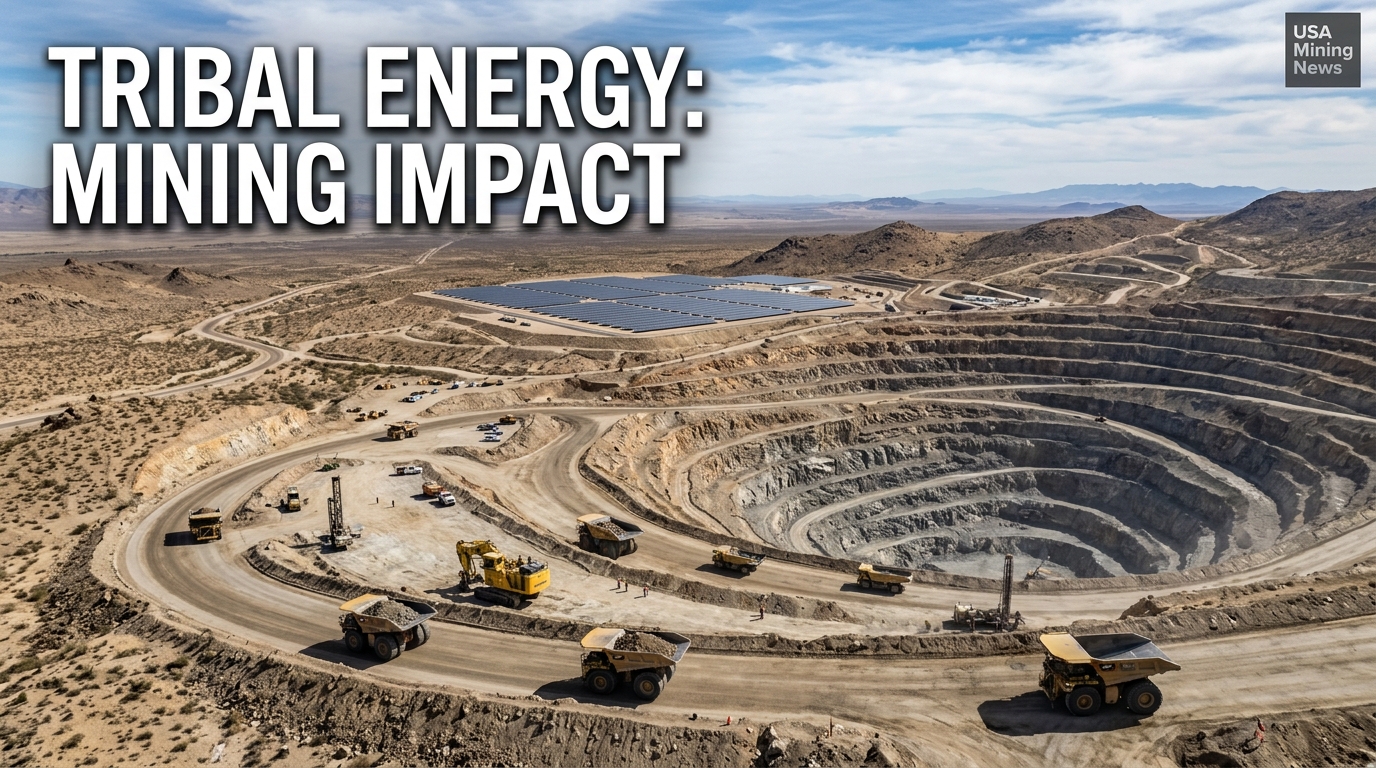
For the mining industry, a sector defined by its intense energy consumption and critical role in sourcing raw materials, the DOE’s Tribal energy investment carries substantial implications. Mining operations — from extraction and crushing to processing and transportation — are inherently energy-intensive. The availability of affordable, reliable, and secure energy is not merely a cost factor but a fundamental determinant of project viability, operational efficiency, and overall economic performance.
Many significant mineral deposits, particularly those containing critical minerals essential for advanced technologies and national security, are located on or near Tribal lands in the United States. Enhanced energy infrastructure in these regions, facilitated by the NOFO, could profoundly impact the feasibility and attractiveness of new and existing mining ventures. The development of localized energy grids or independent power production facilities on Tribal lands could offer mining companies:
- Improved Energy Security: Reduced reliance on often distant or aging national grid infrastructure, which can be prone to disruptions, leads to more stable and predictable energy supply for mines. This is crucial for continuous operations and prevents costly downtime.
- Lower Operational Costs: Access to domestically produced, potentially renewable, and more localized energy sources can lead to significant reductions in energy expenditures, thereby enhancing the economic competitiveness of mining projects.
- Streamlined Development: For new projects, the presence of pre-existing or planned robust energy infrastructure can shorten development timelines and reduce capital expenditure related to site electrification.
- Enhanced Community Engagement: Collaborative energy projects can foster stronger relationships between mining companies and Tribal communities. When Tribes possess greater energy independence and economic self-determination, partnerships with industry can be built on a more equitable and mutually beneficial foundation, fostering long-term stability and social license to operate.
- Support for Critical Minerals Strategy: As the U.S. seeks to bolster its domestic supply chains for critical minerals, the energy component is paramount. Robust energy infrastructure on Tribal lands could accelerate the exploration, extraction, and processing of these vital resources, aligning with the broader “Unleashing American Energy” and “energy dominance” objectives.
- ESG Considerations: Mining companies increasingly face stringent Environmental, Social, and Governance (ESG) criteria. Partnering with Tribes on energy solutions, particularly those involving renewable energy generation, can contribute positively to a company’s ESG profile by demonstrably supporting community development, energy transition, and responsible resource stewardship.
The potential for Tribes to develop large-scale energy projects for revenue generation means that they could become significant energy providers themselves. This diversified energy landscape could present new opportunities for mining companies seeking power purchase agreements (PPAs) with local, stable, and potentially carbon-neutral sources, further integrating energy solutions into their operational models.
The Road Ahead: Timelines and Future Outlook
The immediate next step for interested parties is a webinar scheduled for April 9, 2026, which will provide additional detailed information on this funding opportunity and application procedures. This will be a critical session for eligible Tribal entities to understand the full scope and requirements of the NOFO.
Applications for the Unleashing Tribal Energy Development NOFO are due by July 24, 2026, at 5:00 PM ET. This timeline provides several months for Tribal organizations to develop comprehensive proposals that align with the DOE's strategic objectives and demonstrate a clear path toward achieving affordable, reliable, and secure energy solutions for their communities.
The DOE's Office of Indian Energy reiterates its commitment to maximizing the deployment of energy solutions for the benefit of American Indians and Alaska Natives. By fostering knowledge, skills, and resources, these efforts are anticipated to significantly contribute to the broader national goal of unleashing American energy potential. For the mining industry, this initiative represents not just a governmental funding announcement, but a strategic development that could reshape energy access and operational paradigms in key resource-rich regions, encouraging more sustainable and economically viable domestic mineral production.