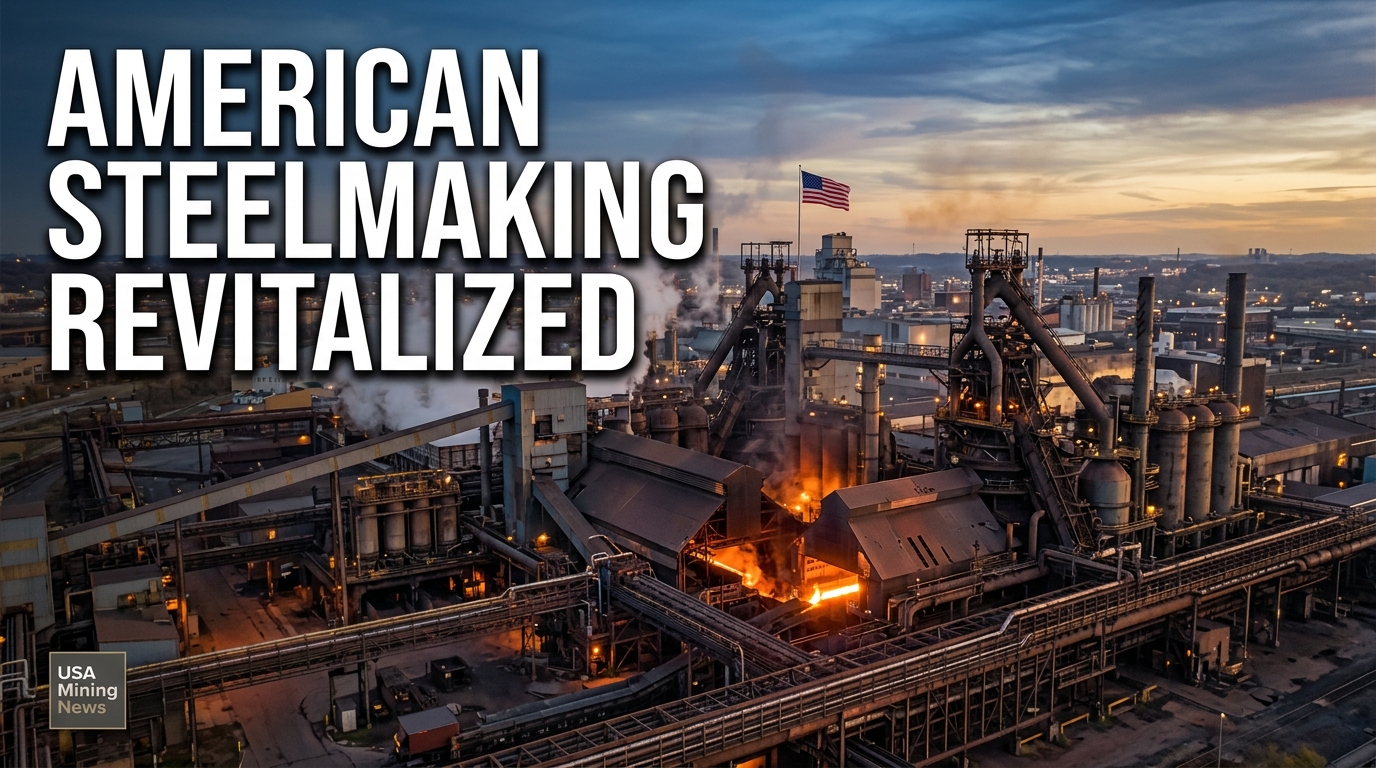
WASHINGTON, D.C. – In a significant move to reinforce America's industrial backbone, the U.S. Department of Energy (DOE) officially announced a substantial $500 million award on August 21, 2026. This federal funding is earmarked to support a larger, $1 billion investment by Cleveland-Cliffs at its critical Middletown Works facility located in Middletown, Ohio. The announcement, underscored by a visit from Vice President JD Vance and U.S. Energy Secretary Chris Wright to the Middletown site, emphasizes the Trump Administration's steadfast commitment to American steelworkers and the broader resurgence of domestic manufacturing capabilities.
This strategic financial injection into one of the nation’s largest flat-rolled steel producers is projected to safeguard 2,300 American jobs, modernize vital steelmaking processes, and significantly strengthen the domestic steel supply chain. For the mining industry, this initiative is particularly resonant, as a robust and modernized domestic steel sector translates directly into sustained demand for foundational raw materials such as iron ore and metallurgical coal, both of which are critical outputs of the mining sector.
Strategic Investment to Fortify Domestic Steel Production
The core of this announcement revolves around the $500 million DOE award, which acts as a catalyst for Cleveland-Cliffs' ambitious $1 billion modernization program at Middletown Works. This substantial investment is explicitly designed to achieve several critical objectives that align with national economic and security interests:
- Modernizing American Steelmaking: Implementing advanced technologies and processes to enhance the efficiency and output of steel production.
- Protecting American Jobs: Directly securing 2,300 existing jobs within the facility, ensuring long-term employment for skilled American workers.
- Strengthening the Domestic Steel Supply Chain: Reducing reliance on foreign imports and ensuring a stable, reliable supply of high-purity steel for key American industries.
Vice President Vance and Secretary Wright's presence at Middletown Works underscored the administration's "America First" agenda, highlighting efforts to bring investment back to American communities and fortify industries deemed essential for national economic and defense security. This commitment to revitalizing industrial assets serves as a critical signal to the mining sector regarding the government's intent to support primary commodity demand within national borders.
Evolution of the Project Scope: From Green Premium to Efficiency Upgrade
An interesting and pragmatic detail revealed in the DOE’s announcement concerns the evolution of the project’s scope. Cleveland-Cliffs initially developed a project based on a "green premium" for steel, anticipating market demand for environmentally superior products. However, the company determined that the business case for this original scope was no longer viable, primarily due to customers' unwillingness to bear the additional cost associated with such a premium.
This market reality prompted a collaborative effort between Cleveland-Cliffs and the DOE to identify a viable alternative. The resulting refined project strategy focuses on upgrading and improving the efficiency of the existing coal-fired blast furnace at Middletown Works. Critically, this revised plan also incorporates the capture and commercialization of co-product blast furnace gas (BFG). This shift represents a pragmatic adaptation to market conditions, emphasizing efficiency and byproduct valorization within existing operational frameworks, rather than pursuing a potentially unfeasible "green premium" approach. For the mining industry, this decision confirms the continued reliance on traditional metallurgical inputs, while simultaneously pushing for operational improvements and environmental performance through technology and resource recovery.
Technical and Operational Enhancements at Middletown Works
The $1 billion investment, bolstered by DOE's $500 million award, will bring a suite of technical and operational upgrades to the Middletown Works facility. These enhancements are designed to improve efficiency, reduce energy consumption, and create new revenue streams from industrial byproducts. The core components of the modernization include:
- Blast Furnace Rebuild and Upgrade: The plant’s main coal-fired ironmaking furnace will undergo a comprehensive rebuild and upgrade. This ensures the foundational element of the steelmaking process is operating at peak performance and longevity.
- AI Deployment for Optimization: Advanced Artificial Intelligence (AI) technologies will be deployed to optimize furnace operations. This is expected to significantly improve energy efficiency and overall operational control, leading to more consistent product quality and reduced waste.
- On-Site Gas-to-Electricity Facility: A new facility will be constructed on-site to convert steel mill process gases, including the captured blast furnace gas, into electricity. This not only monetizes a previous waste product but also reduces the plant's reliance on external power grids, enhancing energy independence and sustainability.
- Byproduct-to-Concrete Materials: Follow-on investments are planned to convert other industrial byproducts from the steelmaking process into materials suitable for concrete used in regional infrastructure projects. This circular economy approach not only minimizes waste but also provides value-added materials for the construction sector, further linking steel production to broader infrastructure development.
Construction on these critical Middletown Works projects is anticipated to commence in the coming weeks, signaling a rapid progression from announcement to implementation.
Cleveland-Cliffs: A Cornerstone of American Manufacturing
Cleveland-Cliffs stands as the largest flat-rolled steel producer in the United States, playing an indispensable role in the nation’s manufacturing base. The Middletown Works facility specifically contributes to this by producing steel essential for products Americans rely on daily. This includes supplying critical steel to American manufacturers across diverse sectors such as:
- The automotive industry
- Heating and cooling (HVAC) manufacturers
- Appliance producers
- Various steel-distribution industries
By securing and modernizing this facility, the investment directly strengthens a vital domestic supply chain, simultaneously reducing America’s reliance on foreign products. As Assistant Secretary of Energy Audrey Robertson articulated, “This landmark investment at Middletown Works will secure a reliable domestic supply of high-purity steel while protecting thousands of quality jobs in Ohio. DOE is proud to partner with Cleveland-Cliffs to reduce America’s dependence on foreign products and position key domestic industries—including automotive, HVAC, appliance, and steel-distribution industries—for long-term competitiveness.” This robust domestic demand for steel, in turn, underpins the market for domestic iron ore and metallurgical coal producers.
National Security and Economic Implications for the Steel Sector
The significance of this investment extends beyond the immediate benefits to Cleveland-Cliffs and Middletown, Ohio. Secretary Wright explicitly stated, “President Trump is rebuilding America’s industrial base. This investment puts American workers and American manufacturing first. It will modernize one of our nation’s critical steelmaking facilities, protect thousands of jobs, and strengthen our domestic steel production—keeping Ohio at the heart of American manufacturing and strengthening our national security.”
This perspective highlights the steel industry's role not just as an economic engine, but as a critical component of national security. A strong domestic steel industry is fundamental for defense manufacturing, critical infrastructure development, and overall economic resilience, especially in times of global supply chain disruptions. For the mining industry, a secure and robust domestic demand for steel provides a strategic imperative for continuous investment in domestic mining operations that supply the necessary raw materials. This ensures that the entire value chain, from pit to product, remains resilient and less susceptible to geopolitical volatilities affecting international commodity markets.
The Broader Context of Federal Investment in Critical Industries
This $500 million award to Cleveland-Cliffs is not an isolated initiative but forms part of a broader federal strategy to bolster critical American industries. The U.S. Department of Energy has been actively making similar investments across the industrial landscape. For instance, just a day prior, on August 20, 2026, the DOE announced another $500 million aimed at securing America's critical mineral and battery supply chains. Such coordinated investments underscore a concerted governmental effort to enhance domestic production capabilities across multiple strategic sectors—from steel to critical minerals—all of which have direct and profound implications for the U.S. mining industry. These initiatives collectively aim to reduce external dependencies and create a more self-sufficient and secure industrial future for the nation.
Future Outlook and Industry Impact
The modernization project at Cleveland-Cliffs' Middletown Works represents a pivotal moment for the American steel industry. By upgrading existing infrastructure and integrating advanced technologies like AI and byproduct commercialization, Cleveland-Cliffs is poised to enhance its competitiveness in the global market. The commitment to a coal-fired blast furnace, while focusing on efficiency and value-added byproduct streams, reflects a pragmatic corporate strategy in the face of current market dynamics.
For the mining industry, this translates into a stable, and potentially growing, domestic demand for high-quality metallurgical coal and iron ore. Furthermore, the initiative to convert industrial byproducts into materials for concrete opens new avenues for other mining sectors, such as aggregates. This comprehensive investment underscores the critical interplay between government policy, corporate strategy, and raw material supply, reinforcing the essential role the mining industry plays in sustaining and advancing America's industrial might for years to come. The expected commencement of construction in the coming weeks sets the stage for a tangible revitalization that promises to resonate throughout the supply chain.