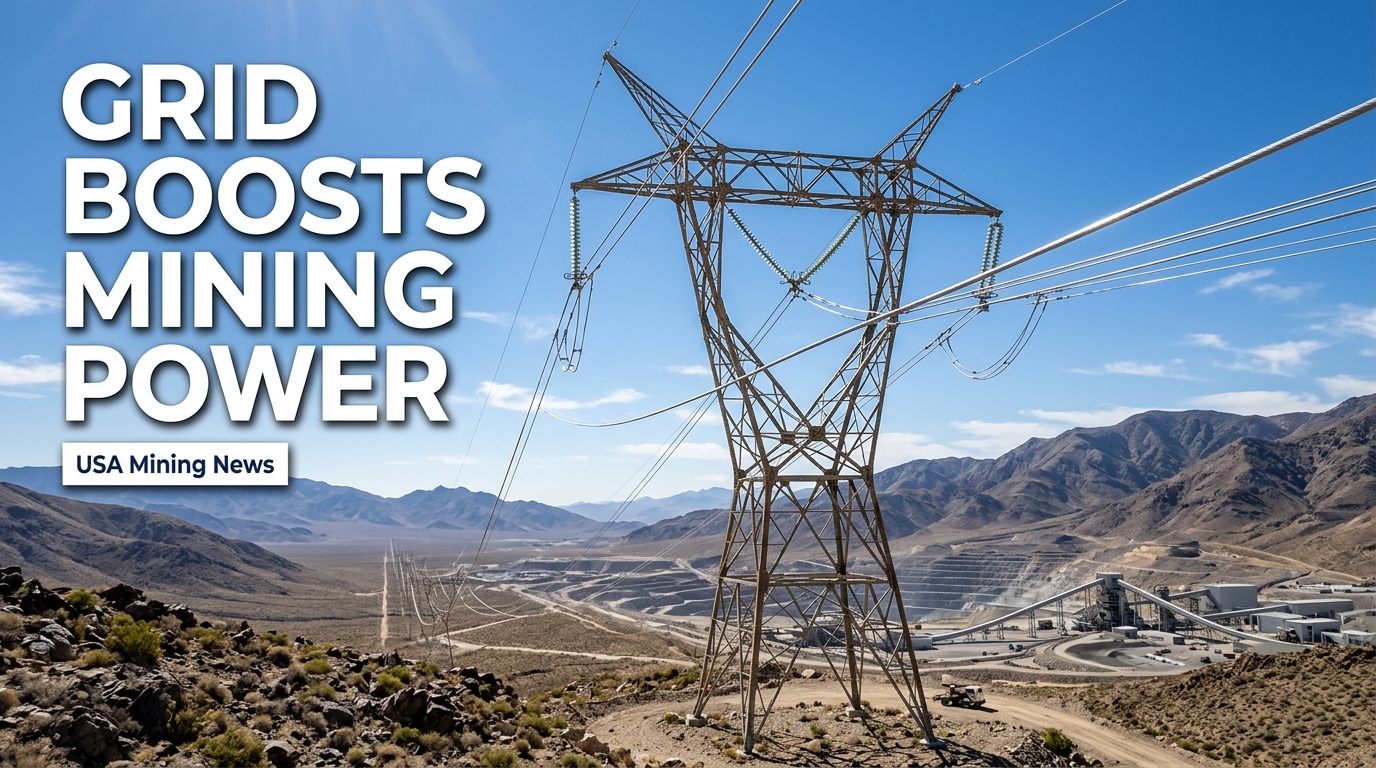
WASHINGTON D.C. – On October 16, 2026, the U.S. Department of Energy (DOE) unveiled a significant federal investment aimed at bolstering the resilience and capacity of the electric transmission grid across Virginia and West Virginia. Leveraging Defense Production Act (DPA) funding, the DOE announced its intent to deploy up to $50 million towards an innovative project designed to enhance existing power line infrastructure, a move deemed critical for national defense and the growing energy demands of the region.
This strategic allocation underscores a proactive approach to grid modernization, focusing on advanced technologies to expedite capacity expansion without the extensive timelines and disruptions often associated with traditional transmission upgrades. For the mining industry, which relies heavily on a stable and affordable energy supply, this development signals a positive step towards greater operational security and cost predictability in a vital U.S. mineral-producing region.
Key Investment Details and Project Scope
The core of this initiative is the "Grid Enhancing Technologies for Virginia & West Virginia Large Load Growth" project, spearheaded by Virginia Energy in close coordination with Appalachian Power, Potomac Edison, and other regional partners. The project is slated to receive up to $50 million in DPA funding, a mechanism traditionally used to prioritize and allocate resources for national defense and critical infrastructure.
The technical approach centers on two key advanced transmission technologies:
- Advanced Reconductoring: This involves replacing existing transmission lines with new, high-capacity conductors that can carry more electricity without requiring the construction of new towers or rights-of-way. These advanced materials, often incorporating composite cores, offer superior strength-to-weight ratios and higher temperature tolerance, allowing for increased current flow.
- Dynamic Line Rating (DLR): DLR systems utilize real-time data, such as ambient temperature, wind speed, and line sag, to dynamically assess the maximum power that a transmission line can safely carry. Unlike static, conservative ratings, DLR allows grid operators to safely increase power flow during favorable conditions, optimizing the existing infrastructure’s capacity.
By deploying these technologies across Appalachian Power’s Virginia system and potentially other parts of the region, the project is estimated to add 290 megawatts (MW) of transmission capacity. Crucially, these upgrades are projected to be completed one to four years faster than conventional transmission expansion methods, with the entire project anticipated to span a 48-month duration. This accelerated timeline highlights a significant shift towards efficiency and speed in critical infrastructure development.
A Strategic Imperative: National Security and Grid Modernization
The DOE's decision to utilize DPA funding for this project emphasizes its broader strategic importance. As U.S. Secretary of Energy Chris Wright articulated, "President Trump is committed to doing everything possible to strengthen American energy security and lower costs for the American people. By deploying Defense Production Act funding to secure and expand electricity access in Virginia and West Virginia, the Trump Administration is strengthening the nation’s energy security for decades to come." This statement underscores the administration's focus on energy independence and resilience as pillars of national strength.
The national security dimension is further highlighted by Presidential Determination No. 2026-10, which explicitly identifies transmission lines and conductors, substations, and power-control and protection equipment as essential to national defense. This formal designation provides the legal and policy framework for invoking the DPA, enabling the federal government to accelerate projects deemed vital for military operations, government functions, and critical defense-related industries.
Office of Electricity Assistant Secretary Katie Jereza echoed this sentiment, noting, "A stronger electric grid doesn't always mean building more power lines. Sometimes it means making better use of the ones we already have. This investment will help unlock more power, strengthen reliability, and ensure our grid can meet the growing demands of American families, businesses, and national defense." Her remarks point to an evolving strategy for grid enhancement, prioritizing optimization and efficiency of existing assets over solely pursuing new construction.
Technical Advancements Driving Efficiency
The deployment of advanced reconductoring and Dynamic Line Rating represents a sophisticated approach to grid enhancement. Conventional transmission upgrades often involve lengthy processes of acquiring new rights-of-way, extensive environmental reviews, and constructing entirely new lines, which can take a decade or more from conception to completion. The chosen technologies offer a compelling alternative:
- Efficiency: By utilizing existing transmission corridors and infrastructure, the project minimizes the need for new land acquisition and reduces the environmental footprint associated with new line construction.
- Speed: The ability to implement these upgrades significantly faster — up to four years sooner than traditional methods — is critical for addressing immediate and rapidly growing demand.
- Cost-Effectiveness: While an initial investment, optimizing existing assets can ultimately prove more cost-effective over the long term compared to greenfield transmission projects, offering better value for taxpayer and ratepayer dollars. The source explicitly mentions protecting taxpayer dollars and ratepayers as a focus of the Trump Administration.
These advanced methods not only increase electricity delivery capacity and reduce congestion but also enhance the overall reliability of the grid, making it more robust against outages and better equipped to handle peak demand periods or unforeseen disruptions.
Implications for the Mining Sector in Virginia and West Virginia
For the mining industry, particularly in regions like Virginia and West Virginia with their rich mineral resources, this investment in grid infrastructure is profoundly significant. Mining operations are among the most energy-intensive industrial activities, requiring massive amounts of reliable, affordable power for:
- Excavation and Haulage: Large electric shovels, draglines, and conveyor systems demand substantial and continuous power.
- Processing Plants: Crushing, grinding, flotation, and other mineral processing stages consume vast quantities of electricity.
- Ventilation and Pumping: Underground mines, especially, rely on constant power for life support systems and water management.
- Support Infrastructure: Offices, maintenance shops, and lighting throughout the mining complex also contribute to the overall energy load.
In states like West Virginia, which has a long history of coal mining, and Virginia, with its significant production of aggregates, industrial minerals, and ongoing interest in critical minerals, dependable electricity is non-negotiable. Unreliable power translates directly into costly operational downtime, potential safety hazards, and disruptions to production schedules. By strengthening the grid and ensuring reliable power, the DOE's project will:
- Enhance Operational Continuity: Mining companies can operate with greater confidence, reducing the risk of interruptions that impact output and profitability.
- Mitigate Cost Volatility: A more efficient and less congested grid can contribute to lower electricity costs, a critical factor for managing the high operating expenses of mining.
- Support Future Growth: The additional 290 MW of capacity and improved reliability provide the necessary infrastructure to support potential expansions of existing mines or the development of new projects, including those focused on critical minerals vital for national defense and advanced technologies.
The mention of supporting "large load growth" and "defense-related industries" directly resonates with the mining sector, especially as the demand for critical minerals—essential for defense applications and renewable energy technologies—continues to escalate. A robust domestic energy infrastructure is a prerequisite for a robust domestic critical minerals supply chain.
Broader Economic and Supply Chain Impacts
Beyond the immediate benefits to grid reliability and the mining sector, this project carries broader economic implications. Lower electricity costs and a more dependable power supply can attract new businesses and industries to the region, fostering economic diversification and job creation. The emphasis on "strengthening domestic supply chains by creating infrastructure deployment of advance technologies and materials" signals a commitment to cultivating internal capabilities in advanced manufacturing and engineering, reducing reliance on foreign sources for critical components.
Furthermore, by optimizing existing infrastructure rather than building entirely new systems, the project aims to improve grid performance while protecting taxpayer dollars and ratepayers. This focus on fiscal responsibility, coupled with technological innovation, positions the initiative as a model for future infrastructure investments across the nation.
The Path Forward: A 48-Month Blueprint
The 48-month project timeline indicates a focused and relatively rapid deployment period for these advanced technologies. Upon completion, the "Grid Enhancing Technologies for Virginia & West Virginia Large Load Growth" project will serve as a critical demonstration of how advanced conductors and real-time transmission monitoring can unlock significant capacity using existing infrastructure. The success of this demonstration could pave the way for wider adoption of these technologies across the U.S. electric grid.
The U.S. Department of Energy's DPA funding commitment represents a pivotal step in enhancing energy security and grid resilience in a strategically important region. For mining industry professionals and investors, this signifies not only a commitment to vital infrastructure but also a direct benefit to the operational stability and economic viability of energy-intensive mineral resource extraction and processing. As the nation continues to navigate growing energy demands and the imperative of national defense, such targeted investments in smart grid technologies will be increasingly essential in ensuring a robust and reliable energy future.