USA Mining News | May 15, 2026
Gold Price Retreats to $4,500 Amid Heightened Inflation Fears and Geopolitical Tensions
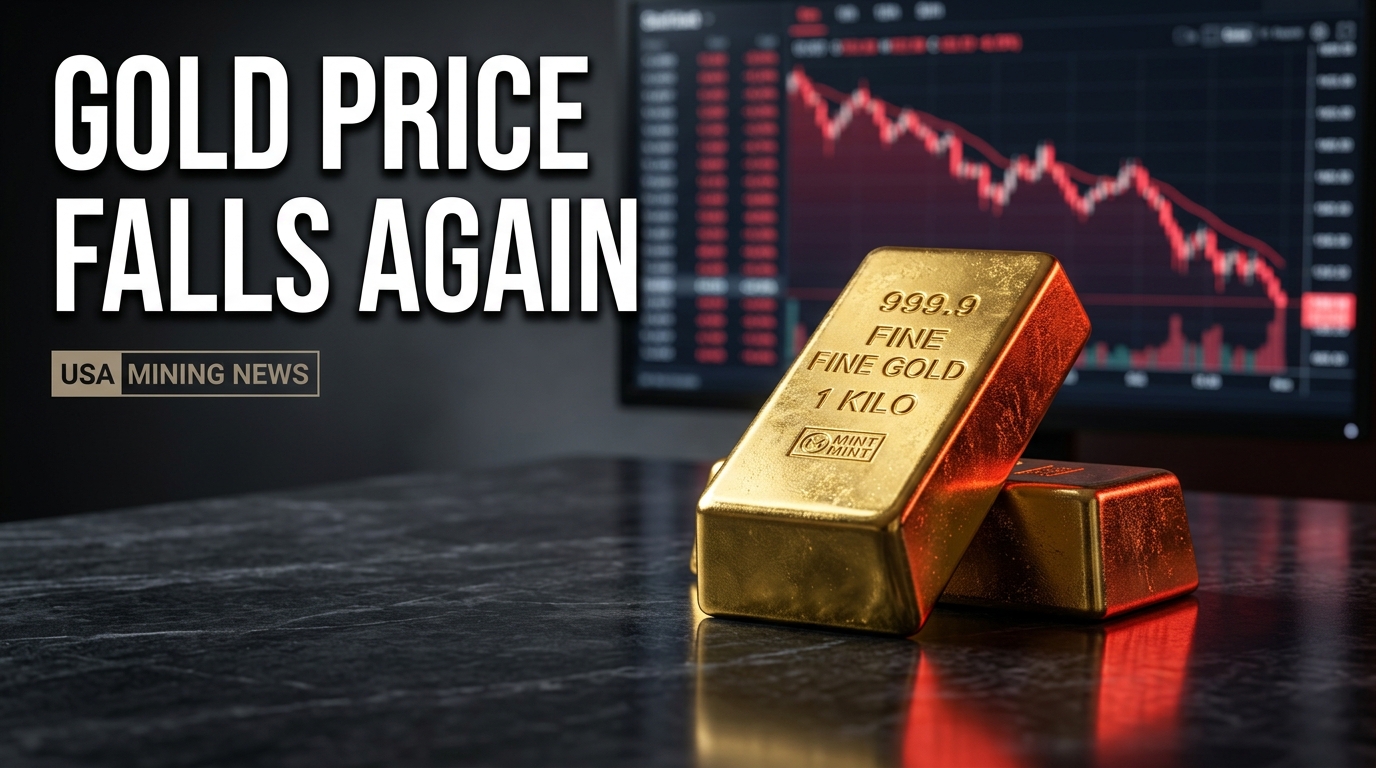
The global mining community and commodity investors are closely watching the gold market as spot prices experienced a notable setback on Friday, May 15, 2026. Gold extended its decline by as much as 3%, pulling back towards the $4,500 per ounce level and effectively erasing all gains accumulated over the previous two trading weeks. This significant price movement is indicative of a broader market selloff, primarily triggered by elevated concerns surrounding global inflation and the potential implications for central bank monetary policies worldwide.
The depreciation of the precious metal coincided with a similar downturn across stock markets, as bond yields surged internationally. Doubts intensified regarding the swift restoration of Middle Eastern oil supplies to normal levels, while the US dollar continued its ascent against major currencies. For gold, these conditions create a challenging environment, as bullion typically performs optimally when bond yields and the greenback are trending lower. The contagion from gold's dip was also observed in other key metals; silver registered a sharp 10% decline, and copper fell 3%, both wiping out their earlier-week gains.
Geopolitical Fallout and the Inflationary Spiral
The overarching narrative dominating commodity markets in recent months has been the ongoing conflict in the Middle East, specifically denominated as the "Iran War," which commenced in late February. This geopolitical volatility has profoundly weakened commodities, with gold alone losing 13% of its value since the conflict began. A primary concern stemming from the conflict is the potential closure of the Strait of Hormuz, a critical chokepoint for global oil shipments. Such a development invokes worries of a global energy crisis, which in turn fuels persistent inflation concerns.
According to Edward Meir, a seasoned analyst at Marex, in comments shared with Reuters, the sell-off across precious metals is attributable to a confluence of factors. Meir stated, "There was a sell-off across the [precious metals] for a couple of reasons. The dollar is quite strong today. We’re also seeing not just a US increase, but a global increase in [bond] yield rates." This perspective underscores the dual pressure points exerted by currency strength and rising borrowing costs on non-yielding assets like gold.
Further compounding inflation fears is the lack of any significant breakthrough in China-US diplomatic efforts aimed at de-escalating the Middle East conflict. The protracted nature of these discussions has done little to assuage market anxieties over inflation and, by extension, the prospect of higher interest rates. Meir further elaborated, "The Chinese really didn’t offer much help in resolving the conflict, and we’re seeing crude oil move up, which reinforces the inflation narrative, and that’s been very bearish for the metals." The connection between geopolitical instability, global energy prices, and the broader inflation outlook remains a critical determinant for commodity market performance.
Yield Pressure and the Interest Rate Outlook
Earlier in the month, gold had briefly rebounded, surging above the $4,700 per ounce mark, spurred by a US proposal to end the conflict. However, this optimism proved short-lived, as back-and-forth talks spanning several days ultimately failed to yield a resolution. Following these latest developments and the persistent inflationary signals, market sentiment has shifted markedly towards tighter monetary policy. Data from Kalshi indicates that the market is currently pricing in a more than 50% chance of an interest rate hike as early as January of next year.
This yield pressure, combined with expectations of a stronger US dollar and stubborn inflation, is expected to continue impacting gold's performance in the immediate term. Analysts Daniel Hynes and Soni Kumari of ANZ Group Holdings, in a note to Bloomberg, articulated this sentiment clearly: "Inflation expectations, higher yields and a stronger dollar are likely to keep gold under pressure in the near term." The Australian banking giant has also adjusted its price outlook, deferring its target of $6,000 per ounce for gold to mid-2027, a postponement from its previous projection of early next year. This recalibration reflects a cautious near-term view, even while maintaining a bullish long-term stance.
A Mixed Outlook: Short-Term Headwinds vs. Long-Term Potential
Despite the recent volatility and the sharp drop experienced on May 15, it is crucial to place gold's performance in a broader context. Bullion remains up by a respectable 6% on the year, buoyed significantly by a record-setting rally in January that saw prices surge to an unprecedented nearly $5,600 per ounce. This illustrates gold's enduring appeal as a safe-haven asset and a hedge against economic uncertainty, even amidst short-term fluctuations driven by macroeconomic headwinds.
Looking further ahead, some institutions project substantial long-term upside for gold. Deutsche Bank, for instance, has famously projected that gold prices could reach $8,000 per ounce on the back of global de-dollarization trends. While this long-term forecast provides a bullish counterpoint to current pressures, it underscores the divergent views prevailing in the market, where geopolitical shifts and currency dynamics are increasingly seen as pivotal drivers beyond traditional supply-demand fundamentals.
Implications for the Mining Industry and Investors
For the global mining industry, particularly companies involved in gold, silver, and copper extraction, these market dynamics present a complex operational and strategic environment.
- Operational Costs: Higher energy prices, driven by Middle East instability and inflationary pressures, translate directly into increased operational expenditures for mining companies. Fuel, transportation, and processing are all energy-intensive, directly impacting profitability margins.
- Investment Decisions: Volatile commodity prices introduce uncertainty into capital expenditure planning, exploration budgets, and long-term project development timelines. Companies may become more conservative in allocating capital, prioritizing existing assets and efficiency gains over new, high-risk ventures.
- Hedging Strategies: Mining firms often employ hedging strategies to lock in future prices and mitigate revenue volatility. The current rapid price shifts in gold, silver, and copper necessitate meticulous risk management and potentially more dynamic hedging approaches.
- Broader Commodity Impact: The synchronized decline across gold, silver, and copper highlights the interconnectedness of commodity markets. Copper, often seen as an economic bellwether, declining signals broader concerns about industrial demand and global economic health, affecting diversified miners particularly.
- Investor Sentiment: For investors in mining equities, the current macroeconomic climate demands a keen understanding of companies' balance sheet strength, cost structures, and geopolitical exposure. While short-term pressures exist, the longer-term bullish forecasts for gold, particularly concerning de-dollarization, suggest opportunities for patient, strategic investors.
Navigating the Path Ahead
The immediate future for gold and other major commodities will largely hinge on the resolution of the Middle East conflict, the trajectory of global inflation, and the subsequent responses from key central banks, particularly the US Federal Reserve. A strong US dollar and higher bond yields are expected to keep a lid on gold prices in the near term, as articulated by leading analysts. However, the underlying drivers of gold's long-term strength – its role as a hedge against geopolitical uncertainty, inflation, and currency debasement – remain intact.
Mining companies and investors alike will need to closely monitor these macro factors, adapting strategies to navigate a market characterized by both significant potential and pronounced volatility. The emphasis will be on robust financial management, operational resilience, and a clear understanding of both short-term headwinds and long-term thematic tailwinds that continue to shape the global mining landscape.