Gordon Mining Acquires Tungsten Tail Project, Bolstering US Critical Mineral Ambitions
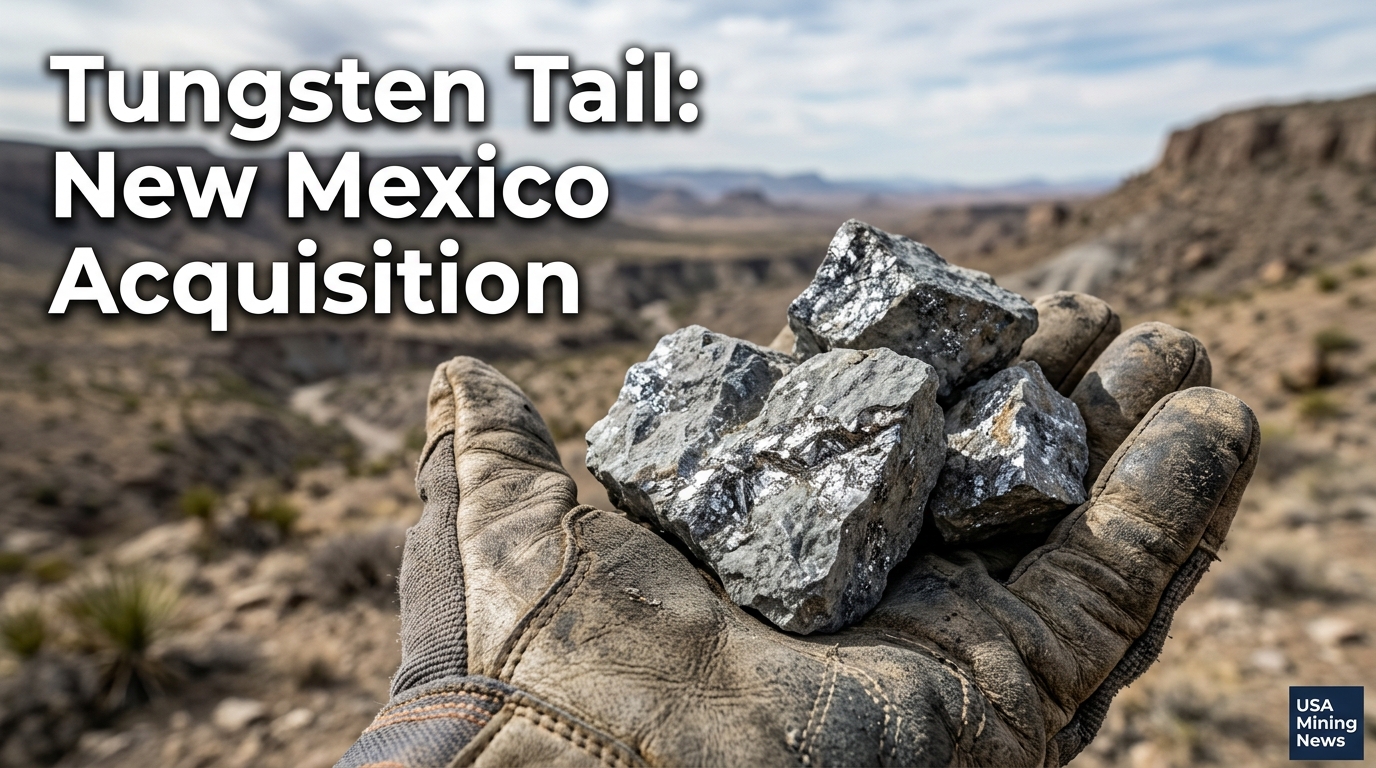
In a significant development for the North American mining landscape, Gordon Mining has announced a definitive agreement to acquire 100% of TT Minerals, the entity that owns the Tungsten Tail Project in Sierra County's Tierra Blanca mining district in New Mexico, US. This strategic acquisition, formally an agreement with Lamina Minerals, encompasses 41 contiguous unpatented lode mining claims, collectively representing approximately 847 acres, or 343 hectares. The transaction, reported on October 21, 2026, signals Gordon Mining’s focused entry into the exploration of tungsten, a commodity increasingly recognized for its critical importance to modern industry and national security.
The acquisition is particularly noteworthy given global geopolitical shifts and the growing emphasis on securing domestic supplies of critical minerals. Tungsten, known for its exceptional hardness and high melting point, is indispensable in a wide array of industrial applications, including the production of cutting tools, wear-resistant parts, defense applications, electronics, and specialized alloys. By targeting a project with documented historical tungsten mineralization within the United States, Gordon Mining is positioning itself to contribute to a more resilient domestic supply chain, a goal shared by governmental agencies and industrial stakeholders alike.
A Strategic Move for Domestic Tungsten Supply
The decision by Gordon Mining to acquire the Tungsten Tail Project reflects a broader industry trend towards de-risking supply chains and exploring opportunities in politically stable jurisdictions. China currently dominates global tungsten production and processing, leading to concerns about supply vulnerability and price volatility. For US-based mining companies, identifying and developing domestic sources of critical minerals like tungsten is not merely a business opportunity but also a strategic imperative.
Ryan Connacher, President and CEO of Gordon Mining, highlighted the project's inherent potential. “Tungsten Tail gives Gordon Mining a tungsten exploration project in the US with a documented history,” Connacher stated. He emphasized the historical context, noting, “The mine shipped small quantities of tungsten mineralisation in 1942 and 1955.” This historical precedent, coupled with subsequent geological work, provides a strong foundation for Gordon Mining's planned exploration initiatives.
Project Location and Geological Promise
The Tungsten Tail Project, formerly known as the Silver Tail mine, is strategically located on the east side of the Black Range. Its precise geographic coordinates place it approximately 12 kilometers south-south-east of Kingston and 15 kilometers south-west of Hillsboro, within an area known for its rich mining heritage. The 41 claims that constitute the project not only cover the historical Tungsten Tail mine but also encompass the central section of the Pierce Canyon fault, a significant geological structure traced by the US Geological Survey (USGS) for approximately 10 kilometers. This fault system is often associated with mineralization, making its presence a key indicator of prospectivity.
Furthermore, the project area includes the former Jayhawk workings, which have historically been noted as a base-metal and silver prospect. While the immediate focus is on tungsten, the presence of other metals suggests a complex geological environment with potential for polymetallic mineralization, offering broader exploration upside. The claims themselves were first located in August 2026, with current maintenance fees paid through the 2027 assessment year, ensuring their good standing. These unpatented lode mining claims are administered by the US Forest Service, and it is noted that a transfer of interest from Strata Mine Technologies to TT Minerals is currently pending, an administrative step that precedes the final acquisition by Gordon Mining.
Understanding the nature of "unpatented lode mining claims" is crucial for industry professionals. Unlike patented claims, unpatented claims grant the holder the exclusive right to explore for and extract minerals, but the land surface remains federal property, subject to reasonable use in connection with mining activities. This framework often involves working closely with agencies like the US Forest Service to ensure compliance with environmental regulations and land use policies, a standard operational aspect for many exploration companies in the US.
Historical Insights and Modern Exploration Potential
The Tungsten Tail Project comes with a compelling historical narrative that underscores its potential. Records indicate that the historical Tungsten Tail mine shipped limited quantities of scheelite-bearing ore in both 1942 and 1955. Importantly, owner-reported grades from those periods, documented in US Bureau of Mines and USGS records, were around 3–4% tungsten trioxide. These figures, while from small-scale historical operations, are significant as they indicate the presence of high-grade mineralization at the surface, providing a valuable starting point for modern exploration.
Further bolstering the project's prospectivity, a 1957 examination by the US Bureau of Mines recommended additional work. Decades later, in 1978, the USGS conducted stream-sediment mapping that identified a tungsten-molybdenum anomaly along the Pierce Canyon fault. The interpretations from this work suggested significant potential for skarn mineralization at depth. Skarn deposits are a type of metamorphic-hydrothermal ore deposit often associated with intrusions into carbonate-rich rocks, and they are well-known global sources of tungsten, copper, gold, and other metals. The specific mention of skarn potential points to a well-understood geological model for high-grade mineralization.
Despite this documented historical production and exploration interest, Gordon Mining’s CEO, Ryan Connacher, highlighted a crucial detail: “We have found no record of any drilling on the project.” This absence of modern drilling is a key factor, presenting Gordon Mining with a significant opportunity to be the first to systematically test the identified anomalies and historical occurrences at depth using contemporary exploration techniques. The project, therefore, transitions from a historical prospect to a modern, undrilled exploration target with considerable upside.
Gordon Mining's Forward-Looking Exploration Strategy
Gordon Mining is not entering this acquisition blindly. The company has already outlined a clear, phased exploration strategy. A critical initial step involves interpreting public data from an airborne magnetic and radiometric survey conducted by the USGS in 2023 across the area, including the Tungsten Tail claims. Airborne geophysical surveys like these are invaluable for remote sensing, providing critical data on the subsurface geology, identifying potential mineralization zones, and aiding in structural mapping without disturbing the ground. Magnetic surveys can detect variations in magnetic minerals, often associated with mineralization, while radiometric surveys measure natural gamma-ray emissions, helping to map different rock types and alteration zones.
Following this data interpretation, Gordon Mining intends to deploy a dedicated geological team to conduct detailed mapping and sampling. This boots-on-the-ground work will involve collecting rock, soil, and possibly stream sediment samples, which will then be analyzed for tungsten and associated indicator elements. The objective of this phase is to refine existing targets and identify new ones, all in preparation for future drilling work. This methodical approach is standard practice in early-stage exploration, aiming to optimize drill hole placement and maximize the chances of discovery.
Tungsten in the Global Market: A Critical Commodity
The global tungsten market is characterized by increasing demand driven by technological advancements and strategic needs. Beyond traditional industrial uses, tungsten plays a vital role in emerging technologies, including electric vehicle components, high-efficiency lighting, and various renewable energy applications. Its properties make it irreplaceable in numerous high-performance scenarios, from jet engines and rocket nozzles to medical devices and nuclear applications.
The US government, through initiatives like the Critical Minerals List, has explicitly recognized tungsten as vital to its economic and national security. This designation underscores the strategic importance of projects like Tungsten Tail. A reliable domestic supply of tungsten would not only reduce reliance on foreign sources but also stabilize prices and foster innovation within critical manufacturing sectors. The development of a US-based tungsten mine would have significant geopolitical implications, enhancing American self-sufficiency and resilience in the face of global supply chain disruptions.
Outlook: Charting a Course for Discovery
For Gordon Mining, the acquisition of the Tungsten Tail Project represents a calculated and strategic expansion of its exploration portfolio into the critical minerals sector. While the project is in its early exploration stages, the combination of historical high-grade mineralization, well-defined geological targets, and the complete absence of modern drilling presents a compelling opportunity. The methodical approach outlined by CEO Ryan Connacher—starting with detailed geophysical interpretation, followed by comprehensive surface mapping and sampling, and culminating in drill target generation—reflects sound exploration practice.
The coming months will be crucial as Gordon Mining’s technical teams delve into the 2023 USGS airborne survey data and initiate field programs. Success at Tungsten Tail could significantly impact Gordon Mining’s valuation and contribute meaningfully to the broader US effort to secure domestic critical mineral supplies. As with all early-stage exploration, risks are inherent, but the substantial potential rewards, coupled with tungsten's strategic importance, make this acquisition a notable development to watch in the evolving landscape of US mining.