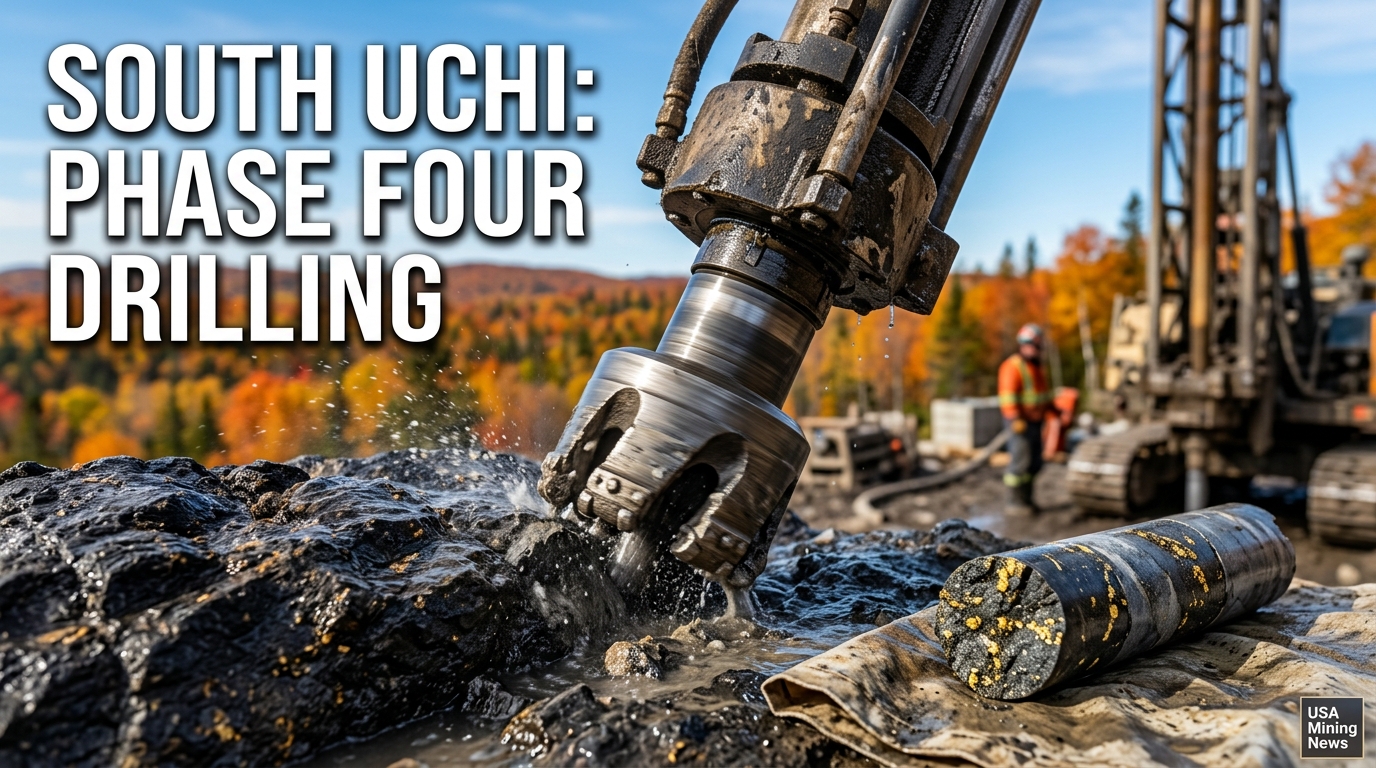
Red Lake District, Ontario, Canada – In a move set to further delineate the gold potential of one of Canada's most renowned mining camps, Kenorland Minerals (TSX.V: KLD) and Auranova Resources have officially commenced Phase Four diamond drilling at the South Uchi Project. The extensive 5,000-meter drilling program, announced for the autumn 2026 season, is concentrated on the highly prospective Papaonga target area within Ontario’s prolific Red Lake District, a region synonymous with significant gold discoveries.
This latest exploration phase represents a crucial step in understanding the geological controls and extent of gold mineralisation previously identified at South Uchi. For mining professionals and investors tracking early-stage gold exploration, the systematic progression of drilling campaigns, especially in established gold districts, provides valuable insights into future potential resource development and strategic corporate partnerships.
Phase Four Commences at Papaonga Target
The current drilling campaign, which began in the autumn of 2026 and is anticipated to conclude by mid-November, is meticulously designed to expand on the encouraging results yielded by earlier exploration efforts. The program’s focus is squarely on the North Papa trend within the Papaonga target, an area where previous drilling has already indicated broad zones of gold mineralisation.
Key objectives for the 5,000-meter program include:
- Follow-up on Prior Intercepts: A primary goal is to conduct step-out drilling along strike and at depth from significant mineralised zones encountered in previous campaigns. Particular emphasis is being placed on hole 26PADD046, which returned multiple promising intercepts.
- Investigating IP Anomalies: The drilling will also target anomalies identified during a recent induced polarisation (IP) geophysical survey. IP surveys are a standard and effective exploration tool for detecting disseminated sulphide minerals, which are often associated with gold deposits. The correlation of IP anomalies with known mineralisation can significantly enhance targeting precision.
- Understanding Geological Controls: Beyond simply identifying gold, the program aims to better characterise the mineralised corridors and the structural controls that govern gold distribution within the North Papa trend. This involves detailed core logging and structural analysis to build a robust geological model.
The systematic approach of following up on both geochemical (drill assays) and geophysical (IP survey) anomalies is a standard industry practice aimed at efficiently defining the footprint and geometry of potential economic mineralisation. Such methodical exploration reduces risk and provides a clearer path toward future resource estimation.
Building on Promising Prior Intercepts
The decision to launch this aggressive Phase Four program is underpinned by compelling results from earlier drilling at the South Uchi Project. Hole 26PADD046, in particular, delivered several notable gold intercepts that underscore the prospectivity of the Papaonga target. These included:
- 14 meters (m) at 0.28 grams per tonne (g/t) gold
- 65.45 m at 0.34 g/t gold, which contained a higher-grade sub-section of 21 m at 0.58 g/t gold
- 35.65 m at 0.31 g/t gold
In addition to these broad zones, another intercept within the project area returned 7.7 m at 1.13 g/t gold, notably featuring a higher-grade interval of 1 m at 7.07 g/t gold. While grades below 1 g/t gold are typically considered low for standalone narrow vein operations, broad zones of 0.3-0.6 g/t gold over tens of meters can be significant, especially in open-pit scenarios or if they represent a large tonnage, bulk-mineable deposit. The presence of higher-grade sub-sections and individual high-grade intervals (e.g., 1m at 7.07 g/t gold) further enhances the prospectivity, suggesting the potential for both bulk tonnage and richer discrete zones.
Geologically, these mineralised intervals are hosted within felsic and mafic volcanic rocks, and are consistently accompanied by notable alteration and sulphide mineralisation. Such geological associations are common in many Archean greenstone-hosted gold deposits, indicating favorable conditions for gold deposition. Drilling has also indicated gold mineralisation near the contact between tholeiitic and calc-alkaline volcanics, a significant geological boundary that often acts as a structural and chemical trap for gold-bearing fluids.
The Strategic Partnership: Kenorland and Auranova
The South Uchi Project is a testament to strategic collaboration in mineral exploration. Kenorland Minerals, an established project generator with a track record in identifying prospective ground, operates the South Uchi Project. In December 2024, Kenorland and Auranova Resources formalized an agreement that granted Auranova the rights to earn up to a 70% project interest. This partnership structure allows Kenorland to leverage Auranova’s financial capacity to advance exploration, while retaining a significant upside.
As of July 2025, Auranova Resources has successfully earned a 51% interest in the project. This milestone was achieved through the completion of specific cash payments and share issuances, as outlined in the initial agreement. Following this earn-in, Kenorland Minerals retains a substantial 30% carried interest in the project, meaning Kenorland is not required to contribute to project expenditures for this portion of their interest, until certain pre-defined milestones are met, typically a production decision. Furthermore, Kenorland holds a 2% net smelter return (NSR) royalty on the project, providing a long-term revenue stream from any future production without ongoing operational costs.
This partnership model is common in the junior mining sector, enabling smaller companies like Kenorland to de-risk projects, unlock value, and focus on their core competency of early-stage discovery, while larger or better-financed partners provide the capital for extensive drilling and development.
Geological Context and Regional Significance of South Uchi
The South Uchi Project's location within the Red Lake District is a critical factor in its appeal. The Red Lake greenstone belt, situated in northwestern Ontario, is globally recognized for its significant high-grade gold deposits, with a history of production stretching back over a century. Major players like Evolution Mining’s Red Lake Gold Mines and Kinross Gold’s Great Bear project underscore the district's continued importance as a gold producer and exploration frontier.
Kenorland initially staked the South Uchi Project due to its compelling potential for large-scale gold systems. Geologically, the project area encompasses volcanic rocks belonging to the Confederation Assemblage. These rocks are situated near significant geological boundaries, which are often considered highly favorable for the accumulation of gold. These boundaries can represent major structural zones that act as conduits for hydrothermal fluids and create competency contrasts, leading to structural traps where gold can precipitate.
The geological setting, coupled with the encouraging drill results and geophysical anomalies from the IP survey, paints a picture of a project with strong potential in an area well-known for hosting world-class gold deposits. Systematic exploration in such a mature and prolific belt significantly increases the probability of discovery.
Kenorland's Broader Exploration Portfolio
While South Uchi is a key focus, Kenorland Minerals maintains an active and diversified exploration portfolio. The company consistently engages in systematic exploration across various projects, often through joint ventures and option agreements with larger mining companies. For instance, in July 2026, Kenorland completed its initial diamond drill program at the Western Wabigoon Project, also located in northwestern Ontario. This project is operated under an option agreement with a subsidiary of Centerra Gold Inc., highlighting Kenorland's strategy of partnering with established producers to advance its exploration assets and expand its footprint across prospective Canadian shield regions.
Outlook and Industry Implications
With drilling at South Uchi expected to conclude by mid-November 2026, the market will keenly await the assay results from this Phase Four program. These results will be instrumental in further refining the geological model, understanding the continuity of mineralisation, and guiding future exploration decisions. Positive outcomes could lead to subsequent drilling phases, potentially progressing towards initial resource estimation, which would represent a significant value-add for both Kenorland and Auranova.
For the broader mining industry, projects like South Uchi exemplify the critical role of junior exploration companies in discovering and de-risking new deposits. In an era of increasing demand for gold, driven by economic uncertainties and industrial applications, identifying and developing new sources of supply is paramount. The systematic and collaborative approach demonstrated at South Uchi in a proven gold district like Red Lake reinforces confidence in the ongoing potential of Canada's mineral wealth and provides a blueprint for successful project generation and advancement.