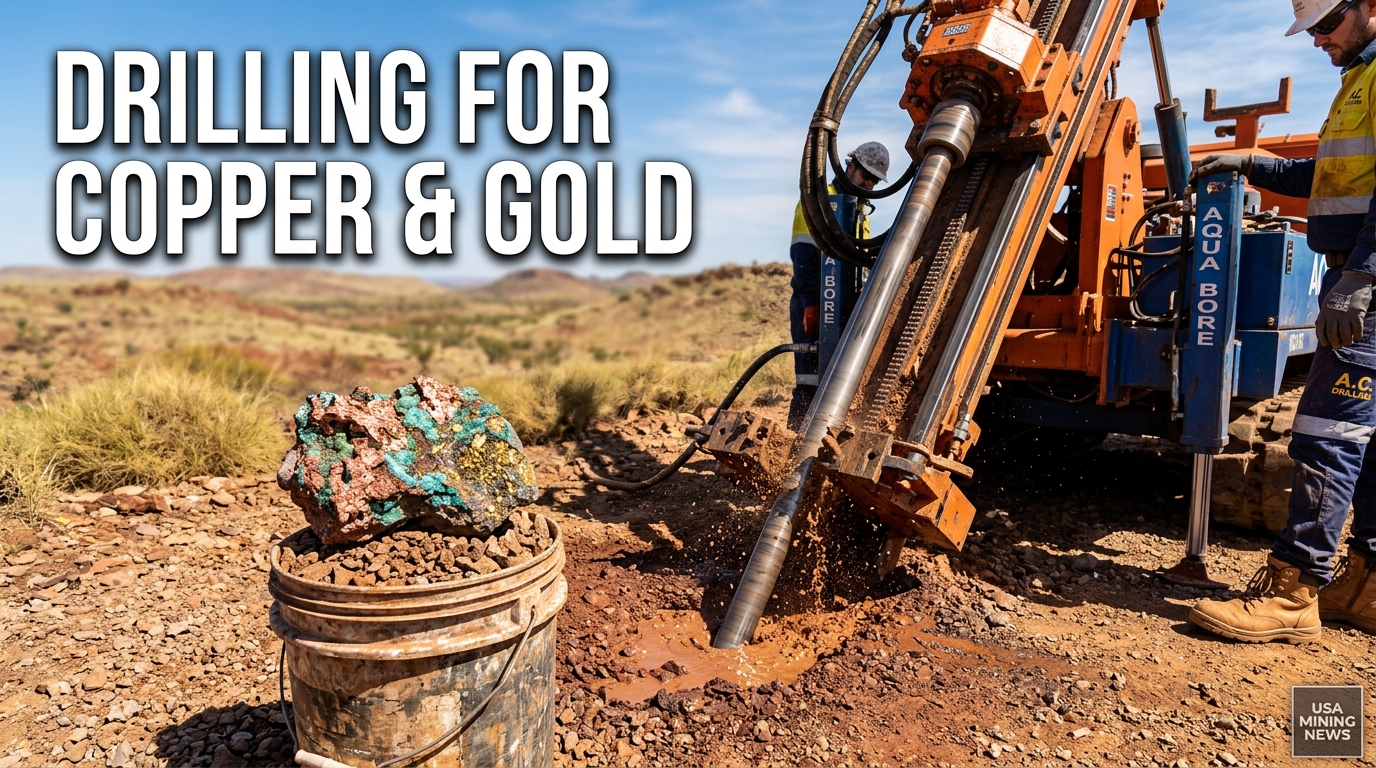
Perth, Western Australia – Great Western Exploration (GWE), an active player in Western Australia’s dynamic exploration scene, has commenced a substantial 3,000-meter air core drilling campaign at its promising Diorama copper-gold target. Located within the company’s Yerrida North Project, approximately 800 kilometers north-east of Perth, this program marks a pivotal moment as it represents the first drilling endeavor at Diorama, a target identified for its potential to host DeGrussa-style mineralization. The drilling, which began on June 3, 2026, is a strategic move to unlock the hidden value beneath surface anomalies in a region known for significant copper-gold discoveries.
Embarking on a New Frontier: The Diorama Program
The 3,000-meter air core drilling campaign at Diorama is designed as an initial, yet comprehensive, pass to evaluate the subsurface geology of this previously undrilled target. Air core drilling is a rapid and cost-effective method often favored in early-stage exploration, particularly in areas characterized by shallow cover or weathered bedrock, which can obscure underlying mineralization. Its primary objective at Diorama is twofold: to test the broader area for copper anomalism and to further investigate specific gossanous outcrop zones identified through earlier field mapping.
Great Western Exploration has emphasized that no drilling has ever taken place at the Diorama target prior to this campaign, underscoring the greenfield nature of this particular exploration effort. The initial identification of Diorama as a priority target stemmed from a significant copper anomaly detected during regional assessment, positioning it as a compelling area for systematic investigation.
Geological Signatures and DeGrussa-Style Potential
The geological indications at Diorama have drawn considerable attention from the industry, particularly the presence of gossanous quartz. Gossans are oxidized, weathered, or leached rock material, typically found at or near the surface, that often form above sulphide ore bodies. The presence of gossanous quartz, as observed during GWE’s field mapping, is often interpreted by geologists as a strong indicator of heavily weathered sulphides existing beneath the surface. These sulphides, in turn, are frequently associated with valuable copper-gold mineralisation.
Field mapping at Diorama has revealed these gossanous quartz occurrences associated with limited surface outcrop, with some mapped areas extending for more than 100 meters. Further observations from GWE indicate that these gossan units are layered with siltstone and shale, providing additional geological context about the depositional environment. A significant portion of the target area is covered by shallow overburden, which, while obscuring direct surface expressions of mineralization, is precisely why the current air core drilling program is critical – to penetrate this cover and reveal the underlying geology.
Crucially, the Diorama target is being explored for its potential as a "DeGrussa-style" system. This classification points to volcanic-hosted massive sulphide (VHMS) deposits, a highly sought-after deposit type known for its high-grade, polymetallic nature. VHMS deposits typically form in submarine volcanic environments where hydrothermal fluids rich in metals precipitate sulphides on or beneath the seafloor. They are renowned globally for hosting significant quantities of copper, zinc, lead, gold, and silver. Sandfire Resources’ DeGrussa copper-gold deposit, located approximately 70 kilometers from Diorama, is a prime example of a successful VHMS operation in the region, lending significant weight to the exploration model being pursued by Great Western Exploration.
Strategic Location in Western Australia's Mineral Belt
The Yerrida North Project, where Diorama is situated, lies within the broader Yerrida Basin, a geological province with increasingly recognized prospectivity. This basin is geographically positioned adjacent to the Bryah Basin, an area already celebrated for hosting significant VHMS deposits such as Sandfire Resources’ DeGrussa and Monty operations. The proximity to these established, high-grade deposits is not merely a geographic convenience; it suggests that the Yerrida and Bryah Basins may share similar geological characteristics and metallogenic endowments, increasing the potential for further discoveries in the wider region.
Western Australia, as a jurisdiction, offers a stable political and regulatory environment, alongside established infrastructure and a skilled workforce, making it an attractive global destination for mineral exploration and development. The Yerrida North Project’s location approximately 800 kilometers north-east of Perth places it within reach of regional service hubs and critical transport routes, which would be essential for any future mining operations stemming from a successful discovery.
Great Western's Broader Exploration Pipeline
The drilling at Diorama is but one component of Great Western Exploration’s aggressive and multi-pronged exploration strategy across its Western Australian tenements. Following the completion of the current Diorama air core campaign, the company has outlined plans for a subsequent phase of more advanced drilling. This involves conducting reverse circulation (RC) drilling at six nearby copper-gold targets identified within its Juggernaut project. This RC drilling phase is anticipated to commence in July 2026.
The Juggernaut targets – specifically named Archer, Falconer, Howard, Palmer, Seymour, and Smith – have been meticulously defined through comprehensive stratigraphic, structural, and geochemical assessments. These targets are notable for overlaying a broad copper-lead-zinc anomaly, further enhancing their prospectivity. Reverse circulation drilling, which typically provides deeper penetration and higher quality samples than air core, is a logical next step for targets that have demonstrated sufficient indicators from initial exploration work, suggesting increased confidence in their potential for significant mineralization.
Beyond Juggernaut, Great Western Exploration has also announced plans for subsequent drilling at the Baroo Copper-Gold target. Furthermore, the company maintains a strategic objective to advance exploration efforts across its other copper-gold targets throughout the Yerrida Basin, with the aim of systematically bringing more areas to a drill-ready status. This methodical approach demonstrates GWE’s commitment to thoroughly evaluating its extensive landholding and maximizing its chances of a major discovery.
Industry Implications and Future Outlook
The ongoing drilling campaign at Diorama, coupled with Great Western Exploration’s broader exploration pipeline, carries significant implications for both the company and the wider mining industry, particularly given the global demand for critical minerals. Copper, often referred to as "Dr. Copper" for its economic bellwether status, is experiencing surging demand driven by the global energy transition, electrification initiatives, and the growth of renewable energy infrastructure. The consistent demand for gold, reinforced by its traditional role as a safe-haven asset and inflation hedge, further enhances the attractiveness of copper-gold prospects.
For Great Western Exploration, a successful discovery at Diorama or any of its other Yerrida Basin targets could be transformative. Junior exploration companies often serve as the crucial engine for new mineral discoveries, undertaking the high-risk, capital-intensive early-stage work that can unlock substantial value. A VHMS-style discovery, akin to DeGrussa, would not only elevate GWE’s profile significantly but could also attract major mining companies interested in partnerships or acquisitions, generating substantial returns for shareholders.
The region’s proven endowment of VHMS deposits sets a high benchmark, but also provides a robust geological model for explorers like GWE. The results from the Diorama air core drilling will be eagerly awaited by investors and industry observers, as they will provide the critical data needed to assess the true potential of this virgin exploration target. Positive results would not only de-risk the Diorama prospect but also validate Great Western Exploration’s geological interpretations and its aggressive multi-target exploration strategy across the Yerrida Basin. As the drilling progresses through June and into July 2026 with the Juggernaut program, the coming months are set to be a period of intense activity and anticipation for Great Western Exploration.