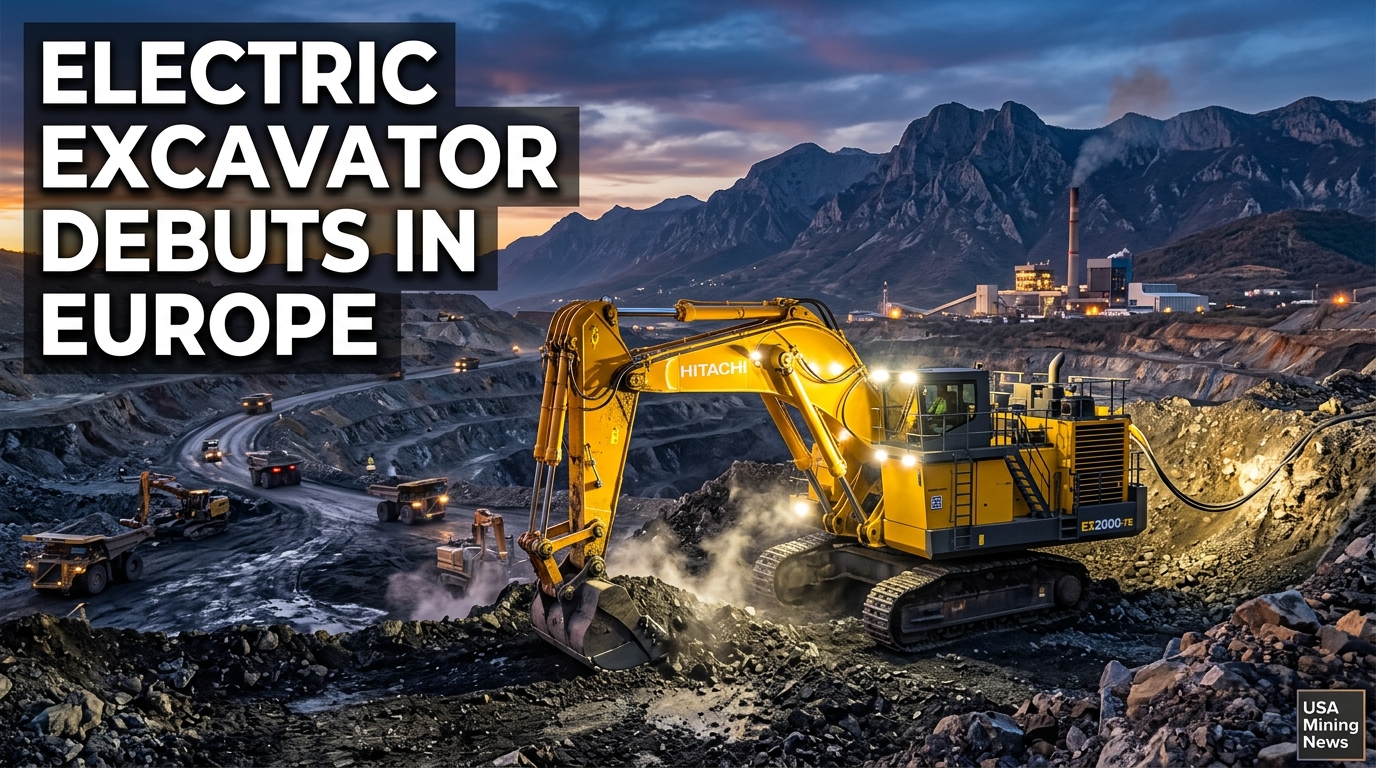
Pljevlja, Montenegro – April 17, 2026 – In a significant stride towards sustainable and efficient mining operations, Hitachi Construction Machinery (Europe) (HCME) has announced the delivery of its cutting-edge EX2600-7E ultra-large electric excavator to Rudnik uglja Pljevlja, a prominent mining operator situated in northern Montenegro. This milestone represents the inaugural deployment of Hitachi's electric excavator model across the European continent, underscoring a growing industry trend towards electrification in heavy machinery.
A Strategic Shift Towards Electrification
The delivery of the 250-tonne EX2600-7E unit, facilitated by West Balkans Machinery (WBM), the authorized Hitachi dealer in the region, is more than just an equipment acquisition; it signifies a strategic pivot for Rudnik uglja Pljevlja. Historically, the Pljevlja mine has relied predominantly on diesel-powered hydraulic excavators and traditional dragline equipment for its coal extraction activities. The integration of the EX2600-7E into its fleet is a direct outcome of a broader modernization program aimed at enhancing operational efficiency and reducing the environmental footprint of its mining activities.
Rudnik uglja Pljevlja’s decision to invest in an electric-drive excavator was underpinned by several compelling operational and economic rationales. Key benefits cited include the promise of reduced long-term operating costs, simpler maintenance requirements, and the advantage of constant torque provided by its robust 860kW electric motor. These factors are critical in a sector continually striving to optimize production while managing expenditures in an increasingly volatile commodity market.
Technical Prowess and Operational Integration
The EX2600-7E represents the latest in Hitachi’s line of ultra-large excavators, renowned for their reliability and performance in demanding mining environments. The assembly of this advanced unit at the mine site was a collaborative effort, involving skilled Hitachi technicians specifically dispatched from Japan and representatives from WBM, ensuring meticulous setup and commissioning. WBM’s role extends beyond supply; the dealer is also committed to providing comprehensive ongoing parts and maintenance support throughout the generous two-year or 8,000-operating-hour warranty period, assuring Rudnik uglja Pljevlja of uninterrupted operational continuity.
This new electric excavator joins an existing fleet of Hitachi machines at the Pljevlja mine, demonstrating Rudnik uglja Pljevlja's established relationship with the manufacturer and confidence in its products. The mine’s current Hitachi inventory includes an EX2600-6, delivered in 2019, as well as an EX1200-6 and an EX1200-7, which arrived in 2019 and 2022, respectively. The progressive adoption of newer generation equipment, now including a fully electric model, highlights a systematic approach to fleet renewal and technological upgrade.
Leveraging Local Resources for Sustainable Operations
A significant factor shaping Rudnik uglja Pljevlja's investment in electric machinery is the ready availability of locally generated electricity. The Pljevlja mine operates adjacent to the Pljevlja Thermal Power Plant, a crucial energy infrastructure that produces over 40% of Montenegro’s total electricity. This proximity allows the mine to power its new electric excavator directly from the grid, drastically reducing its dependence on imported diesel fuel. The strategic advantage of utilizing domestic power not only contributes to national energy independence but also insulates the operation against the fluctuating costs and supply chain vulnerabilities associated with fossil fuels.
The Pljevlja mine plays a critical role in Montenegro’s energy landscape. Operational agreements mandate a minimum annual production of 1.65 million tonnes (mt) of dark lignite, although actual output typically fluctuates between 1.5mt and 2.2mt per year. A substantial portion of this coal, ranging from 85% to 95%, is dedicated to fueling the adjacent power plant. Beyond national energy provision, the mine also fulfills obligations to local households and businesses, and increasingly, services export contracts, including significant supply agreements with Serbia’s state-owned utility, Elektroprivreda Srbije.
Broader Industry Implications and Hitachi’s Vision
The deployment of the EX2600-7E in Montenegro is highly indicative of wider trends within the global mining industry. As mining companies face increasing pressure to decarburize their operations and enhance environmental, social, and governance (ESG) performance, electric-drive equipment offers a compelling solution. The benefits extend beyond reduced emissions, encompassing lower noise pollution, decreased vibration, and reduced thermal output, all of which contribute to improved working conditions and community relations. Furthermore, the inherent design simplicity of electric motors, with fewer moving parts than internal combustion engines, often translates to longer service intervals and increased uptime – a critical metric for production-driven mining operations.
Hubertus Muenster, HCME Sales VP, articulated the company’s pride in this achievement: “We are proud to supply our reliable orange ultra-large excavators, including the country’s first EX-7 electric machine, to play an important part in Montenegro’s energy sector. We appreciate the trust that Rudnik uglja Pljevlja has placed in our electric products and the excellent support of our local dealer.” This statement highlights Hitachi’s commitment not only to product innovation but also to fostering strong partnerships with its customers and regional support networks.
Hitachi's strategic vision for advancing mining technology extends beyond electric drive systems. In October 2025, a significant charter agreement was signed between Hitachi Construction Machinery and Rio Tinto subsidiary Technological Resources. This collaboration is focused on the development of remote operation technologies for ultra-large hydraulic excavators, signaling Hitachi’s intent to lead in the broader automation and digitalization of mining operations. Such advancements are crucial for improving safety, optimizing productivity, and enabling autonomous operations, which are increasingly becoming industry standards in major mining regions globally.
The Road Ahead for Rudnik uglja Pljevlja and European Mining
For Rudnik uglja Pljevlja, the EX2600-7E symbolizes a critical investment in its future viability and operational resilience. By embracing advanced electric machinery and leveraging local energy resources, the mine positions itself as a forward-thinking entity in the European coal sector. This move could also serve as a blueprint for other European mines contemplating similar transitions, especially those with access to dependable and affordable grid power.
As the global mining industry continues its trajectory towards greater sustainability and technological integration, the successful operation of the EX2600-7E at the Pljevlja mine will be closely watched. It represents a tangible step in the energy transition journey for a region that still relies significantly on coal for its energy security, demonstrating that modernization and efficiency improvements are achievable even within traditional heavy industries. The precedent set by Rudnik uglja Pljevlja, supported by Hitachi’s technological leadership and WBM’s local expertise, could very well pave the way for more widespread adoption of electric mining equipment across Europe, reshaping the continent’s approach to resource extraction for decades to come.