IEA Highlights Critical Mineral Supply Risks, France Mobilizes Strategic Response
The global mining industry is grappling with intensifying pressure on supply chains for critical minerals, a challenge acutely highlighted by a recent warning from the International Energy Agency (IEA). According to the 2026 edition of the IEA’s Global Critical Minerals Outlook, significant vulnerabilities are emerging that could undermine the ambitious industrial and energy transition plans of nations worldwide, including France. This comprehensive report, providing data and analysis on supply, demand, investment, and market trends for minerals vital to modern manufacturing and green technologies, underscores a complex interplay of declining investment, increasing market concentration, and geopolitical maneuvers.
Reported by RFI on July 20, 2026, the IEA's assessment reveals that critical mineral prices, encompassing essential commodities such as cobalt, copper, graphite, lithium, nickel, and rare earth elements, experienced a rebound in 2025 and early 2026. This price recovery followed earlier declines and was attributed to tightening supply conditions. However, this positive price movement masks deeper structural issues.
IEA's Severe Outlook for Critical Minerals
The IEA’s findings paint a concerning picture for the long-term stability of critical mineral supply. A pivotal revelation is a 9% fall in investment across the sector in 2025, bringing an end to several years of sustained growth. This decline in capital allocation is particularly troubling given the escalating global demand for these materials, driven by the rapid expansion of electric vehicles, renewable energy infrastructure, and advanced electronics. Reduced investment today invariably translates to constrained supply in the future, exacerbating potential deficits.
Further contributing to market instability, the report notes a surge in price volatility,
fueled in part by new export restrictions imposed by major suppliers. A salient example is the implementation of restrictions on rare earth exports in April 2025. These measures had immediate tangible effects, leading some manufacturers globally to reduce or even halt production due to a lack of access to these indispensable materials. The IEA's analysis starkly illustrates the potential economic fallout, estimating that up to $6.5 trillion in annual downstream production outside of China could be affected if such restrictive measures are expanded in scope or intensity. This figure represents an immense portion of global manufacturing output, highlighting the systemic risk inherent in concentrated and geopolitically sensitive supply chains.
Despite these significant headwinds, the IEA did observe a silver lining in the form of public financing commitments for critical minerals projects. These commitments more than quadrupled between 2023 and 2025, signaling a growing recognition by governments of the strategic importance of securing these resources. This surge in public funding, often taking the form of grants, loans, or guarantees, aims to de-risk projects and incentivize private investment in a sector notorious for its high capital requirements and extended development timelines.
Concentration and Geopolitics: The Supply Chain Challenge
A central theme of the IEA's outlook is the alarming concentration of critical mineral supply chains, particularly in refining operations. Over the past two years, Indonesia and China together accounted for more than three-quarters of the growth in refined mineral supply. This concentration is not merely an economic reality but a significant geopolitical vulnerability. China, in particular, has long held a dominant position in the refining and processing of many critical minerals, including rare earths, which are essential for high-tech applications, defense systems, and green technologies. Indonesia has meanwhile rapidly scaled up its nickel processing capacity, primarily for the electric vehicle battery market, further solidifying its role as a key player.
This market concentration grants considerable leverage to a select few countries, enabling them to influence global prices and implement export controls that can ripple through global manufacturing. The situation has prompted a strategic response from other nations. Countries such as the United States and Malaysia, for instance, have begun actively to challenge China’s long-standing position in rare earth refining, investing in domestic capacity and fostering international partnerships. These efforts are part of a broader global push to diversify supply sources and reduce dependence on any single nation for mission-critical materials. For mining professionals and investors, understanding these complex geopolitical dynamics is crucial, as they heavily influence commodity prices, trade policies, and investment opportunities.
France's Proactive Response: The France 2030 Strategy
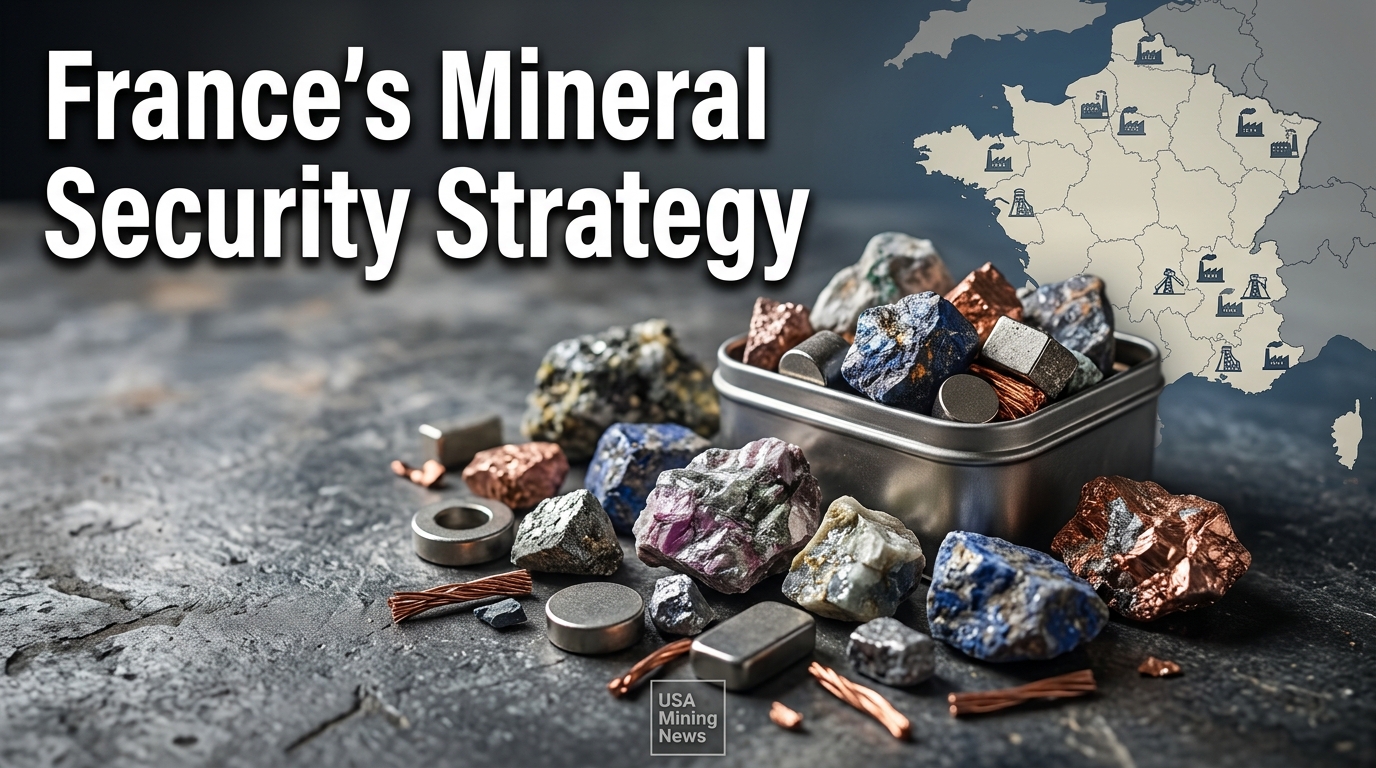
France, a European industrial powerhouse deeply committed to its energy transition goals, has responded decisively to these global pressures. In 2023, as an integral part of its broader France 2030 investment plan, the nation launched a comprehensive critical minerals strategy backed by 500 million euros, equivalent to approximately $571.76 million. This substantial investment underscores the French government's recognition of critical minerals as a matter of national strategic importance.
The core objective of this ambitious initiative is to significantly reduce France's dependence on external sources for 26 specific key raw materials deemed essential for its industrial base and future economic resilience. This strategy is multi-faceted, encompassing efforts to bolster domestic extraction, expand processing capacity within France, and establish robust recycling infrastructure. It represents a coordinated effort to build a resilient, self-sufficient, and sustainably managed critical minerals value chain from the ground up, reducing exposure to geopolitical risks and supply disruptions.
Domestic Extraction and Processing Initiatives
France’s strategy is already translating into concrete projects across the country. In the realm of domestic extraction, a key focus is the exploitation of lithium-rich geothermal brines in Alsace. This innovative approach seeks to extract lithium from underground hot water reservoirs, offering a potentially more environmentally friendly and domestically secure source compared to traditional hard rock or brine mining operations in other parts of the world. Two prominent companies are leading these pioneering efforts:
- Lithium de France: Engaged in exploring and developing these geothermal lithium resources, aiming to establish commercial-scale production.
- Imerys: A global leader in mineral-based specialty solutions, also deeply involved in developing new lithium production facilities, leveraging its extensive experience in mineral processing.
Beyond extraction, expanding in-country processing capacity is another critical pillar of France's strategy. Refining and processing are often the most complex and energy-intensive stages of the value chain, and historically, these have been the most concentrated outside of Europe and North America. France is making strategic investments here:
- Carester: This company is developing a rare earth separation plant in Normandy. Rare earth separation is a highly technical process, and establishing domestic capabilities is crucial for securing the supply of individual rare earth elements, each with specific applications in high-performance magnets, catalysts, and electronics.
- Eramet: The Paris-based mining and metallurgy group is investing in manganese refining operations in Dunkirk. Manganese is a vital component in certain electric vehicle battery chemistries and steel alloys, making its secure supply of strategic importance to French industry.
The 'Urban Mine': A Circular Economy Approach
Recognizing that primary extraction alone cannot guarantee long-term supply security, France is also making significant strides in promoting a circular economy for critical minerals through recycling. This approach, often dubbed the "urban mine," aims to recover valuable materials from end-of-life products, thereby reducing the need for virgin mineral extraction and mitigating environmental impacts. This is particularly crucial for costly and environmentally sensitive minerals found in modern electronics and batteries.
French companies at the forefront of this initiative include:
- Veolia: A global leader in ecological transformation, investing in advanced recycling technologies.
- SUEZ: Another major player in environmental services, focused on developing infrastructure for material recovery.
Through the efforts of these and other companies, France is strategically establishing capacity for recovering critical minerals such as lithium, cobalt, and nickel from used batteries. As the electric vehicle market continues its exponential growth, the volume of spent batteries will also rise, making this "urban mine" a progressively important source of raw materials. This closed-loop approach enhances resource efficiency, reduces waste, and contributes significantly to France's long-term critical mineral independence.
Broader Industry Implications and Future Outlook
The IEA's stark warning and France's proactive, multi-pronged strategy offer invaluable insights for the broader mining industry and global investors. France's experience serves as a microcosm of the challenges and opportunities faced by many industrialized nations. The dichotomy between declining private investment and quadrupling public financing between 2023 and 2025 highlights a critical market failure—the inability of purely private capital to fully account for the strategic and national security value of critical minerals. Governments are stepping in to bridge this gap, recognizing that supply chain resilience is a public good.
For mining companies, this trend signals growing opportunities in regions demonstrating strong governmental support and a clear strategic vision for critical minerals. However, it also means navigating increasingly complex regulatory landscapes and demonstrating superior environmental and social governance (ESG) performance to secure public and social licenses to operate. The long lead times inherent in mine development, coupled with growing environmental scrutiny, mean that even with significant investment, bringing new supplies online remains a formidable challenge.
Looking ahead, the success of strategies like France's will be critical in mitigating future price volatility and supply shocks. Diversification of supply, both geographically and through the adoption of recycling, is no longer a luxury but an existential necessity for global industries. The emphasis on domestic extraction and processing, while costly in the short term, promises greater long-term stability and resilience, fundamental for achieving ambitious energy transition targets. The intricate balance between market forces, geopolitical realities, and environmental imperatives will continue to shape the critical minerals landscape for decades to come, demanding strategic foresight and collaborative action from all stakeholders in the mining sector.