Exploring New Frontiers: Jaguar Uranium Gains Key Environmental Approval for La Rosada in Argentina
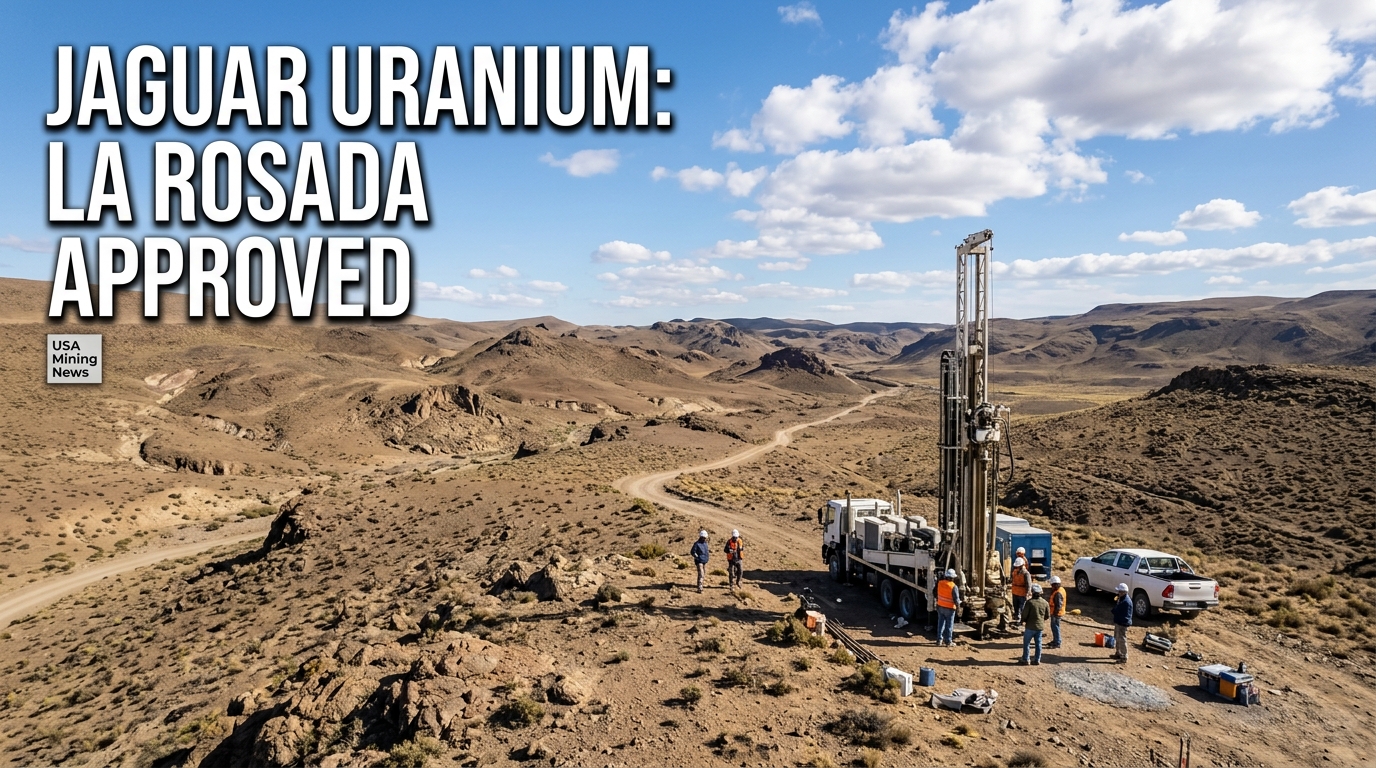
BUENOS AIRES, Argentina – September 30, 2026 – In a significant development poised to advance critical mineral exploration in South America, Jaguar Uranium has announced the receipt of environmental approval for its La Rosada prospect, a pivotal component of the company’s flagship Laguna Salada uranium and vanadium project in Argentina. The authorization, granted by the Ministry of Environment of the Province of Chubut, marks a critical milestone for Jaguar Uranium, allowing comprehensive exploration activities across a substantial 59,895.3 hectares.
This approval is not merely a procedural step; it is a strategic enabler for Jaguar Uranium, paving the way for detailed fieldwork in a region increasingly recognized for its mineral potential. The La Rosada prospect represents a substantial segment of the larger Laguna Salada project, which encompasses approximately 230,000 hectares. The newly authorized area alone constitutes roughly a quarter of the entire project footprint and is, to date, the single largest component within Laguna Salada to receive such an environmental exploration permit. This scale underscores the company's commitment to district-scale exploration, a strategy often employed in the search for world-class deposits.
A Major Step for Laguna Salada
The Laguna Salada project is Jaguar Uranium’s primary focus for uranium and vanadium exploration, strategically located within a mineral-rich district in Argentina. The environmental approval, known as an Environmental Impact Assessment (EIA) permit, is fundamental for any resource company to proceed with prospecting and exploration work. Its issuance by the Ministry of Environment of the Province of Chubut signals regulatory confidence in Jaguar Uranium’s plans and its capacity to conduct operations responsibly within the established environmental guidelines.
The importance of this permit cannot be overstated. In the mining industry, obtaining environmental approvals is often one of the most challenging and time-consuming phases of project development. It requires extensive studies, stakeholder consultations, and a robust demonstration of environmental stewardship. For Jaguar Uranium, this approval de-risks a substantial portion of its Laguna Salada project and provides clarity for its operational timeline and capital deployment.
Steven Gold, CEO of Jaguar Uranium, underscored the significance of the development, stating, “Approval of the EIA marks an important milestone for Jaguar Uranium. Given the scale of the Laguna Salada project, this approval advances our exploration strategy and positions the company to move efficiently into the next phase of fieldwork.” This statement highlights the strategic advantage gained, allowing the company to transition from the permitting stage to active exploration, a critical step toward potential resource delineation.
This recent authorization for La Rosada follows an earlier similar EIA approval granted in March 2026 for the Guanaco prospect, which lies approximately 45km south-west of La Rosada. This sequential permitting demonstrates a methodical approach by Jaguar Uranium to systematically unlock the exploration potential across its extensive Laguna Salada land package, building on regulatory successes as it progresses.
Strategic Location and Advanced Exploration Plans
The La Rosada prospect's location is strategically important within the Laguna Salada project. Its proximity to Guanaco, another key prospect within the company's portfolio that has already received similar environmental clearance, suggests a contiguous or related geological setting, potentially enhancing the overall prospectivity of the district. The approval covers exploration activities across six distinct properties within the 59,895.3 hectares, providing Jaguar Uranium with a broad canvas for its initial fieldwork.
Jaguar Uranium has outlined a comprehensive and technically sound exploration program for the upcoming season, which is scheduled to commence following the end of the region's winter. The planned activities are designed to systematically evaluate the prospectivity of La Rosada and build upon initial geological understandings. Key elements of this program include:
- Systematic Geochemical Sampling: This involves the methodical collection and analysis of soil, rock, and potentially water samples across a grid pattern. Geochemical anomalies can indicate the presence of buried mineral deposits, guiding more focused follow-up work.
- Detailed Geological Mapping: Geologists will conduct extensive field mapping to accurately delineate rock types, structural features like faults and folds, and alteration zones. This is crucial for understanding the geological controls on mineralization.
- Radiometric Grid Surveys: Given the primary focus on uranium, radiometric surveys are essential. These surveys measure natural gamma radiation emitted from radioactive elements in the ground. By conducting these on a systematic grid, Jaguar can identify areas of elevated radioactivity, which are direct indicators of uranium mineralization.
- Electrical Resistivity Tomography (ERT): This advanced geophysical technique involves injecting electrical currents into the ground and measuring the resistivity of subsurface materials. ERT is particularly effective in identifying variations in lithology, groundwater presence, and structural features. Crucially for La Rosada, ERT will be used to help identify and evaluate deep fluvial paleochannels. Uranium and vanadium deposits often occur in such ancient river systems, where reducing conditions can precipitate these minerals from groundwater. Understanding these paleochannels is key to targeting potential roll-front or tabular uranium deposits.
These combined methodologies represent a robust, multi-disciplinary approach aimed at effectively de-risking exploration targets and prioritizing areas for potential future drilling, a critical phase in proving up mineral resources.
Jaguar Uranium's Broader Argentine Footprint
Jaguar Uranium's strategic presence in Argentina extends beyond the Laguna Salada project. The company is also actively advancing the historic Huemul uranium mine situated in Mendoza Province. This dual focus – exploring greenfield, district-scale potential at Laguna Salada while also advancing a brownfield, historic mine site at Huemul – demonstrates a diversified approach to resource development in Argentina. Huemul represents a different stage of development and potential for leveraging past infrastructure and geological understanding, complementing the grassroots exploration efforts at La Rosada.
Argentina, with its vast and underexplored territories, holds significant potential for critical minerals. The nation's geological endowment, coupled with a growing global demand for energy transition metals, positions companies like Jaguar Uranium at the forefront of future supply chains. The commitment to a district-scale approach, particularly for commodities like uranium and vanadium, is indicative of a strategy aimed at discovering large, long-life assets capable of making a meaningful contribution to global supply.
The Importance of Environmental Approval in Mining
For industry professionals and investors, the granting of an EIA permit is a significant marker of project viability and progress. An EIA is a comprehensive regulatory process that assesses the potential environmental impacts of a proposed project and outlines measures to mitigate or manage these impacts. It typically involves detailed studies on geology, hydrology, biodiversity, air quality, social impacts, and cultural heritage, followed by public consultations and regulatory reviews.
In Argentina, environmental permitting often involves both federal and provincial authorities, with provinces having significant autonomy over resource management within their borders. The approval from the Ministry of Environment of Chubut Province is therefore a direct endorsement from the local regulatory body with jurisdiction over the Laguna Salada project area. This not only signifies compliance with local laws but also provides a crucial 'social license to operate' – an often intangible but essential factor for long-term project success.
An approved EIA reduces project risk, makes a project more attractive to investors, and demonstrates a company's adherence to responsible mining practices. It ensures that exploration activities, while inherently impactful, are conducted with a minimal footprint and with plans in place for environmental protection and eventual rehabilitation.
Uranium and Vanadium: Market Context and Future Demand
The commodities Jaguar Uranium is targeting – uranium and vanadium – are both experiencing renewed interest due to evolving global energy and industrial demands.
- Uranium: As a primary fuel for nuclear power plants, uranium is increasingly seen as a vital component in the global energy transition. Nuclear energy provides reliable, carbon-free base-load power, and its role is expanding amidst concerns over climate change and energy security. The development of Small Modular Reactors (SMRs) is also poised to further drive demand for uranium. Geopolitical tensions, particularly affecting major uranium producers, have further highlighted the need for diversified and secure supply sources, making new discoveries in stable jurisdictions like Argentina highly strategic.
- Vanadium: While traditionally used as an alloying agent to strengthen steel (e.g., in high-strength low-alloy steel for automotive and aerospace industries), vanadium is gaining significant traction for its role in grid-scale energy storage. Vanadium Redox Flow Batteries (VRFBs) offer advantages in terms of longevity, scalability, and safety for large-scale renewable energy integration and grid stabilization. This growing demand from the burgeoning battery sector, alongside sustained demand from traditional industrial applications, positions vanadium as a critical metal for the future economy.
Jaguar Uranium's focus on both these commodities provides a dual-pronged opportunity to capitalize on these robust market trends, enhancing the overall value proposition of the Laguna Salada project.
Future Outlook and Industry Implications
With the environmental approval in hand, Jaguar Uranium is now poised to execute its systematic exploration program at La Rosada. The immediate next steps will involve mobilizing field teams and equipment to the site following the end of the local winter season. The data gathered from the geochemical sampling, geological mapping, radiometric surveys, and ERT will be crucial in defining specific drill targets. Successful identification of significant mineralization could lead to subsequent drilling campaigns, resource estimation, and ultimately, a clearer understanding of the economic potential of La Rosada and the broader Laguna Salada project.
For Argentina, a successful exploration program could bolster its profile as an emerging supplier of critical minerals. The development of new uranium and vanadium resources could attract further foreign investment, create local employment opportunities, and contribute to regional economic development in Chubut Province. As global supply chains for critical minerals face increasing scrutiny and demand surges, new, responsibly developed sources in geopolitically stable regions become ever more important.
Jaguar Uranium’s latest approval for La Rosada is a tangible step forward in the complex and capital-intensive journey of mineral exploration. It underscores the company's progress and potential to contribute to the global supply of essential metals needed for clean energy and advanced industrial applications, marking an exciting period for the company and for Argentina’s mining sector.