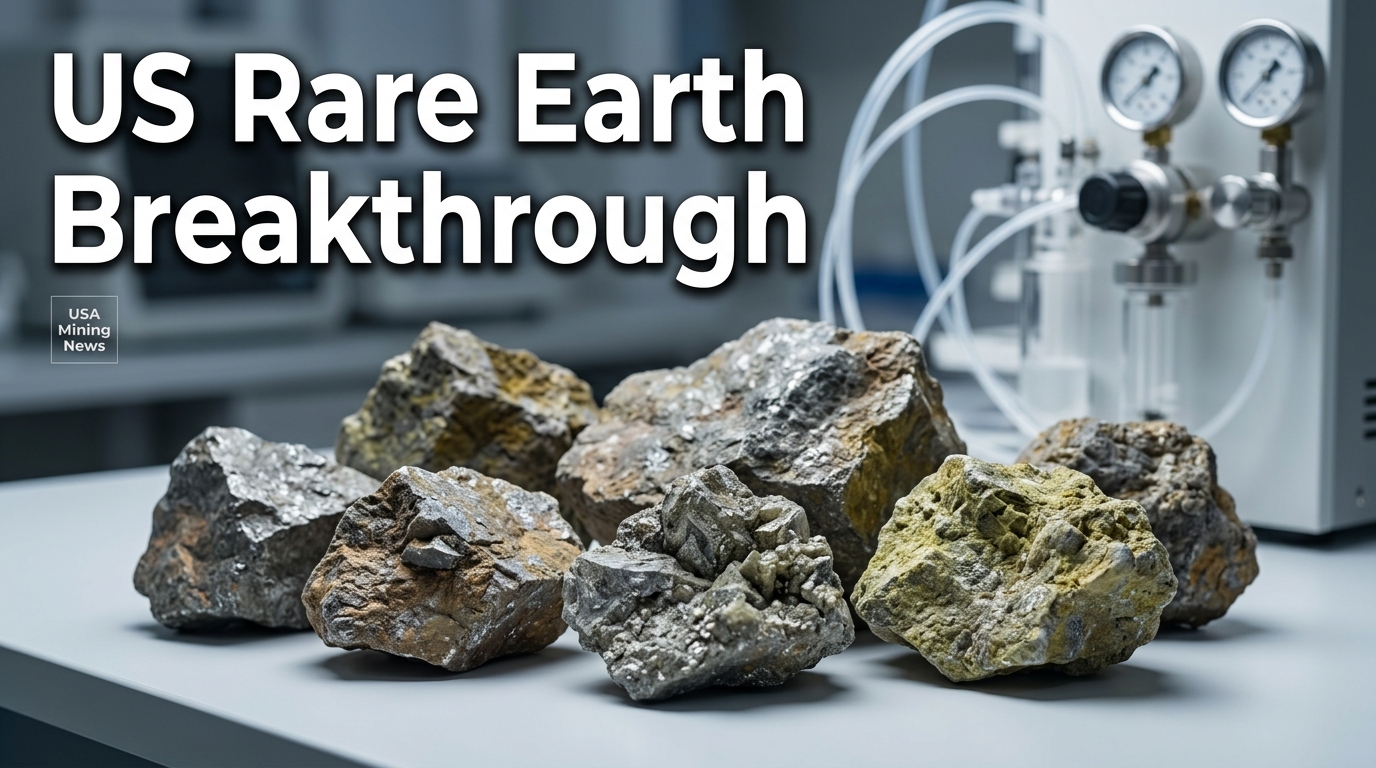
In a significant development for the domestic critical minerals sector, California-based Maglut Heavy Industries announced the public launch of its advanced chromatography-based platform, the ARC-1 rare earth separation system, tailored for the processing and refining of rare earth elements (REEs) within the United States. The unveiling, which took place at a closed event at the company’s headquarters in Long Beach, California, on August 27, 2026, marks a pivotal moment in the ongoing efforts to bolster America’s sovereign capabilities in critical mineral supply chains, a strategic imperative underscored by both national security concerns and economic competitiveness.
Reimagining Rare Earth Processing: The ARC-1 Platform
Maglut’s ARC-1 system represents a departure from the conventional, and often environmentally challenging, methods of rare earth separation. The company’s proprietary technology is built upon a water-based process, drawing inspiration from sophisticated biotechnology techniques commonly employed in the purification of biologic medicines. This innovative approach is positioned as a direct alternative to the widely used solvent extraction process, a method notorious for its labor and energy intensity, large environmental footprint, and reliance on hazardous chemicals.
According to Maglut, its chromatography platform is engineered not only to achieve competitive operating costs but also to secure crucial social acceptance—a factor increasingly vital for new industrial projects globally. The company has rigorously tested its ARC-1 process at a pilot scale, demonstrating its efficacy in separating complex rare earth feedstock into individual oxides with impressive purities of 99.9% and above. This level of purity is essential for high-tech applications, where even trace impurities can compromise performance.
The fundamental shift from solvent extraction to a water-based chromatography system could yield significant advantages. Traditional solvent extraction, or liquid-liquid extraction, typically involves a multi-stage counter-current process where rare earth-bearing solutions are repeatedly mixed with organic solvents. This process often requires substantial quantities of organic reagents, acids, and bases, resulting in large volumes of wastewater and a complex chemical waste stream. It demands significant capital expenditure for large facilities and substantial operational expenditure due to reagent consumption and energy use for heating and pumping. In contrast, chromatography, by utilizing differences in adsorption affinities on a stationary phase, can often achieve high separation efficiencies with a smaller physical footprint and reduced consumption of harsh chemicals, aligning with modern industrial demands for sustainability and efficiency.
Strategic Imperative: Rebuilding US Sovereign Capability
The significance of Maglut’s announcement extends far beyond technological innovation; it addresses a gaping vulnerability in the US industrial base. Rare earth elements are not merely niche materials; they are indispensable inputs for a vast array of modern technologies and industries. Their applications span critical sectors, including:
- Semiconductors: Essential for polishing wafers and in various electronic components.
- Energy Infrastructure: Key components in wind turbines (neodymium and praseodymium for magnets), electric vehicle motors, and energy-efficient lighting.
- Defense Equipment: Crucial for guidance systems, lasers, radar, stealth technology, and night-vision devices, making them vital for national security.
- Modern Technologies: Found in consumer electronics, medical imaging, catalysts, and advanced ceramics.
Despite this pervasive importance, domestic capacity for the separation and processing of these critical materials in the United States remains severely limited. For decades, the US, like much of the Western world, allowed its rare earth processing capabilities to decline, largely due to cheaper foreign processing, particularly from China, which came to dominate the global supply chain.
Curtis Wu, co-founder and CEO of Maglut, articulated this concern pointedly: “Rare earth processing is one of the clearest examples of a sovereign capability America let atrophy. The countries that control access to critical minerals will shape the next era of technology. Our mission is to rebuild domestic manufacturing of rare earth materials by reimagining the way they are processed.” Wu’s statement encapsulates the broader geopolitical and economic ramifications of critical mineral dependencies, highlighting the urgent need for robust, domestic supply chains to secure technological leadership and national security in an increasingly competitive global environment.
Navigating a Shifting Global Landscape: Market and Regulatory Drivers
Maglut’s launch is strategically timed to coincide with a period of intense focus on rare earth supply chains globally. Geopolitical tensions, particularly between the US and China, have brought the fragility of these supply lines to the forefront of policy discussions. The overwhelming reliance on a single nation for the refinement of these critical materials poses significant economic and strategic risks.
A major regulatory catalyst for the revitalized interest in domestic processing is a set of new US regulations slated to take effect in January 2027. These regulations will mandate that US defense contractors eliminate Chinese sources from their rare earth magnet supply chains. Given the integral role of rare earth magnets in advanced military hardware, this directive creates an immediate and pressing demand for secure, non-Chinese sources of separated rare earths and their downstream magnet production. Maglut’s ARC-1 system offers a potential pathway for defense contractors to meet these stringent new compliance requirements, providing a domestically processed material solution.
Beyond regulatory pressures, favorable market dynamics are also playing a role. Recent advances in chromatography technology have enhanced its industrial viability, making it a more attractive option for large-scale applications. Concurrently, rising rare earth prices—driven by increased demand from green energy technologies, electric vehicles, and defense applications—have created a more economically conducive environment for investment in alternative, higher-cost processing technologies that offer supply chain security and environmental benefits.
The Technical Edge: Chromatography vs. Solvent Extraction
To fully appreciate Maglut’s innovation, it is important to understand the technical and operational differences between chromatography and the incumbent solvent extraction method. Solvent extraction has been the industrial standard for rare earth separation for decades due to its scalability and established engineering. However, it is an inherently complex and resource-intensive process:
- Chemical Intensity: Requires large volumes of organic solvents (e.g., tributyl phosphate), kerosene diluents, and strong acids and bases (hydrochloric acid, nitric acid, caustic soda) to adjust pH and facilitate separation.
- Environmental Impact: Generates significant volumes of acidic and alkaline wastewater, requires solvent recovery and regeneration, and carries risks of solvent losses into the environment. Its large physical footprint is also a consideration for permitting and public acceptance.
- Operational Complexity: Involves numerous extraction and scrubbing stages, demanding precise control over flow rates, pH, and temperature. Labor-intensive to operate and maintain.
- Energy Consumption: Significant energy is consumed in pumping large volumes of liquids, mixing, and sometimes heating.
Maglut’s chromatography platform, in contrast, offers a potentially cleaner and more efficient alternative. Chromatography separates components in a mixture by passing them through a stationary phase (e.g., a resin column) where different components travel at different speeds due to varying interactions with the stationary phase. Key advantages include:
- Water-Based Process: Significantly reduces or eliminates the need for volatile organic solvents, leading to a much smaller environmental footprint and safer working conditions.
- High Purity: Often capable of achieving very high purity levels in a fewer number of stages compared to solvent extraction, as demonstrated by Maglut's 99.9% success.
- Reduced Waste: Potentially generates less hazardous waste and less complex effluent, improving its social acceptability and reducing disposal costs.
- Scalability: While historically seen as less scalable for bulk production than solvent extraction, recent advancements, as noted by Maglut, are making industrial-scale chromatography viable for rare earth applications.
The focus on a “water-based process inspired by biotechnology techniques” suggests a sophisticated approach that leverages advances in material science and process engineering. This could lead to a more benign process that is easier to permit, operate, and gains community support, addressing the social acceptance challenge that many traditional mining and processing operations face.
Future Outlook and Industry Impact
Maglut Heavy Industries’ unveiling of ARC-1 represents a compelling step toward diversifying and securing the rare earth supply chain for the US. The next critical phase for Maglut will involve scaling up its pilot-proven technology to commercial production. This will entail substantial capital investment for facility construction, securing reliable feedstock from domestic or allied sources (whether from primary mining or recycling operations), and navigating the complex regulatory landscape for commercial deployment.
Should Maglut successfully scale its operations, the impact on the broader mining and critical minerals industry could be profound. It could:
- Diversify Processing Options: Offer a viable, non-Chinese alternative for rare earth separation, reducing geopolitical risks.
- Boost Domestic Manufacturing: Create new high-tech manufacturing jobs and foster innovation within the US.
- Set New Environmental Standards: Potentially establish a new benchmark for environmentally responsible rare earth processing, influencing global industry practices.
- Enhance National Security: Directly support the defense industrial base by ensuring a secure supply of critical materials for military applications.
However, challenges remain. The rare earth market is complex, with price volatility and the sheer capital intensity of establishing new processing facilities. Maglut will need to demonstrate long-term economic viability and consistent performance at commercial scale. Competition from established, albeit less environmentally friendly, facilities abroad also presents a persistent challenge. Nevertheless, the confluence of strategic national interest, regulatory impetus, and technological advancement positions Maglut Heavy Industries as a significant new player poised to reshape America’s rare earth destiny. Their mission to rebuild domestic manufacturing by reimagining processing methods aligns squarely with the nation's broader objectives for critical mineral independence and technological resilience.