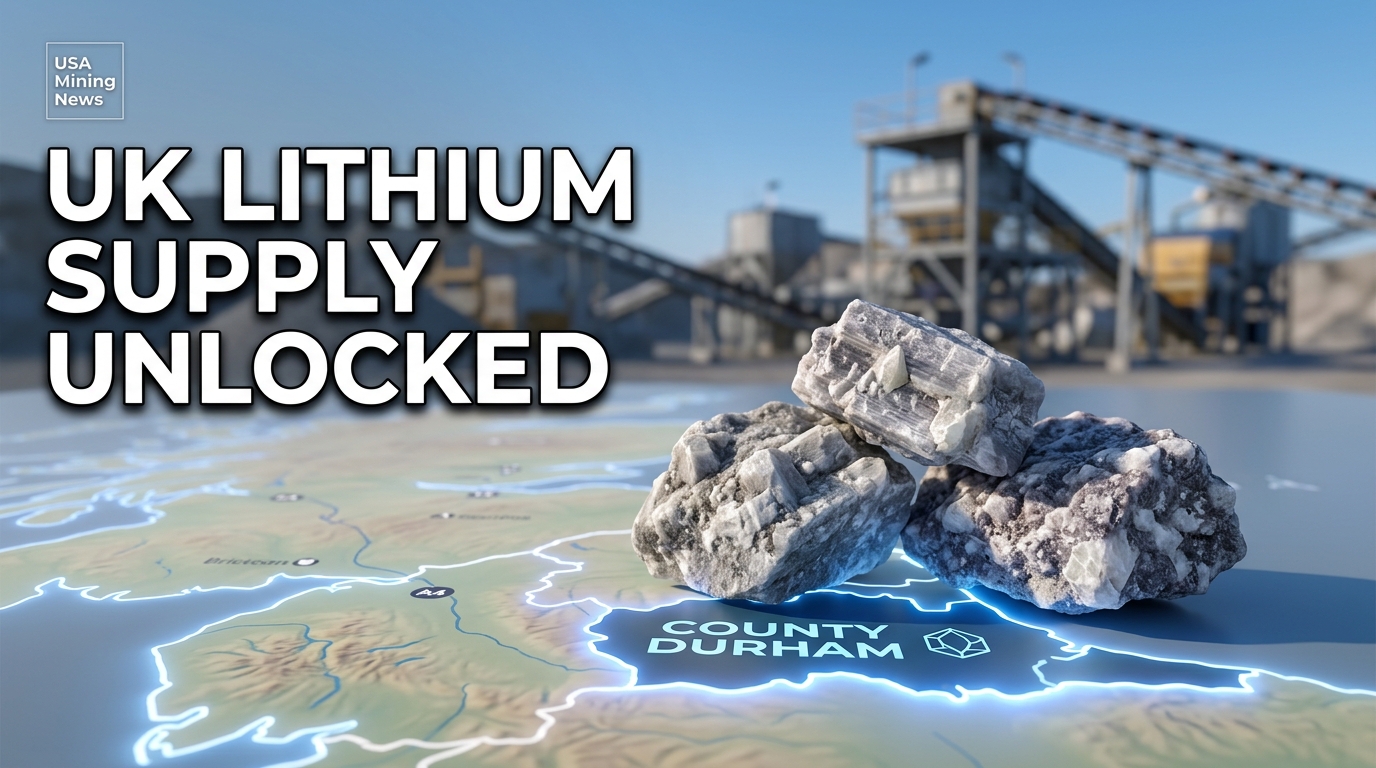
In a significant boost for the United Kingdom's burgeoning critical minerals industry, Northern Lithium has successfully secured £600,000 ($812,382) in governmental funding. Announced on April 17, 2026, this grant, obtained through the UK Government’s Scale-up Feasibility Studies competition, is earmarked to advance the company's ambitious 2026 development agenda. Complementing substantial private equity commitments totalling £5 million, this funding package positions Northern Lithium to make considerable strides toward establishing a domestic lithium supply chain, a strategic imperative for the UK's industrial future and energy transition.
Strategic Funding Boosts Northern Lithium's UK Ambitions
The £600,000 grant is specifically designated to support Northern Lithium’s UK Lithium front-end engineering design (FEED) feasibility study. This critical engineering phase is a prerequisite for establishing a commercial-scale lithium-from-brines production facility at Ludwell Farm in County Durham. The FEED study will develop a comprehensive engineering package and formulate a viable business case, both essential steps for attracting the significant subsequent investment required for manufacturing and commissioning the initial production unit.
This governmental support forms part of the UK Government’s broader DRIVE35 programme, which is administered collaboratively by the Department for Business and Trade, the Advanced Propulsion Centre UK, and Innovate UK. The DRIVE35 initiative underscores the UK's commitment to fostering innovation and scaling up crucial industrial capabilities that align with national strategic objectives, particularly in advanced manufacturing and sustainable technologies.
Adding to this governmental backing, Northern Lithium has recently fortified its financial position with substantial equity commitments from private investors. Earlier commitments totaled £2 million, primarily sourced from new investors, intended to fund the company’s extensive work agenda for the first half of 2026. Demonstrating strong investor confidence and an accelerated development trajectory, the company decided in January of this year to increase its funding by an additional £3 million, pushing the total equity raised to a robust £5 million, exclusive of the new government grant. This combined capital injection is pivotal for progressing the Ludwell Farm project from conceptual design to a detailed, investment-ready blueprint.
Charting a Path to Domestic Lithium Production
Northern Lithium’s strategic ambition is to commence commercial production from its Ludwell Farm facility by 2028. This initial operational phase is intended as a precursor to a more expansive development strategy across the 240km² Northern Pennine Orefield project. The company has set a formidable long-term production target: aiming to produce more than 20,000 tonnes per annum (tpa) of lithium carbonate equivalent (LCE) by 2035. Achieving this output would establish Northern Lithium as a significant domestic supplier of essential raw materials, directly addressing the UK’s current 100% import-dependency for lithium and bolstering its industrial needs, energy transition initiatives, and overarching net-zero objectives.
The selection of a lithium-from-brines method is noteworthy. Brine extraction, often involving direct lithium extraction (DLE) technologies, is increasingly being explored globally as a potentially more environmentally sustainable and resource-efficient method compared to traditional hard rock mining. It typically involves extracting lithium from geothermal brines or shallow subterranean reservoirs. For the UK, leveraging such a method in areas like the Northern Pennine Orefield leverages a unique geological asset that could yield a secure, local supply of critical minerals without relying on open-pit operations that are common in other lithium-producing regions.
Successful execution of the FEED study is paramount for validating both the technical feasibility and economic viability of the project. It involves detailed engineering work, cost estimations, and environmental impact assessments, all of which are crucial for de-risking the subsequent phases of manufacturing and commissioning. Upon completion, the FEED study will serve as a foundational document to secure the substantial financial investments necessary to bring the commercial plant online.
Aligning with UK Critical Minerals and Net Zero Strategies
Northern Lithium’s project is intrinsically aligned with several pivotal national strategies, underscoring its strategic importance beyond mere commercial development. It directly supports the UK Automotive Council’s 2024 Roadmap, which emphasizes strengthening supply chains and sourcing critical minerals domestically. In an era of increasing geopolitical and economic volatility, securing domestic supplies of key materials like lithium is paramount for industrial resilience.
Furthermore, the initiative is a critical component of the UK’s broader Critical Minerals Strategy and Net Zero Strategy. The transition to a green economy, particularly the widespread adoption of electric vehicles (EVs) and large-scale renewable energy storage, is heavily dependent on a reliable and sustainable supply of lithium. By developing a domestic source, the UK aims to mitigate risks associated with global supply chain disruptions and reduce its exposure to volatile international commodity markets.
Nick Pople, Northern Lithium’s Managing Director, articulated the project's strategic contribution: “Northern Lithium’s targeted lithium production by 2035 will provide a significant boost to the UK Government’s goal to secure at least 50% of UK lithium requirements from domestic sources by that date and help address the UK’s current 100% import-dependency.” Pople also expressed gratitude for the multi-faceted support received, noting that it enables Northern Lithium to “unlock the next scale-up step towards commercialisation, and anchor a sustainable UK lithium industry.” This statement highlights the transformational potential of the project not just for the company, but for the UK's industrial self-sufficiency.
Economic and Employment Impact
Beyond its strategic supply chain implications, the project is poised to deliver significant economic and social benefits, particularly in regional employment. Northern Lithium plans to create more than 100 direct jobs within its facilities, contributing to regional employment enhancement in County Durham. This direct job creation will provide skilled opportunities in an emerging high-tech sector, fostering local economic growth and technological expertise.
The impact extends far beyond the immediate site. The development of a domestic lithium supply chain is crucial for safeguarding the broader UK electric vehicle sector. By providing a reliable local source of lithium, Northern Lithium's operations contribute to supporting an estimated 270,000 jobs within the UK’s EV sector, jobs that are projected to be in place by 2035. This indirect safeguarding of jobs underscores the foundational role of critical mineral supply in supporting downstream manufacturing industries and the broader automotive value chain.
Broader Industry Context and Global Implications
The global mining industry is witnessing a profound shift driven by the accelerating demand for critical minerals essential for the energy transition. Lithium stands at the forefront of this shift, being a fundamental component of lithium-ion batteries that power electric vehicles, portable electronics, and grid-scale energy storage systems. Nations worldwide, including the United States and various European countries, are actively pursuing strategies to localize and diversify their critical mineral supply chains, moving away from historical reliance on a few dominant producing regions.
The UK, with this initiative, is aligning itself with this global trend. Countries are increasingly recognizing the economic and national security imperative of securing their own raw material supplies. Projects like Northern Lithium's, focused on domestic brine resources, represent a forward-thinking approach to resource development. While brine operations often face initial technical hurdles related to specific brine chemistries and processing methods (such as Direct Lithium Extraction - DLE), they hold the promise of lower carbon footprints and reduced water usage compared to some traditional mining methods, aligning with broader sustainability goals.
The success of Northern Lithium could serve as a blueprint for further development of the UK's untapped geothermal brine resources, potentially attracting more investment and fostering innovation in critical mineral extraction technologies. It also sends a clear signal to international partners and investors about the UK's serious commitment to building a resilient, sustainable, and technologically advanced industrial base.
Future Outlook and Challenges
The immediate next steps for Northern Lithium involve the rigorous completion of the FEED feasibility study. Its successful conclusion will be instrumental in demonstrating the project’s bankability and will pave the way for securing subsequent rounds of significant investment critical for the construction and commissioning phases. Mining projects, particularly those involving novel extraction technologies for critical minerals, are complex undertakings and face a range of potential challenges, including permitting complexities, scaling up production, managing market fluctuations, and continuously adapting to advancements in processing technology.
However, the robust government support via the DRIVE35 program and the substantial equity commitments demonstrate a strong foundation and collective will to overcome these hurdles. The strategic alignment with national objectives provides a compelling rationale for continued investment and regulatory facilitation. Northern Lithium is not merely developing a mine; it is positioned to become a cornerstone of the UK's battery supply chain, enabling the electric vehicle revolution and laying essential groundwork for a decarbonized future.
The company’s progress towards its 2028 commercial production goal and its 20,000 tpa LCE target by 2035 will be closely watched by industry stakeholders, investors, and policymakers alike, as it represents a tangible step towards securing the UK’s position in the global critical minerals landscape.