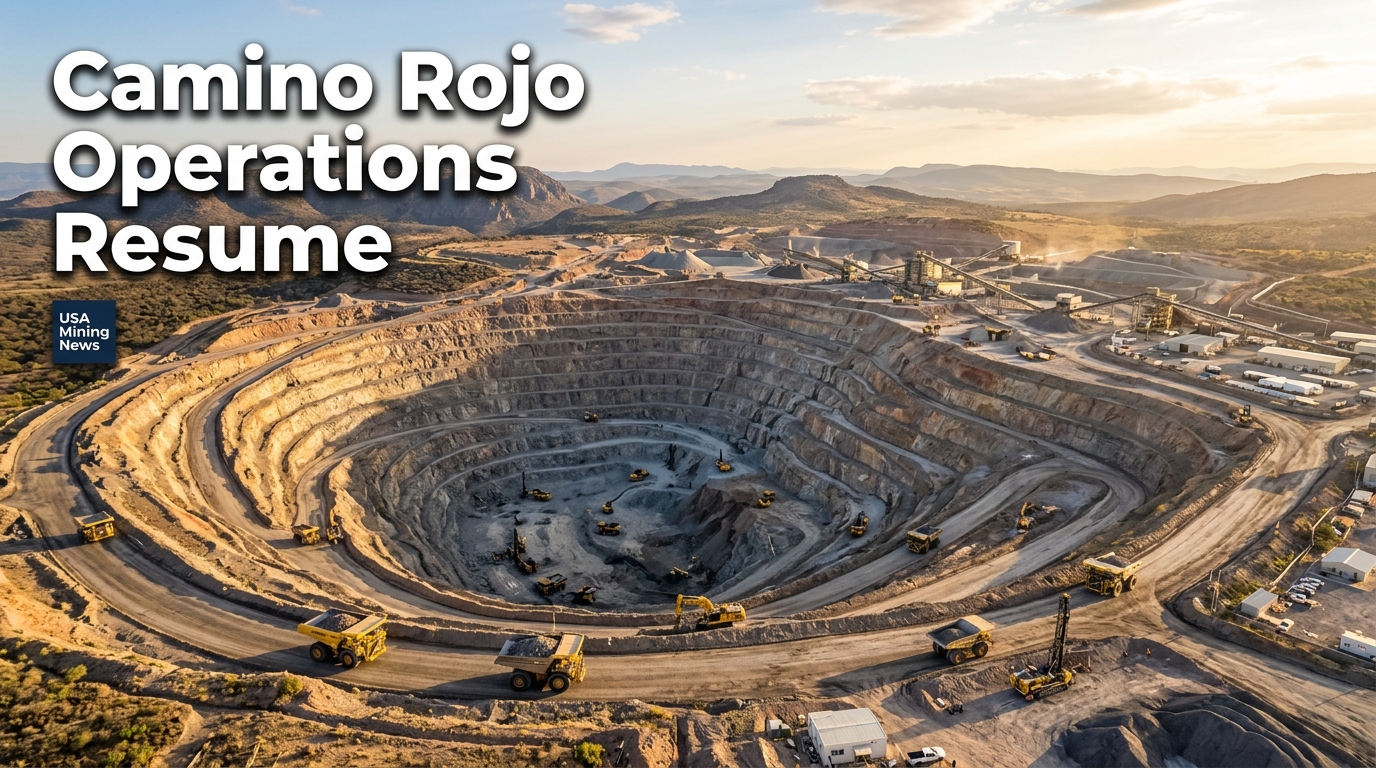
ZACATECAS, MEXICO – Orla Mining has announced the full resumption of operations at its wholly-owned Camino Rojo Mine in Zacatecas, Mexico, marking a rapid resolution to a recent labor dispute that had temporarily halted mining activities. The interruption, which commenced on June 1, 2026, involved a work stoppage and blockade initiated by certain union employees, bringing into focus the intricate dynamics of labor relations within Mexico’s vital mining sector. This swift return to normal operations is a critical development for Orla Mining, allowing the company to sustain its production targets and maintain investor confidence in its Mexican asset.
Operations Resume at Camino Rojo Amidst Labor Resolution
The temporary halt at the Camino Rojo Mine, an open-pit heap leach gold operation, was triggered by protests surrounding ongoing negotiations. The core issues at the heart of the dispute were a worker productivity bonus and the constitutionally mandated profit-sharing entitlement, known in Mexico as Participación de los Trabajadores en las Utilidades, or PTU. These benefits are significant components of compensation for Mexican workers, and their negotiation often forms a critical part of collective bargaining agreements across various industries, including mining.
Orla Mining, a prominent gold producer, had faced a challenging few days with the operational disruption. However, the company demonstrated a proactive approach in seeking a resolution. Representatives from Orla Mining swiftly engaged with union officials, with key support from the Mexican Department of Federal Labour Conciliation. This multi-party meeting, held on June 3, 2026, proved instrumental in de-escalating the situation and charting a path forward.
Throughout the interruption, Orla Mining confirmed that all required safety and environmental controls at the Camino Rojo site remained operational and were continuously monitored. This commitment underscores the company's adherence to responsible mining practices, even under challenging circumstances, ensuring the integrity of the site and its surrounding ecosystem.
Navigating Labor Relations: The Role of Mexican Federal Authorities
The intervention of the Mexican Department of Federal Labour Conciliation was pivotal in resolving the impasse at Camino Rojo. During the meeting on June 3, 2026, the Labour Authority formally declared the mine blockade to be illegal. This authoritative pronouncement provided a clear legal framework for resolution and served as a crucial directive to the union leadership involved.
Following the Labour Authority's declaration, the union leadership demonstrated a willingness to cooperate by agreeing to communicate this directive to its members. This step was essential in facilitating the orderly lifting of the blockade and ensuring a peaceful return to work. The successful mediation by federal labor authorities highlights the significant role that governmental bodies play in maintaining industrial peace and enforcing labor laws within Mexico's mining landscape. For international mining companies operating in the country, understanding and effectively engaging with these regulatory frameworks is paramount to operational stability.
While operations have resumed, the dialogue regarding the productivity bonus is slated to continue at a later date, once normal activities at the Camino Rojo site are fully re-established. This phased approach allows for immediate operational stability while committing to ongoing negotiations on workers' entitlements, signaling a constructive path for future labor relations. Orla Mining has reiterated its commitment to working collaboratively with its employees and union leadership to achieve a mutually beneficial agreement.
Camino Rojo: An Overview of Orla Mining's Key Asset
The Camino Rojo Mine is a cornerstone asset for Orla Mining, operating as a modern open-pit heap leach facility, a common and cost-effective method for extracting gold from lower-grade ore. The mine is 100% owned by Orla Mining, giving the company full control over its development and operational strategy.
The mine commenced commercial production in 2022 and has quickly ramped up to become a significant contributor to Orla's portfolio. In the fiscal year 2025, the operation produced a substantial 96,764 ounces of gold, demonstrating its capacity and efficiency. Crucially, even with the recent temporary disruption, Orla Mining has confidently reiterated its 2026 gold production guidance for Camino Rojo, projecting between 110,000 and 120,000 ounces, provided no further unforeseen disruptions occur. This reaffirmation by management signals confidence in the project's underlying operational robustness and the ability to mitigate short-term challenges.
From a geological and resource perspective, Camino Rojo boasts significant potential. The mine's current estimations include:
- Proven and Probable Gold Reserves: 900,000 ounces. These reserves represent the ounces that can be economically and legally extracted under current market conditions and mining methods.
- Measured and Indicated Resources: Five million ounces of gold. These resources represent a larger, less certain volume of gold that holds strong potential for future conversion to reserves through additional exploration and feasibility studies.
These impressive resource and reserve figures are contained within a substantial 138,636-hectare land package, offering considerable scope for future exploration and expansion, further underscoring Camino Rojo’s long-term strategic value to Orla Mining. The combination of established production, significant reserves, and extensive land holdings positions Camino Rojo as a key asset in the North American gold production landscape.
Understanding Profit-Sharing and Productivity Bonuses in Mexican Mining
The labor dispute at Camino Rojo centered on two common yet often complex aspects of worker compensation in Mexico: the Participación de los Trabajadores en las Utilidades (PTU), or profit-sharing entitlement, and productivity bonuses. Understanding these elements is crucial for any mining company operating within Mexico.
PTU is a constitutional right granted to all workers in Mexico under Article 123 of the Mexican Constitution and further regulated by the Federal Labor Law. Mexican companies are obligated to distribute 10% of their annual taxable profits among their employees. The distribution formula typically considers both the number of days worked and the salary earned by each worker during the year. This annual payout is a significant component of income for many Mexican workers and can become a point of contention if workers perceive a disconnect between company profitability and their share of profits, or if there are disputes over the calculation methodology. For mining companies, which can experience significant fluctuations in profitability due to commodity price cycles, managing expectations around PTU payments is a constant challenge.
Productivity bonuses, on the other hand, are typically negotiated as part of collective bargaining agreements and are tied to specific operational metrics, such as production targets, efficiency improvements, or safety achievements. These bonuses are designed to incentivize workers to perform above standard expectations, linking worker compensation directly to the company's operational success. While beneficial for fostering a high-performance culture, defining clear, measurable, and fair metrics for these bonuses requires careful negotiation and can also lead to disputes if targets are perceived as unrealistic or unachievable. The recent stoppage at Camino Rojo underscores the importance of transparent and equitable negotiation processes for both PTU and productivity bonuses to maintain a harmonious industrial environment.
Strategic Implications for Orla Mining and the Gold Market
The swift resolution of the labor dispute at Camino Rojo carries significant strategic implications, not only for Orla Mining but also for the broader gold mining sector operating in Mexico. For Orla Mining, the rapid return to full operations is a strong positive signal to investors and stakeholders. Prolonged disruptions can severely impact production guidance, elevate operating costs, and erode investor confidence, potentially leading to negative re-ratings by analysts. By reaffirming its 2026 production guidance of 110,000–120,000 ounces of gold, Orla Mining has demonstrated its resilience and ability to effectively manage unforeseen circumstances, reinforcing the stability of its operational outlook.
The gold market, known for its sensitivity to geopolitical and operational risks, tends to react positively to signs of stability from key producers. Orla Mining’s ability to quickly restore production at a significant asset like Camino Rojo helps to mitigate any concerns about supply interruptions and operational integrity. In a global environment where gold continues to serve as a strategic asset, stable operations from mid-tier producers like Orla Mining contribute to the overall health and predictability of the supply chain.
Furthermore, the resolution sets a positive precedent for other mining companies operating in Mexico. It highlights the effectiveness of engaging with federal labor authorities and fostering constructive dialogue with union leadership. Mexico is a major mining jurisdiction, and its labor relations environment is closely watched by international investors. A demonstrated capacity for conflict resolution through official channels can reassure potential investors about the stability and predictability of the operating environment in the country.
Looking Ahead: Sustained Dialogue and Production Stability
With operations at Camino Rojo fully restored, Orla Mining's immediate focus will undoubtedly be on achieving its reiterated 2026 production guidance. The commitment to continued dialogue regarding the productivity bonus, once normal operations are fully re-established, is a crucial element for ensuring long-term labor peace and stability.
Jason Simpson, President and CEO of Orla Mining, conveyed the company's appreciation for the collaborative efforts in resolving the situation: “We are pleased to welcome our employees back to work and thank the union and the Mexican Labour Authority for their partnership in resolving the matter. We look forward to continuing our dialogue with the employees and union partners to reach a mutually beneficial agreement on the productivity bonus.” Simpson's statement emphasizes Orla's commitment to fostering enduring, positive relationships with its workforce and union representatives.
The successful navigation of this labor dispute at Camino Rojo underscores management's capability to address operational challenges efficiently and collaboratively. For mining companies, operational continuity is paramount, and proactive engagement with labor groups and regulatory bodies is a key component of sustainable and profitable operations. As Orla Mining moves forward, maintaining open lines of communication and working towards equitable agreements will be essential for underpinning the long-term success of the Camino Rojo Mine and bolstering the company's standing as a responsible operator in Mexico. The episode serves as a reminder that robust labor relations are as critical to a mining project’s success as its geological endowments or technological capabilities.