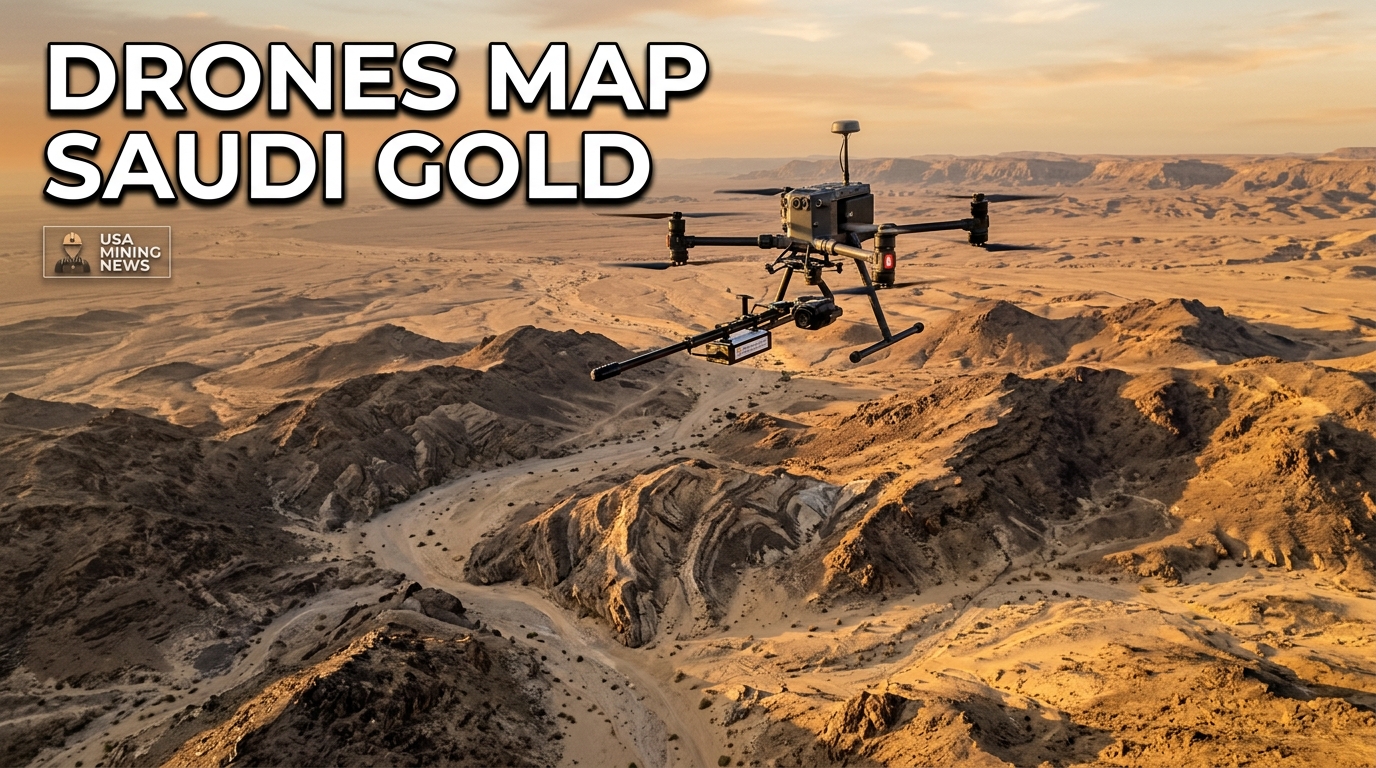
Peako Initiates Advanced UAV Magnetic Surveys Across Key Saudi Gold Projects
In a significant step forward for its exploration endeavors in the Kingdom of Saudi Arabia (KSA), Peako has announced the launch of high-resolution magnetic surveys utilizing unmanned aerial vehicles (UAVs) across five strategic target areas. This sophisticated geophysical program, commencing on August 24, 2026, is a crucial precursor to the company’s first drilling campaigns in Saudi Arabia, which are firmly slated to begin in October. The deployment of cutting-edge UAV technology underscores a growing trend in the mining industry towards precise, efficient, and data-rich exploration methods, particularly in geologically prospective but often logistically challenging regions like the Arabian Shield.
This initiative by Peako aligns with Saudi Arabia's ambitious Vision 2030, which seeks to diversify the nation's economy beyond hydrocarbons, with the mining sector playing a pivotal role. The KSA has actively promoted its mineral potential, attracting international mining companies through a revamped mining law and an investment-friendly environment. Peako's systematic approach to exploration, moving from regional reconnaissance to detailed geophysics and then to drilling, reflects a methodical strategy aimed at unlocking the significant gold potential identified across its license areas.
Precision Geophysics: Elevating Exploration in the Arabian Shield
The core of Peako’s current operational thrust lies in its high-resolution magnetic surveys, an essential tool in deciphering subsurface geology without direct physical access. These surveys are designed to provide an unparalleled level of detail across the targeted areas. The scope of work encompasses:
- An extensive area of 54 square kilometers.
- Approximately 1,400 line kilometers of survey flight.
- Mainly 30-meter line spacing, allowing for dense data collection.
- Flown at a remarkably low altitude of 33 meters, which significantly enhances data resolution and detail by minimizing signal attenuation and maximizing geological response.
Beyond magnetic data, the UAVs will also gather high-resolution imagery and detailed topographic information. This multi-layered data acquisition strategy is critical. Magnetic surveys excel at mapping variations in magnetic susceptibility, which often correlate with different rock types (lithologies) and structural features such as faults, folds, and intrusive bodies – all critical controls for gold mineralization. The accompanying imagery and topographic data will provide essential contextual information, enabling Peako’s geologists to refine their structural and lithological models with greater accuracy and precision. This comprehensive dataset will be instrumental in defining and prioritizing optimal drill targets, ensuring that the upcoming drilling program is as effective and resource-efficient as possible.
Strategic Target Areas and Historical Highlights
Peako’s UAV surveys are strategically focused on several key license areas that have demonstrated significant gold potential through previous exploration work. These include Sukhaybarat South, Wadi Jarir, and Jabal Jumaymah, each presenting unique geological characteristics and promising historical results.
At Sukhaybarat South, three distinct grids have been established to cover the Redhill SE, Matar, and Karak targets. The detailed magnetic data from these grids is expected to provide crucial insights:
- At Redhill SE, the survey aims to enhance the understanding of local structural features. This area has seen past reverse circulation (RC) drilling, which encountered compelling intersections such as 4 meters at 11.32 grams per tonne (g/t) gold and 5 meters at 5.6 g/t gold, indicating high-grade mineralization.
- The Matar grid, spanning 15 square kilometers, targets outcropping unidirectional solidification textures (USTs), which are often associated with gold-bearing intrusive systems. Previous sampling here has yielded impressive grades of up to 22.9 g/t gold.
- At Karak, the surveys will build upon previous rock chip samples that contained up to 9.1 g/t gold over a substantial strike length of 2 kilometers and a width of 1.5 kilometers, suggesting a potentially large mineralized system.
In the Wadi Jarir area, a 19-square-kilometer grid is anticipated to significantly improve the structural model for an extensive 8-kilometer by 2-kilometer corridor. Exploration at Wadi Jarir has previously identified compelling gold grades:
- Mapping work has revealed gold grades of up to 41.5 g/t within quartz carbonate veins, indicative of high-tenor mineralization.
- Historical drilling recorded intervals of up to 26 meters at 0.7 g/t gold from 13 meters, demonstrating the presence of broader mineralized zones at relatively shallow depths.
The Jabal Jumaymah grid, covering 3 square kilometers, is specifically designed to refine geological interpretations following earlier scout drilling that uncovered promising intervals, including 7 meters at 10.12 g/t gold. This high-grade intercept highlights the area's potential and the need for more detailed structural understanding to guide further drilling.
Beyond these immediate survey areas, Peako has also reported encouraging reconnaissance sampling results from additional sites, such as Bulgah East. Rock chip samples from Bulgah East have reported results of up to 5.05 g/t gold, with associated soil anomalies extending for more than 10 kilometers. This site’s prospectivity is further enhanced by its proximity to the known 3.4 million ounce Bulgah deposit, suggesting the potential for district-scale mineralization.
Bridging Geophysics to Drilling Success
The immediate strategic importance of these UAV magnetic surveys cannot be overstated. By delivering highly detailed structural and lithological information, Peako's geologists will be able to refine their targeting significantly. This precision is critical in reducing exploration risk and optimizing the allocation of capital for the upcoming drilling program. The data collected will help differentiate between various geological units, identify subtle structural controls that may host gold mineralization, and delineate zones of alteration associated with gold deposits.
As Peako chairman Gernot Abl commented, "We are excited to commence our first geophysical survey programme at our KSA projects. The magnetics data from key targets across the Sukhayabarat South, Wadi Jarir and Jabal Jarir licence areas will enhance our geological interpretation, structural understanding and exploration targeting as we prepare to commence drilling in October." His statement encapsulates the direct link between this geophysical work and the subsequent drilling phase, emphasizing that the surveys are not merely data collection exercises but integral components of a well-orchestrated exploration strategy aimed at tangible discovery.
Saudi Arabia's Vision 2030 and Mining Sector Growth
Peako's investment in advanced exploration methods in Saudi Arabia is emblematic of a broader trend within the global mining industry, drawn by the Kingdom's mineral wealth and governmental support. The Arabian Shield, a vast geological province forming the western part of Saudi Arabia, is renowned for its gold, copper, zinc, and other metallic deposits. Historically, the region has been underexplored with modern techniques, presenting significant untapped potential. The adoption of UAV technology, combined with geological expertise, positions companies like Peako to capitalize on this opportunity.
The KSA’s proactive stance in modernizing its mining regulations and infrastructure development creates a favorable environment for foreign investment. Successful exploration and eventual resource delineation by companies such as Peako will not only contribute to their own corporate growth but also to the KSA’s economic diversification goals, potentially establishing new mining hubs and generating significant economic activity in line with Vision 2030.
Outlook: A Pivotal Phase for Peako in the Kingdom
With the UAV magnetic surveys now underway, the immediate focus for Peako will shift to the rapid processing and interpretation of the collected data. The goal is to generate high-priority drill targets that will be tested during the drilling program scheduled for October. The success of this initial drilling campaign will be pivotal for Peako, potentially validating its exploration models and leading to the delineation of significant gold resources.
Industry watchers and investors will be keenly awaiting updates on the survey results, and more critically, the forthcoming drilling assays. Positive drill results could significantly re-rate Peako’s valuation and further solidify the investment case for gold exploration in Saudi Arabia. This period represents a crucial juncture for Peako, as it transitions from systematic geophysical exploration to the definitive phase of testing its geological hypotheses through the drill bit in a highly prospective, emerging mining jurisdiction.