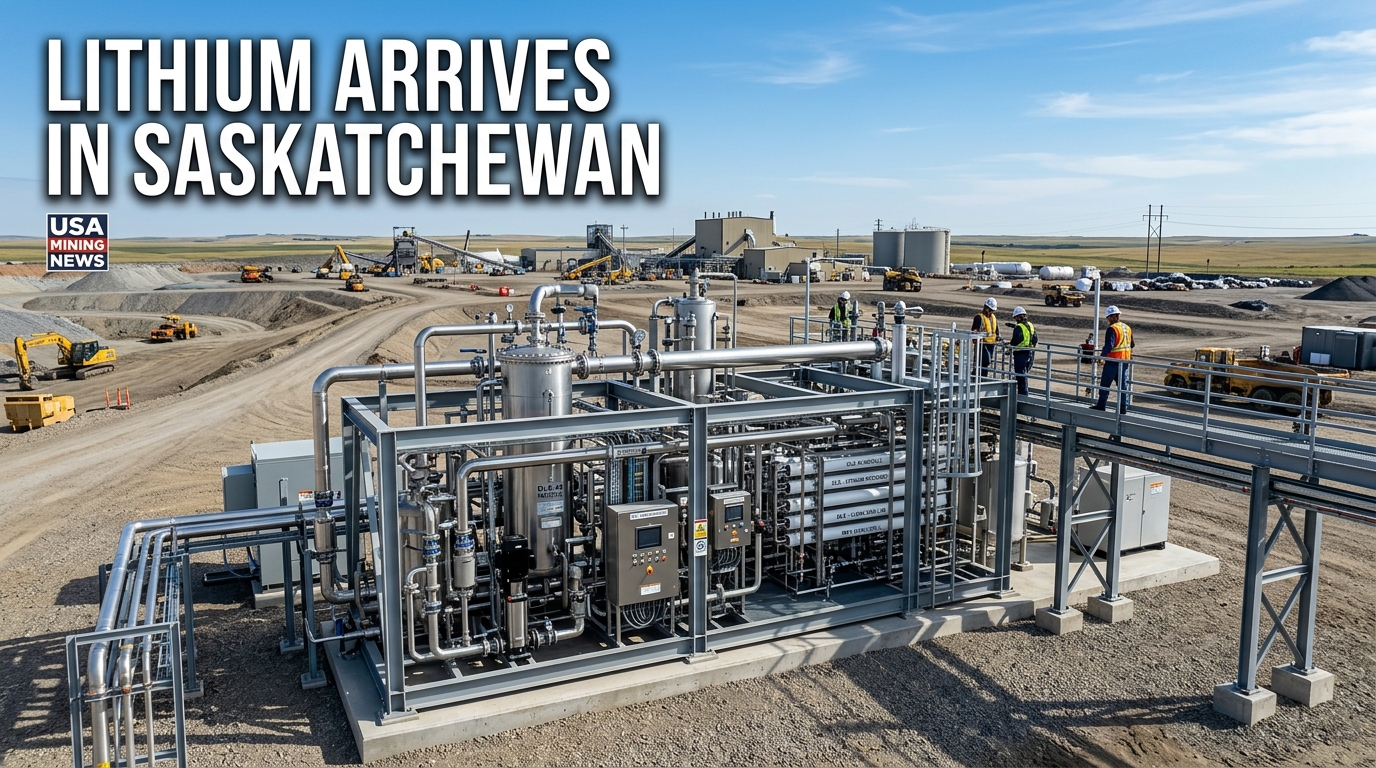
In a significant development for the North American critical minerals sector, Prairie Lithium officially announced the arrival of a commercial direct lithium extraction (DLE) unit at its project site in Saskatchewan, Canada, on July 10, 2026. This milestone is poised to accelerate the company’s trajectory towards becoming a key domestic supplier of battery-grade lithium, a commodity indispensable for the escalating global demand in electric vehicles (EVs) and renewable energy storage.
A Major Leap for Prairie Lithium in Saskatchewan
The delivery of the DLE unit represents a substantial stride for Prairie Lithium, signaling a nearing culmination of its efforts towards achieving Phase One of commercial lithium production. The unit’s arrival marks a critical transition from project development to operational readiness, positioning Prairie Lithium to establish a new domestic source of lithium in Canada.
A notable aspect of this development is the sheer scale of the new DLE unit. Prairie Lithium has stated that this commercial system is approximately four times the size of the DLE unit currently operating at Standard Lithium’s Arkansas project. For context, Standard Lithium introduced a single DLE column at its Arkansas facility in March 2024. This comparison underscores the ambitious scale of Prairie Lithium’s initial production phase, directly supporting the company’s objectives for rapid deployment and commercialization.
With the DLE unit now on-site, the immediate focus shifts to the intricate processes of installation and commissioning. These crucial next stages are anticipated to be completed before the close of 2026, setting the stage for the commencement of commercial operations and the eventual production of lithium in Saskatchewan.
Key Infrastructure and Risk Mitigation
The successful integration of the DLE unit is supported by a foundation of infrastructure already established at the Prairie Lithium project site. This pre-existing infrastructure plays a vital role in de-risking the Phase One production timeline and operational efficiency. The established elements include:
- Production wells: Essential for accessing the lithium-rich brines from underground reservoirs.
- Disposal wells: Crucial for the responsible and environmentally sound management of spent brine following lithium extraction.
- Power supply systems: Providing the necessary energy backbone to operate the DLE unit and associated processing facilities.
The presence of these foundational elements significantly reduces the operational complexities and potential delays typically associated with greenfield projects. By having these critical components in place, Prairie Lithium has proactively mitigated various technical and logistical risks, enabling a more streamlined path to production. This integrated approach ensures that the project can advance efficiently, capitalizing on the high demand for lithium in the current market.
Securing the Market: The Hydro Lithium Offtake Agreement
A critical component of Prairie Lithium’s commercial strategy, and a strong indicator of market confidence in its future output, is the binding off-take agreement with Hydro Lithium. This agreement commits 100% of the lithium projected to be produced during Phase One to Hydro Lithium. Such a comprehensive agreement provides several strategic advantages:
- Revenue certainty: It guarantees a clear pathway to initial revenue immediately upon the start of production, de-risking the financial aspects of the project.
- Market validation: The commitment from a major industry player like Hydro Lithium validates the quality and anticipated market acceptance of Prairie Lithium’s DLE-produced lithium.
- Operational focus: With sales secured, Prairie Lithium can concentrate fully on optimizing its production processes and achieving operational targets without the immediate pressures of market development and sales negotiations for its initial output.
This off-take agreement underscores the strategic significance of Prairie Lithium’s project within the broader context of North American battery material supply chains, ensuring that its output will directly feed into established commercial routes.
Leadership Perspective and Strategic Execution
Paul Lloyd, Executive Chairman of Prairie Lithium, articulated the significance of this milestone, stating, “The arrival of North America’s largest commercial Direct Lithium Extraction unit marks another defining milestone for the company as we advance towards becoming one of North America’s newest commercial lithium producers.” His statement reflects not only the tangible progress represented by the DLE unit’s arrival but also the strategic intent to position Prairie Lithium as a significant domestic player.
Lloyd also emphasized the company’s consistent performance against its strategic objectives: “Over the past 18 months we have continued to execute against each of the major milestones required to advance Prairie Lithium toward commercial production.” This track record of consistent execution instills confidence in the company’s ability to bring the project to fruition within its projected timelines, a crucial factor for investors and industry stakeholders tracking new critical mineral supplies.
The Significance of Direct Lithium Extraction (DLE) Technology
The adoption of Direct Lithium Extraction (DLE) technology by Prairie Lithium is particularly noteworthy within the broader mining industry for several reasons. DLE offers a potentially more sustainable and efficient method for extracting lithium from brine resources compared to traditional methods such as evaporation ponds or hard-rock mining. While the specifics of Prairie Lithium's proprietary DLE process are not detailed, DLE technologies generally offer:
- Reduced environmental footprint: DLE processes typically require less land use and can involve lower water consumption compared to large-scale evaporation ponds, which can be expansive and water-intensive.
- Faster processing: DLE can significantly reduce the time required to extract lithium compared to evaporation ponds, which rely on natural climatic conditions.
- Higher recovery rates: Advanced DLE methods often boast higher lithium recovery rates, optimizing the utilization of brine resources.
For the lithium industry, DLE represents a critical technological advancement that can unlock economically viable lithium resources from various brine sources, including those with lower lithium concentrations or in geographies where conventional methods are not practical. This innovation is pivotal for increasing global lithium supply responsibly and diversifying extraction methods beyond a few dominant practices.
Saskatchewan's Emerging Role in Lithium Production
Prairie Lithium has specifically highlighted Saskatchewan as a location "favourable to mining initiatives," a strategic choice that positions the province as an emerging player in the North American lithium landscape. Saskatchewan is renowned for its rich natural resource endowment and an established mining sector, which provides a conducive environment for resource development. The province's geological makeup includes sedimentary basins with significant brine potential, often co-located with existing oil and gas infrastructure, which could facilitate resource delineation and project development.
The provincial government of Saskatchewan has also demonstrated a commitment to fostering critical mineral development, recognizing the economic opportunities and strategic importance of these resources. This supportive regulatory and political environment, combined with an experienced workforce and existing infrastructure, renders Saskatchewan an attractive hub for innovative lithium extraction projects like Prairie Lithium's. The development here aligns with broader national strategies to build resilient domestic supply chains for critical minerals.
Market Implications and North American Supply Chains
The arrival of Prairie Lithium’s DLE unit and its progression towards commercial production carries significant implications for the global and, particularly, the North American lithium market. The surging demand for lithium, primarily driven by the exponential growth in electric vehicle manufacturing and renewable energy storage solutions, underscores the urgent need for diversified and secure supply chains.
North American nations are actively seeking to reduce their reliance on foreign sources for critical minerals, aiming to establish robust domestic supply lines that can support their burgeoning EV manufacturing and battery production industries. A new commercially viable producer like Prairie Lithium in Canada directly contributes to this strategic objective. It enhances regional supply chain security, provides a local source of a vital battery component, and fosters economic growth within the continent.
For investors, Prairie Lithium’s advancement represents a compelling opportunity in a high-demand sector. The combination of proven DLE technology, a secured off-take agreement, and a favorable operating jurisdiction mitigates several investment risks typically associated with early-stage mining ventures, framing it as a potentially lucrative addition to North America’s critical minerals portfolio.
Forward Momentum: Installation, Commissioning, and Future Outlook
With the DLE unit now on site, the immediate future for Prairie Lithium involves the rigorous process of installation and commissioning, which is expected to be completed before the end of 2026. Successful execution of these phases will culminate in the commencement of commercial lithium production, transforming Prairie Lithium into one of North America’s newest commercial lithium producers.
Beyond Phase One, the successful deployment and operation of this large-scale DLE unit could serve as a blueprint for future expansions, potentially leading to increased production capacities and further development of Saskatchewan's lithium brine resources. Prairie Lithium’s strategic progress not only contributes to the immediate supply needs of the battery industry but also signifies a broader trend of technological innovation and regional self-sufficiency in the critical minerals sector, vital for the global transition to a greener economy.