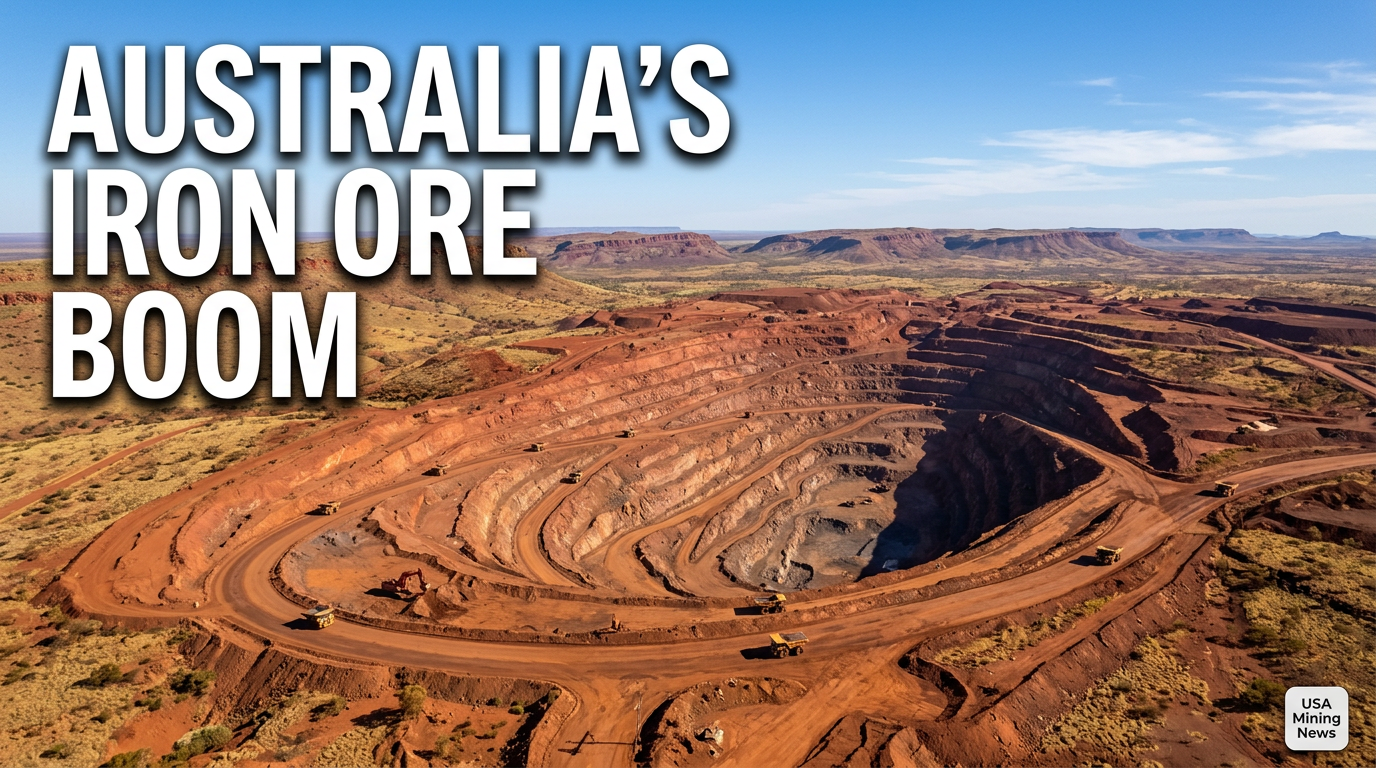
Australia is poised for a significant increase in iron ore production in 2026, with output projected to rise by 2.6% to 993.4 million tonnes, driven by the ongoing ramp-up of key projects like MRL’s Onslow, Rio Tinto’s Western Range, and Fortescue’s Iron Bridge, alongside new mine start-ups. This growth follows an estimated 1.4% increase in 2025, solidifying Australia’s position as the world's leading iron ore supplier, though the long-term outlook to 2035 includes both substantial new capacity and planned mine closures.
Australia's Pivotal Role in Global Iron Ore Supply Amidst Evolving Market Dynamics
Australia, the undisputed heavyweight in global iron ore production, is set to further solidify its dominance, with detailed projections indicating a robust increase in output for 2026. Accounting for a substantial 36.8% of global iron ore production in 2024, the nation’s supply capacity is of critical importance to the worldwide steel industry, particularly in Asia. The trajectory of Australian iron ore output is a key indicator for commodity markets, shipping logistics, and the strategic planning of steel manufacturers across the globe. According to analysis conducted by GlobalData, the coming years are anticipated to bring sustained growth, albeit with strategic adjustments and the inevitable ebb and flow of mine life cycles.
2025: A Year of Growth Amidst Operational Nuances
The year 2025 set the stage for the anticipated increase, with Australia’s iron ore output estimated to have reached 967.8 million tonnes (mt), marking a 1.4% year-on-year increase. This growth was largely underpinned by the successful and continued ramp-ups across several high-profile projects. Mineral Resources Limited (MRL) saw significant contributions from its Onslow project, while BHP Group's South Flank operation continued to scale up its production. Fortescue Metals Group’s Iron Bridge, a critical development for the company’s higher-grade magnetite concentrate, also contributed positively to the national supply base.
A significant new entrant in late March 2025 was the Western Range mine, a joint venture between Rio Tinto, holding a 54% stake, and China Baowu Steel Group, with 46%. This project alone added an annual production capacity of 25 million tonnes (mtpa) to Australia’s formidable supply pipeline, signalling strategic long-term collaboration and investment in sustaining high-volume output.
However, the path to growth in 2025 was not without its challenges. Industry operators navigated a complex landscape of operational adjustments and external factors that partially offset the gains. BHP’s Yandi mine, a long-standing cornerstone of production, commenced a ramp-down phase due to resource depletion, a natural progression for mature assets. Concurrently, softer iron ore prices impacted profitability and led to a moderated output from Roy Hill. Weather-related disruptions also played a role, with Cyclone Zelia in February 2025 causing temporary interruptions to operations and logistics, highlighting the vulnerability of mining operations to climatic events in the Pilbara region. Furthermore, the Koolyanobbing mine faced a suspension, being placed on care-and-maintenance in early 2025 due to a combination of limited reserves and elevated operating costs, underscoring the constant economic evaluation facing mine operators.
The Buoyant Outlook for 2026: Project Ramp-Ups and Resumptions
Looking ahead, the projections for 2026 are decidedly optimistic, with Australia’s iron ore production forecast to increase by a robust 2.6% to reach 993.4mt. This forthcoming increase is primarily attributed to the continued momentum from projects integral to the 2025 growth. The Onslow, Western Range, and Iron Bridge projects are all expected to achieve further operational stability and increased output as their ramp-up phases mature.
Adding to this upward trajectory are several anticipated new project start-ups and resumptions. The planned commissioning of the McPhee Creek and Lamb Creek operations is set to introduce additional supply into the market. A notable development on the resumption front is the Koolyanobbing mine, which is slated to recommence operations in December 2025. This follows its sale from Mineral Resources Limited’s Yilgarn iron ore operations and assets to Yilgarn Iron Investments Pty Ltd on June 30, 2025, demonstrating investment confidence and the potential for distressed assets to find new life under different ownership structures.
However, the positive growth profile for 2026 will be partially tempered by planned closures. Itochu Corporation’s Yandi and MRL’s Wonnmunna iron ore mines are scheduled for decommissioning. These two operations collectively contributed a significant 27.2mt to national output in 2024, illustrating the ongoing challenge of balancing new supply with the inevitable depletion of mature resources.
Strategic Investments Driving Future Capacity
The long-term health and growth of Australia's iron ore sector hinge on a continuous pipeline of strategic investments in both new projects and the expansion of existing infrastructure. Beyond the immediate forecast for 2026, continued efforts by major producers are expected to ensure Australia maintains its pre-eminent position.
The period between 2026 and 2035 is projected to see Australia's overall iron ore output trend higher, with a compound annual growth rate (CAGR) of 1.1% ultimately reaching 1,094.6mt by 2035. This sustained growth will be supported by a suite of new developments scheduled to come online sequentially. Key among these are the Mulga Downs project, anticipated to commence operations in 2028, and a series of other significant developments in the pipeline for 2030, including Rhodes Ridge, Marillana, Hawsons, and Ridley Magnetite. These projects represent substantial capital commitments and testify to the long-term confidence in global iron ore demand.
Furthermore, incremental gains from established operating hubs are expected to provide consistent support to national output. These include the continuing evolution and optimization of the Onslow, Iron Bridge, and Western Range sites, along with contributions from West Angelas and the perennial Mt Newman Joint Venture. These brownfield expansions and operational efficiencies are crucial for maximizing resource recovery and extending mine lives.
Navigating the Long-Term Horizon: Depletion and New Frontiers
While the overall outlook to 2035 is positive, the industry will need to navigate periods of adjustment. A temporary dip in production is forecast around 2033, primarily due to the scheduled closures of the Roy Hill and Firetail mines in 2032. Such fluctuations underscore the cyclical nature of mining and the strategic necessity of planning new capacity well in advance of resource depletion in existing operations.
Beyond the major closures, a series of other depletion-driven shutdowns are anticipated during the forecast period. These include the full cessation of operations at the Yandi mine in 2026, followed by the Buzzard and Iron Ridge operations in 2029, and the Marandoo mine in 2030, among others. These closures, while necessary as reserves are exhausted, highlight the continuous effort required by mining companies to identify, develop, and bring new resources into production to offset declining output from mature assets.
Implications for the Global Steel and Mining Sectors
Australia’s enduring role as the largest iron ore producer carries profound implications for the global steel industry, which relies heavily on a stable and secure supply of high-quality raw materials. The consistent output projections from Australian miners provide an essential foundation for the planning and economic stability of steel mills worldwide, particularly those in East Asia, which are primary customers for Australian ore.
For the mining sector itself, this trajectory indicates sustained investment opportunities, technological advancements in extraction and processing, and ongoing demand for skilled labor and specialized equipment. The strategic partnerships, such as Rio Tinto’s joint venture with China Baowu Steel Group at Western Range, exemplify the integrated nature of the global supply chain and the capital-intensive requirements for developing next-generation mining assets. The effective management of mine closures and the successful commissioning of new projects are critical for maintaining the delicate balance between supply and demand, influencing global iron ore prices and, consequently, the profitability of both mining companies and steel producers.
The Road Ahead: Sustaining Australia's Dominance
As Australia approaches and moves beyond 2026, its iron ore sector remains a dynamic and strategically vital component of the global economy. The robust project pipeline, coupled with ongoing operational optimizations from major players like BHP, Rio Tinto, Fortescue, and Mineral Resources Limited, underscores a commitment to sustained leadership in iron ore supply. While the industry faces inherent challenges from resource depletion, volatile commodity prices, and environmental factors, strategic foresight, continuous innovation, and significant capital investment are poised to keep Australia at the forefront of the global iron ore market, providing essential raw materials for the world’s industrial development well into the next decade. The careful balance of bringing new capacity online while managing the responsible decommissioning of mature mines will define Australia's iron ore narrative into 2035 and beyond.