Red Mountain Uncovers Promising Skarn Mineralisation at Montana Tungsten Project
Red Mountain Mining has announced a significant development at its Pioneer Tungsten Project in Montana, USA, with the identification of visible, outcropping garnet skarn at both its Greenstone and Mammoth prospects. This discovery, confirmed by the company’s US field crew in late May 2026, represents a crucial step forward for the project, suggesting robust tungsten mineralisation potential in an area with established historical production and regional significance. The news, released on June 9, 2026, follows Red Mountain's strategic move to acquire full ownership of the project, underscoring its commitment to advancing exploration and resource delineation.
Strategic Acquisition Paves the Way for Exploration
The confirmation of outcropping skarn mineralisation comes on the heels of Red Mountain Mining's decisive action to exercise its option to acquire 100% ownership of the Pioneer Project. This full acquisition is a pivotal moment, providing the company complete control over exploration strategy, investment decisions, and the long-term development pathway for the project. For junior mining companies, securing 100% ownership eliminates complexities associated with joint ventures or tiered royalty agreements, often streamlining the project advancement process and making it more attractive for future investment or partnerships. The confidence demonstrated by Red Mountain in moving to full ownership indicates a strong belief in the project's intrinsic value and its potential to deliver a significant tungsten resource.
The Pioneer Tungsten Project itself comprises three distinct claim areas: Greenstone, Mammoth, and Lost Creek. These claims are strategically situated along the eastern margin of the Mount Torrey Batholith, a geological setting renowned for its potential to host significant skarn-type mineralisation. This batholith, a large intrusion of granitic rock, typically acts as the heat and fluid source for contact metamorphic processes that form skarns, making such a geological alignment highly prospective for exploration targets.
Geological Context and Outcrop Discovery
The primary target mineralisation within the Pioneer Project is tungsten, specifically in the form of scheelite (calcium tungstate), which is commonly found within garnet skarns. Skarn deposits are a unique type of metamorphic-hydrothermal deposit formed when hot, chemically active fluids, typically derived from a cooling intrusive body like a granodiorite or granite, react with carbonate-rich country rocks, such as limestone. This interaction leads to the formation of a distinct mineral assemblage, predominantly of garnet and pyroxene, often hosting valuable minerals like scheelite.
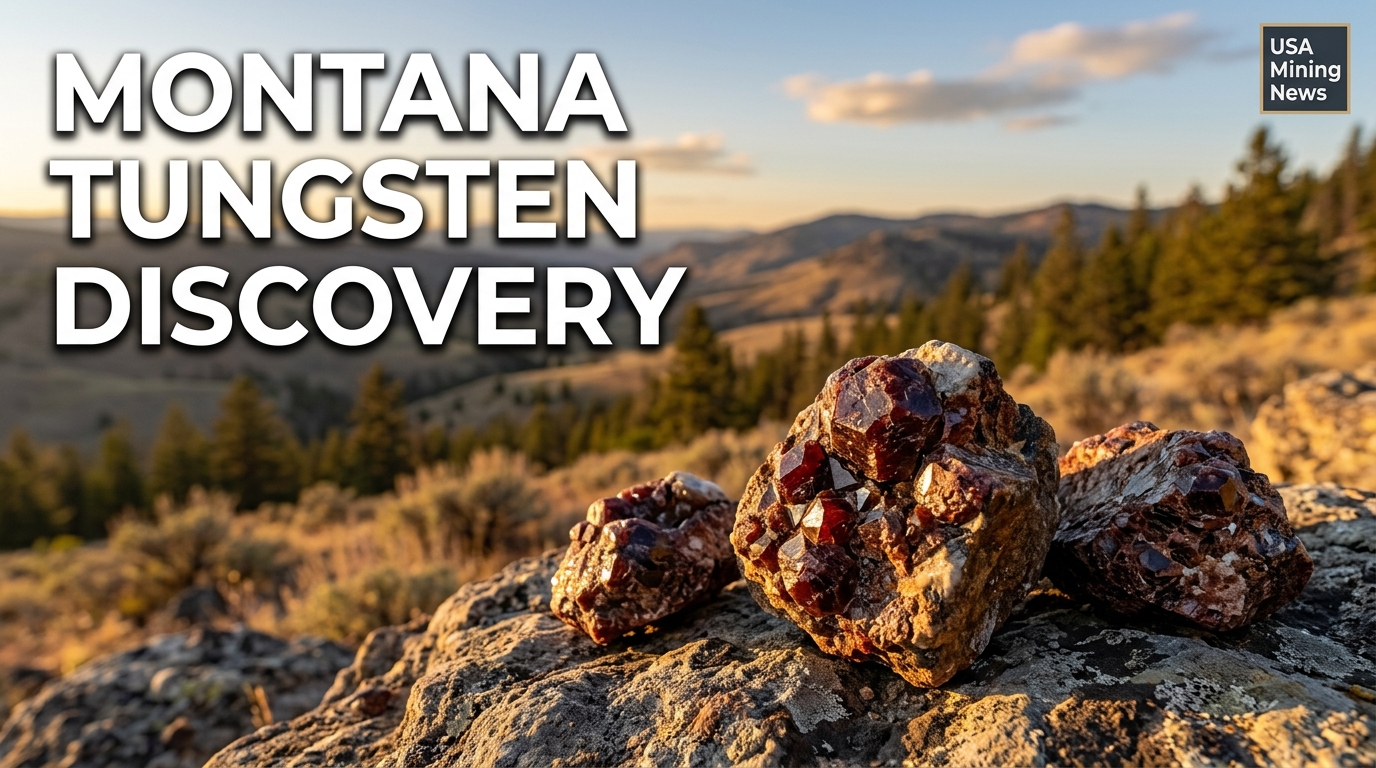
During fieldwork conducted by Red Mountain’s US crew in late May, visible exposures of these characteristic garnet skarns were confirmed at both the Greenstone and Mammoth prospects. The identification of outcropping skarn is a significant visual indicator for geologists, as it directly confirms the presence of the target rock type at the surface, reducing exploration risk. To thoroughly assess the mineralisation potential, the fieldwork team collected 24 rock chip samples from these visible exposures. These samples have been submitted for comprehensive multi-element analysis, which will provide crucial data on tungsten grades and the presence of any associated pathfinder elements. The results from these analyses are eagerly anticipated and are expected to be available before the end of June 2026. Positive results would substantially de-risk the project and provide empirical evidence to inform the next phase of exploration.
Subsurface Insights and Exploration Potential
Further bolstering the prospectivity of Greenstone and Mammoth, a recent magnetic modelling study conducted by Arrow Geosciences has provided compelling subsurface insights. This study suggested the presence of distinct subsurface magnetic bodies beneath both claim areas. Red Mountain interprets these magnetic anomalies as potential shallow extensions of the deeper granodiorite source rock, which is genetically associated with the skarn mineralisation. Magnetic surveys are a standard and effective geophysical tool in mineral exploration, particularly for skarn deposits, where the alteration minerals or the intrusive source itself can exhibit distinct magnetic properties that contrast with the surrounding host rocks. Identifying such anomalies at depth beneath known surface exposures is highly encouraging, as it supports the possibility of additional, and potentially larger, limestone-hosted, tungsten-bearing garnet skarn mineralisation extending at depth below the exposed quartzite units. This understanding is critical for planning future drilling campaigns, as it provides targets for down-dip extensions of the observed surface mineralisation and for blind deposits beneath cover.
Montana's Tungsten Heritage and Regional Significance
The Pioneer Tungsten Project is situated within a broader geological province known for its historical tungsten production, which adds considerable validation to Red Mountain’s exploration efforts. The eastern margin of the Mount Torrey Batholith is not only the geological home of Red Mountain's claims but also hosts other significant tungsten occurrences. Notably, the adjacent Gentung Tungsten Deposit, located nearby on the same eastern margin, boasts a stated mineral resource of 6.83 million tonnes (Mt) at an average grade of 0.315% tungsten trioxide (WO3). This substantial resource estimate at an adjacent property provides a compelling benchmark for the potential scale and grade of mineralisation that could be present within Red Mountain’s claims.
Beyond existing resources, the region has a rich history of tungsten mining. Historical mines in the vicinity, specifically Ivanhoe and Lost Creek – one of which is part of Red Mountain's project claims – are estimated to have collectively produced a combined total of 680,000 tonnes of tungsten ore in previous decades. This historical production underscores the long-recognized mineral potential of the area and suggests that the geological conditions are conducive to forming economically significant tungsten deposits. For mining investors and industry professionals, district-scale historical production is often a powerful indicator of prospectivity, as it validates the presence of mineralizing systems and often provides insights into metallurgical characteristics and mining conditions.
The renewed interest in the Mount Torrey Batholith region is further evidenced by the activity of other major players. In November 2025, Almonty Industries, a prominent global tungsten producer, acquired neighbouring properties. Such strategic acquisitions by established tungsten companies highlight the increasing recognition of the regional prospectivity and the long-term importance of securing stable tungsten supplies. This competitive interest can also be beneficial in terms of infrastructure development and shared knowledge within the district.
Forward Momentum: Next Steps for Red Mountain
With the current fieldwork completed and samples submitted, Red Mountain Mining has clearly outlined its immediate and medium-term plans for the Pioneer Tungsten Project. Throughout June 2026, the company plans to continue with further reconnaissance mapping and surface sampling. This systematic approach is crucial for refining geological models, identifying additional areas of interest, and ensuring comprehensive coverage of the project's potential. Detailed mapping can help delineate the extent of skarn alteration, identify structural controls on mineralisation, and pinpoint the most promising areas for further investigation.
The pivotal next step, however, is contingent on the analytical results from the 24 rock chip samples. Red Mountain has indicated that, subject to receiving positive analytical outcomes from these tests, it expects to proceed with drill testing. The primary targets for this potential drilling program would be the possible downdip extensions of skarn mineralisation at one or more of the prospects within the project area. Drill testing is the definitive method for confirming the presence, grade, thickness, and geological continuity of mineralisation at depth, transitioning a prospect from a conceptual target to a quantifiable resource. This methodical, results-driven progression from surface observations and geophysical interpretations to targeted drilling is standard industry practice and demonstrates a prudent approach to exploration.
Broader Implications for the Tungsten Market
The developments at Red Mountain's Pioneer Tungsten Project carry broader implications for the global tungsten market and especially for domestic US supply chains. Tungsten is classified as a critical mineral by many governments, including the United States, due to its indispensable role in various high-tech and industrial applications. It is essential for the manufacturing of hard metals (such as cemented carbides used in cutting tools and wear-resistant parts), high-temperature alloys (for aerospace and defense), and increasingly in electronics and battery technologies. The global supply of tungsten has historically been concentrated in a few countries, leading to concerns about supply chain resilience and geopolitical risks.
New discoveries and advanced exploration projects like Pioneer, particularly within stable geopolitical jurisdictions like the United States, are vital for diversifying global supply and enhancing national security through a reliable domestic source of critical minerals. For investors, a successful tungsten project in Montana offers exposure to a commodity with enduring strategic demand. For the mining industry at large, Red Mountain's progress highlights the continued potential for discovering and developing new resources in established mining regions, often leveraging modern exploration techniques to unlock previously unrecognized or overlooked potential. As the world continues to industrialize and embrace advanced technologies, the demand for critical metals like tungsten is only expected to grow, making projects like Pioneer increasingly significant.