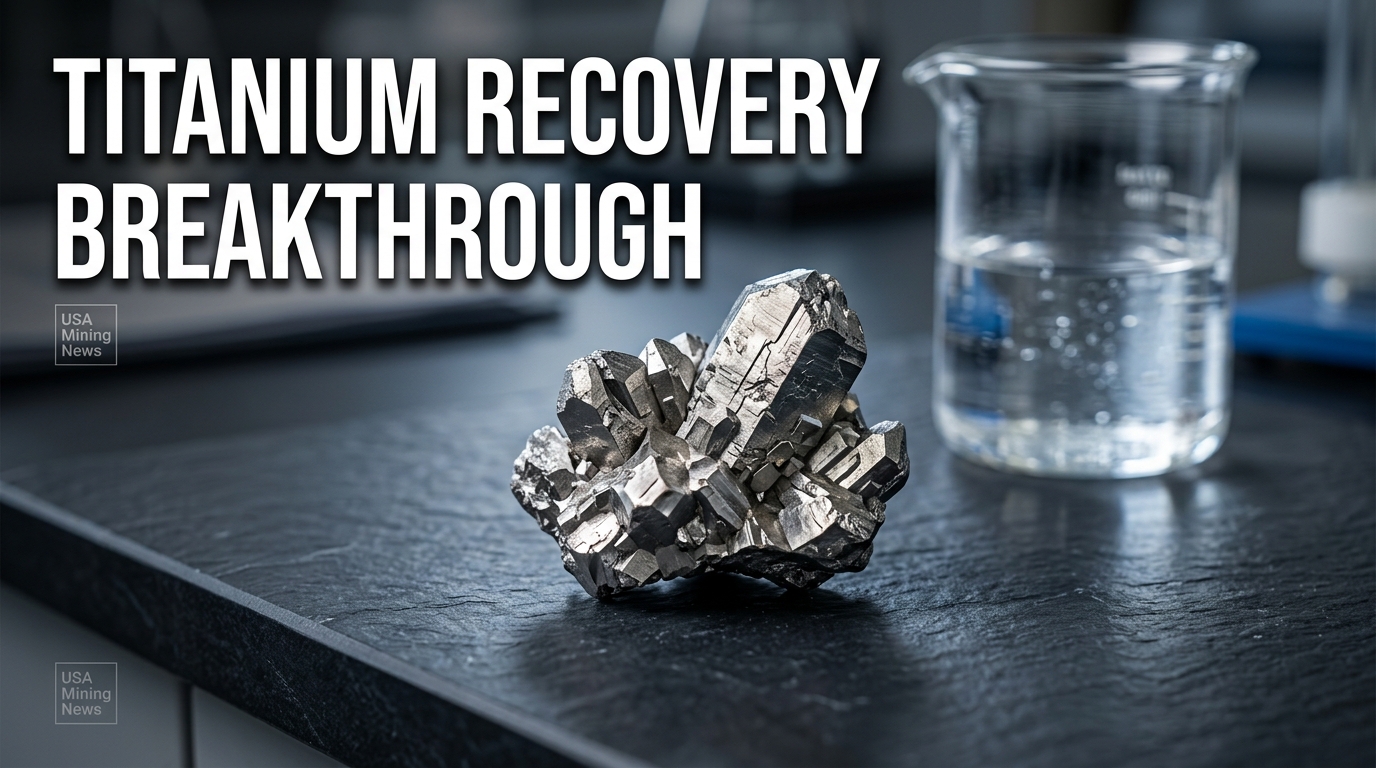
In a significant development for the critical minerals sector, Temas Resources and SAGA Metals have reported highly encouraging results from an independent metallurgical validation program, showcasing the efficacy of Temas' proprietary Regenerative Chloride Leach (RCL) Platform Technology. The program, which focused on extracting valuable metals from titanium-vanadium-iron mineral samples supplied by SAGA Metals, demonstrated remarkable recovery rates, signaling a potential breakthrough in processing complex critical mineral deposits.
Breakthrough in Critical Mineral Extraction: The RCL Platform's Validation
The validation program successfully achieved titanium recoveries of up to 90.8%, a figure that underscores the efficiency of the RCL process in extracting this vital industrial metal. Beyond titanium, the technology also yielded impressive vanadium recoveries, reaching up to 97.4%, along with iron recoveries of up to 91.5%. These results, made public on July 31, 2026, met all the technical objectives set for the initial stage of testing, providing a strong foundation for future development.
The independent metallurgical validation involved processing three distinct types of mineral material, each presenting unique processing challenges. These included run-of-mine massive oxide, vanadiferous titanomagnetite concentrate, and ilmenite concentrate. The RCL mixed chloride leaching process was applied to all samples under standardized operating conditions during two-stage tests. Notably, the ilmenite concentrate proved to be the most amenable to titanium extraction, yielding the highest recoveries for that metal, while consistently high vanadium and iron recoveries were observed across all tested materials.
Key Players and Strategic Implications
For Temas Resources, this announcement represents a pivotal commercial milestone. Tim Fernback, President and CEO of Temas, emphasized the strategic importance of this validation, stating, "Today’s announcement represents one of the most important commercial milestones achieved by Temas since acquiring the RCL Platform Technology." He further elaborated on the company’s vision, noting, "While we have consistently demonstrated the capabilities of the RCL process on our own mineral assets, successfully validating the technology on third-party mineralisation is another significant step toward building a global critical minerals processing business." This statement highlights Temas' ambition to not only utilize the RCL platform for its own projects, such as the La Blache and Lac Brûlé properties in Quebec, Canada, but also to position it as a licensable technology for broader industry application.
SAGA Metals stands to benefit significantly from these findings as well. The successful validation supports the technical evaluation of various processing options for their extensive titanium-vanadium mineral resources. Among these, SAGA's Radar Project, located in Newfoundland and Labrador, is a key asset that could see enhanced viability through the application of the RCL technology. Efficient extraction methods are crucial for unlocking the economic potential of such projects, particularly those containing complex mineralogies.
Temas’ commitment to advancing its mineral assets is evident in its prior activities; in November 2025, the company completed its autumn/winter HQ diamond drilling programme at the La Blache property in Quebec, further delineating the resources that could potentially be processed using the RCL platform.
Technical Nuances of the Regenerative Chloride Leach (RCL) Process
The success of the RCL Platform Technology lies in its Regenerative Chloride Leach process, a hydrometallurgical approach that utilizes mixed chloride leaching. Chloride leaching processes are often favored in the mining industry for their ability to efficiently dissolve metal values from complex ore bodies and concentrates, offering advantages over traditional pyrometallurgical methods or other hydrometallurgical routes in specific applications. The "regenerative" aspect suggests a focus on reagent recycling and efficiency, which can lead to lower operating costs and a reduced environmental footprint—critical considerations in modern mining operations.
The ability to achieve consistent high recoveries across diverse feedstocks—from run-of-mine material to specific concentrates like ilmenite and vanadiferous titanomagnetite—demonstrates the versatility and robustness of the RCL platform. This flexibility is particularly valuable in an industry where mineralogy can vary significantly even within a single deposit, often requiring tailored and expensive processing solutions. The independent technical review concluded that the stage one testing met all benchmarks, providing a strong endorsement of the technology's current state and its future potential.
Advancing to Stage Two: Optimisation and Commercialization
With stage one successfully completed, an independent technical review has recommended immediate progression to a detailed bench optimisation program, designated as stage two. This next phase is critical for refining the process and preparing it for larger-scale application. The objectives for stage two include:
- Optimizing recoveries further to maximize metal extraction efficiency.
- Refining process parameters, such as leach chemistry, to ensure optimal reaction conditions.
- Developing efficient reagent recycling strategies to reduce operational costs and environmental impact.
- Generating comprehensive engineering data, which is essential for designing and scaling up the process to pilot-scale development.
These detailed engineering studies and the eventual pilot-scale demonstrations are crucial steps in bridging the gap between laboratory success and commercial viability. The parties involved, Temas and SAGA, anticipate that the stage two optimisation will yield the necessary data to support these subsequent engineering studies and potential pilot plant operations, paving the way for full commercial adoption.
Why This Matters for the Mining Industry
The successful validation of the RCL Platform Technology for enhanced critical mineral recovery holds profound implications for the global mining industry. Demand for critical minerals, particularly titanium and vanadium, continues to soar, driven by advancements in aerospace, defense, energy storage (vanadium redox flow batteries), and various high-tech applications. However, efficiently and economically extracting these minerals, especially from complex or lower-grade deposits, remains a significant challenge.
Technologies like Temas' RCL platform offer a potential solution by improving recovery rates and potentially lowering the processing costs of challenging ores. For mining companies, this translates into improved project economics, potentially making previously uneconomical deposits viable. Furthermore, innovative processing technologies are increasingly important in addressing environmental concerns associated with mineral extraction, as they can sometimes offer more sustainable alternatives to conventional methods by reducing waste, energy consumption, and chemical usage through efficient regeneration and recycling.
The demonstration of this technology on third-party mineralization is a key indicator of its potential for widespread adoption across the industry. It suggests that the RCL platform is not merely tailored to Temas' specific projects but possesses broader applicability, which could significantly de-risk its commercialization path through licensing and other strategic arrangements.
The Road Ahead: Scaling and Market Integration
The future success of the RCL Platform hinges on the outcomes of the upcoming stage two optimisation program. If these efforts continue to yield positive results, they will underpin future decisions regarding the scaling of the technology. This could involve the construction of a pilot plant, followed by a demonstration plant, and eventually full-scale commercial operations. Temas' strategy to position the RCL Platform as a comprehensive processing technology, offering options for technology licensing and commercial arrangements, reflects a forward-thinking approach to leveraging intellectual property in the critical minerals space.
Ultimately, the ability to efficiently extract critical minerals such as titanium, vanadium, and iron from diverse feedstocks using an advanced hydrometallurgical process could contribute significantly to strengthening global supply chains for these essential materials. As the world continues to prioritize sustainable sourcing and domestic mineral production, innovative technologies like Temas' Regenerative Chloride Leach Platform will be instrumental in meeting the ever-growing demand from the industrial and high-tech sectors.