July 15, 2026
The global mining sector, a cornerstone of industrial economies, faces an escalating imperative to decarbonize its operations. While electrification and hydrogen solutions are on the horizon, the immediate challenge revolves around reducing emissions from the heavy-duty diesel fleets that power the vast majority of mining activities. In this context, renewable diesel, also known as Hydrotreated Vegetable Oil (HVO), is rapidly emerging as a compelling "drop-in" solution, enabling mines to significantly lower their lifecycle greenhouse gas (GHG) emissions without sacrificing the critical performance and reliability demanded by tough operational environments.
The Imperative for Lower Emissions in Mining
Diesel fuel remains the lifeblood of mining operations worldwide, powering haul trucks, loaders, excavators, and support fleets that are essential for high productivity and reliable power in some of the planet's most demanding conditions. Industry projections suggest that diesel powertrains will continue to dominate mining fleets well into 2040. However, this reliance comes with a substantial environmental footprint. Mobile diesel fleets can account for a significant portion of a mining company's Scope 1 and 2 emissions – up to 25% of total emissions, and a staggering 90% of Scope 1 emissions in surface mining operations.
The drive for emission reduction is fueled by a dual pressure of increasing regulatory scrutiny and ambitious corporate sustainability goals. Dozens of the world's leading mining companies have publicly committed to net-zero ambitions by 2050, often supported by critical interim targets, such as a 30% reduction in emissions by 2030. For open-pit operations, characterized by long haul routes and steep ramps, decoupling productivity from emissions has historically been a complex challenge. The haul fleet is not just a component; it is a fundamental cog in the efficient movement of ore, directly impacting a mine's economic viability. Finding a solution that decarbonizes operations without undermining this core functionality is paramount.
Renewable Diesel (HVO): A Scaling Solution
Renewable diesel distinguishes itself as a practical alternative because it is chemically identical to petroleum diesel but produced from sustainable feedstocks such as used cooking oil, animal fats, and vegetable oils. Its identical chemical structure means it can be used directly in existing diesel engines without modification, a feature that offers substantial operational and capital expenditure advantages.
The availability of renewable diesel is rapidly expanding globally, a critical factor for industrial-scale adoption. Worldwide renewable diesel production capacity, which stood at 2,914 million gallons per year in 2020, is projected to surge to 9,407 million gallons per year by 2030. This impressive growth is being driven by a broader global shift towards decarbonization across the transport, freight, and industrial sectors, ensuring a robust supply pipeline for heavy industries like mining.
Key Advantages: Compatibility, Emission Reduction, and Performance
For mining operators contemplating the transition, renewable diesel presents three compelling advantages that make it a highly attractive option:
- Compatibility: One of the most significant hurdles to adopting alternative fuels is the need for costly infrastructure overhauls or engine retrofits. Renewable diesel sidesteps these challenges entirely. It is a "drop-in" fuel, meaning it can be used directly in many existing haul trucks and heavy machinery without any engine modifications. This compatibility extends to on-site infrastructure, allowing mines to utilize their current storage tanks, dispensing systems, and maintenance practices. For fleet managers and procurement teams, this translates into seamless integration, minimizing disruption to operations and avoiding substantial capital expenditure.
- Significant GHG Emission Reduction: The primary driver for renewable diesel adoption is its potential for substantial lifecycle GHG emission reductions. While the exact reduction potential varies based on production pathways and feedstock sources, independent assessments highlight its impressive environmental benefits. For instance, under Directive (EU) 2023/2413 ("RED III"), which amends Directive (EU) 2018/2001 ("RED II"), renewable diesel derived from used cooking oil is assigned a default carbon intensity reduction of 83% compared to conventional diesel, with a typical reduction reaching 87%. These figures demonstrate the profound impact renewable diesel can have on a mine's carbon footprint.
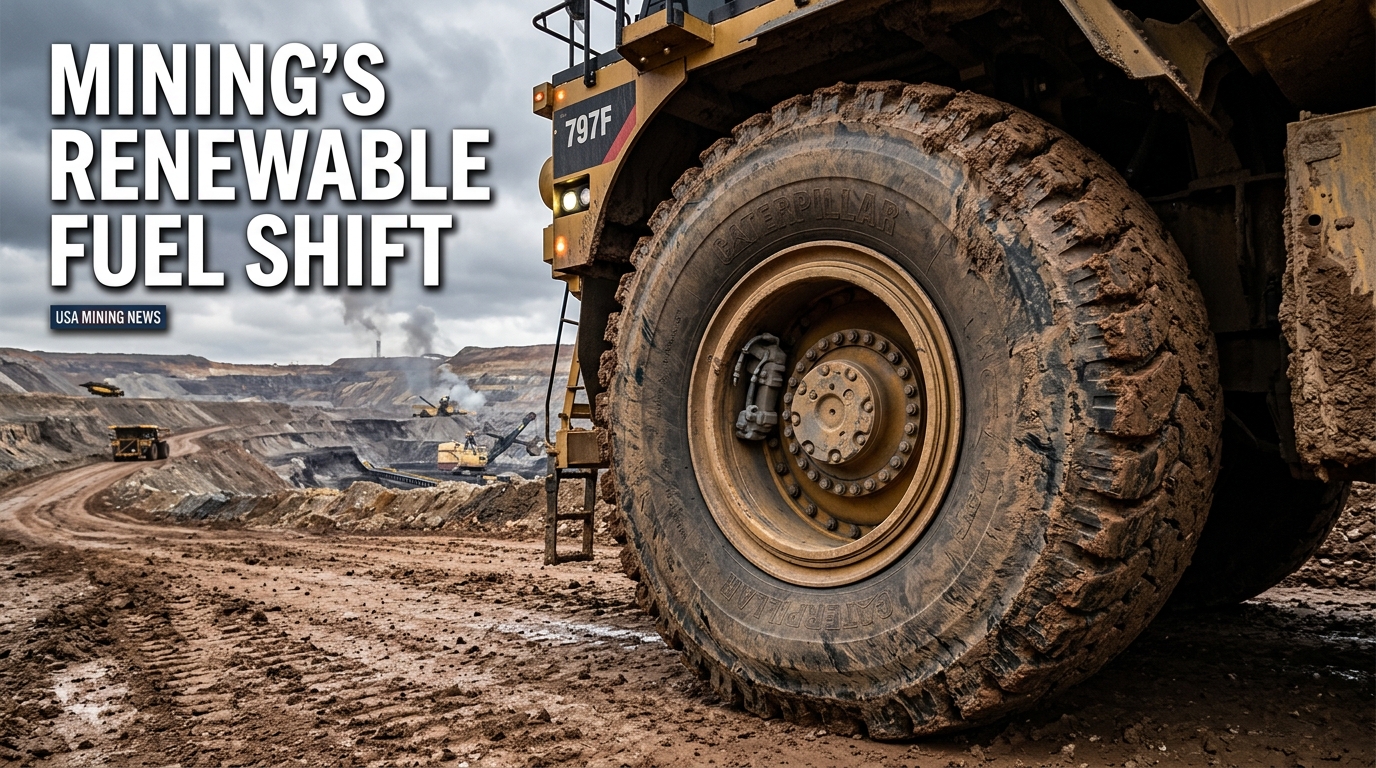
- Uncompromised Performance: In mining, any energy solution that compromises productivity or operational reliability is unlikely to gain traction. Early adoption of renewable diesel in real-world mining conditions has yielded encouraging results regarding performance. Imperial Oil's Kearl Oil Sands operation, for example, successfully ran Caterpillar haul trucks on 100% renewable diesel, reporting no loss of power or performance even under demanding operational conditions. Similarly, Rio Tinto's Kennecott mine in Utah transitioned 97 haul trucks and heavy machines to renewable diesel following a successful site trial, with operators reporting no adverse impact on power output or overall machine performance. This established performance parity is crucial, transforming renewable diesel from an interesting concept into a genuinely viable and attractive option for the industry.
Early Adopters Pave the Way
The theoretical benefits of renewable diesel are now being concretely demonstrated by leading mining companies. The experiences of Imperial Oil's Kearl Oil Sands operation and Rio Tinto's Kennecott mine serve as powerful case studies. These early adopters have not only proven the chemical compatibility of renewable diesel with heavy mining equipment but also validated the logistical feasibility of integrating it into large-scale operations.
At Kearl, the deployment of 100% renewable diesel in its Caterpillar haul trucks provided crucial real-world data, confirming that the fuel delivered consistent power and performance without operational compromises. This success underscores renewable diesel's ability to operate effectively in the challenging environment of an oil sands mining operation.
Rio Tinto's Kennecott operation in Utah represents an even broader deployment, moving 97 haul trucks and heavy machines onto renewable diesel. This extensive trial and subsequent adoption showcased the scalability of the solution across a diverse fleet. The absence of reported power or performance loss from these major operations provides a strong evidentiary base for wider industry consideration. These pioneering efforts have demonstrated that the chemistry and the logistics are sound, setting a precedent for other mining companies globally.
Strategic Implementation: Preparing for the Renewable Diesel Future
While the benefits are clear, successful adoption of renewable diesel requires a structured, site-specific approach. Every mining operation is unique, influenced by topography, climate, ore body characteristics, haul profiles, and fleet mix. Therefore, the initial step towards broader implementation should involve carefully planned site-specific pilot programs.
These pilots are essential for gathering critical data on how renewable diesel performs in actual operating conditions, enabling mines to track key performance indicators (KPIs) before scaling deployment. Such a phase demands close collaboration across multiple departments:
- Operations teams need to confirm the fuel behaves predictably and does not disrupt routine workflows.
- Maintenance crews require clarity on any potential changes in engine component life, such as filter life, oil condition, or injector performance, to adjust maintenance schedules accordingly.
- Commercial and procurement teams must thoroughly understand the cost implications, explore contracting options, and establish reliable supply chains to ensure uninterrupted fuel availability.
By obtaining solid baseline data and maintaining meticulous monitoring throughout the pilot phase, mining companies can confidently assess whether renewable diesel delivers the expected GHG emission reduction profile without negatively impacting productivity or increasing operational costs.
Market Implications and Future Outlook
The rise of renewable diesel marks a pivotal development in the mining industry’s journey towards decarbonization. With escalating regulatory pressures, investor demands for stronger ESG (Environmental, Social, and Governance) performance, and internal corporate commitments to environmental stewardship, mining companies are actively seeking pragmatic solutions that bridge the gap between emission reduction goals and operational realities.
Renewable diesel offers a direct, low-friction pathway for fleets expected to remain diesel-powered for the foreseeable future. Its ability to offer significant lifecycle GHG reductions while maintaining, or even enhancing, operational performance positions it as a go-to option where supply is dependable and economics are favorable. As global production capacity continues its rapid expansion, renewable diesel is poised to become an increasingly integral part of the mining industry’s composite strategy for a lower-emission future, demonstrating that impactful change can be achieved without complete technological overhauls.