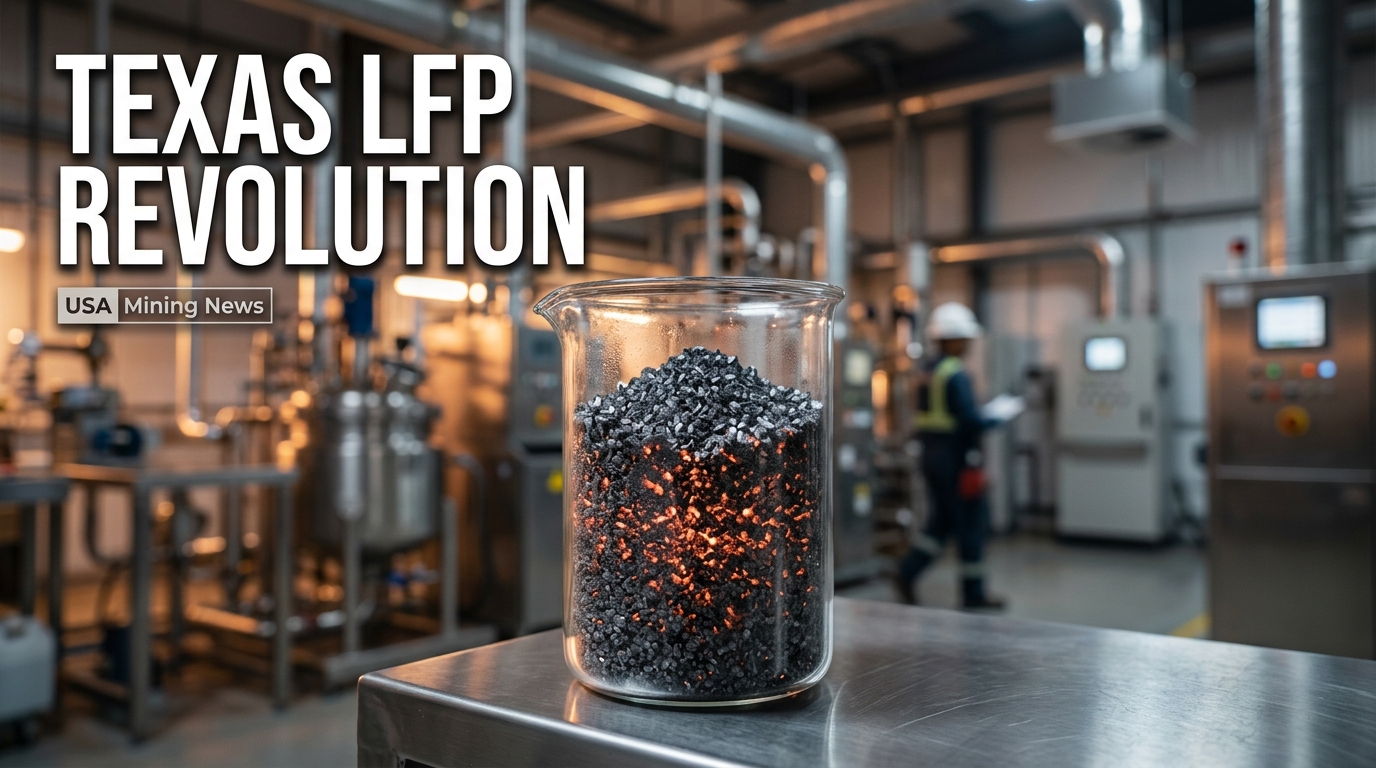
Hooks, Texas – June 5, 2026 – In a move set to significantly bolster the domestic battery supply chain and reduce reliance on foreign imports, Wildcat Discovery Technologies, a subsidiary of Holyvolt Group, and Energy Exploration Technologies (EnergyX) have announced a strategic agreement to develop a lithium iron phosphate (LFP) cathode active material manufacturing facility in Hooks, Texas. This ambitious joint venture, slated for construction on a 330-acre parcel at the TexAmericas Centre, represents a substantial private sector investment exceeding $230 million and is poised to become a cornerstone of the burgeoning US battery manufacturing landscape.
The planned facility underscores a concerted effort by key industry players to onshore critical battery component production, a necessity highlighted by global supply chain vulnerabilities and escalating demand across diverse sectors. With an initial production target of 15,000 tonnes per annum of LFP cathode material, this plant is not merely an investment in infrastructure but a strategic play for energy independence and national security.
Establishing a Domestic LFP Supply Chain in Texas
The selection of Hooks, Texas, within the TexAmericas Centre, provides a highly advantageous industrial setting for this large-scale manufacturing operation. The 330-acre parcel offers significant space for development and future expansion, crucially featuring existing rail access and readily available utility resources—factors that are paramount for efficient material transport and energy-intensive manufacturing processes. The TexAmericas Centre, a former army depot itself, possesses a robust industrial infrastructure capable of supporting projects of this magnitude.
Strategically, the LFP cathode plant’s location is optimized for vertical integration and supply chain efficiency. It will be situated immediately adjacent to EnergyX’s existing Project Lonestar lithium plant, facilitating a streamlined supply of foundational lithium carbonate. Furthermore, its proximity to the Red River Army Depot emphasizes its potential role in supporting defense electrification initiatives, underscoring the dual-use nature of advanced battery technologies.
The project is expected to deliver a significant economic boost to the region. Estimates suggest the initiative could directly create approximately 150 permanent jobs, offering long-term employment opportunities in advanced manufacturing. Beyond direct employment, the construction and indirect support sectors are projected to generate an additional 800 to 1,200 positions, stimulating broader economic activity and fostering a skilled workforce pipeline for the growing US battery industry. This localized job creation is a key benefit, aligning with national economic development priorities focused on revitalizing domestic manufacturing.
The Strategic Importance of LFP Cathode Materials
Lithium Iron Phosphate (LFP) cathode materials have emerged as a critically important component in the global energy storage and electric vehicle (EV) markets, renowned for their superior safety characteristics, longer cycle life, and lower cost compared to other lithium-ion chemistries like nickel-manganese-cobalt (NMC) or nickel-cobalt-aluminum (NCA). These attributes make LFP particularly well-suited for a wide array of applications, including:
- Large-scale stationary energy storage systems, enhancing grid stability and enabling greater integration of renewable energy sources.
- Mainstream electric vehicles, offering a more affordable option that can accelerate EV adoption by reducing battery costs.
- Military equipment and various defense electrification initiatives, where robustness, safety, and reliability are paramount.
- Specialized applications such as drones and other advanced energy technologies that require dependable and safe power sources.
Mark Gresser, CEO of Wildcat, articulated the pressing need for such domestic production. "LFP cathode materials are essential to the future of energy storage, defence electrification and affordable electric mobility, yet the United States remains heavily dependent on foreign supply," Gresser stated. "This project is designed to help close that gap by combining Wildcat’s cathode materials technology and high-throughput development platform with EnergyX’s domestic lithium supply strategy and Texas project footprint." This statement highlights the national imperative to reduce vulnerability in a strategically vital sector, addressing economic competitiveness and national security concerns concurrently.
The current reliance on foreign, predominantly Asian, supply chains for LFP cathode materials poses significant risks ranging from geopolitical instability to supply disruptions and price volatility. By establishing a robust domestic manufacturing capability, Wildcat and EnergyX aim to insulate US industries from these external pressures, fostering greater resilience and predictability for American manufacturers and consumers.
A Vertically Integrated Approach: Lithium Supply and Technology
A distinctive and highly strategic aspect of this joint venture is the vertically integrated approach to the battery materials supply chain. EnergyX is set to be the primary supplier of lithium carbonate, a key precursor for LFP cathode production, directly from its adjacent Project Lonestar plant. The terms of this supply agreement are designed to mitigate market risks, including a set price floor and ceiling, as well as a discount compared to prevailing market rates for lithium. This arrangement offers significant benefits:
- Price Stability: It provides a degree of insulation from the often-volatile fluctuations in global lithium prices, offering greater predictability for the LFP cathode plant’s operational costs. This stability is crucial for long-term planning and competitive product pricing.
- Supply Security: By securing a domestic source of lithium carbonate, the project reduces its exposure to international supply chain disruptions, a common challenge faced by many LFP producers who rely on global commodity markets for their raw materials.
Further solidifying this integrated strategy, EnergyX holds lithium mining rights covering approximately 50,000 acres beneath the planned LFP cathode plant site and the neighboring Lonestar lithium facility. While specific details on the extraction methods and resource estimates from these extensive holdings were not provided in the announcement, this demonstrates a long-term commitment to controlling the upstream supply of lithium, from extraction to refined products, within a localized ecosystem.
The collaboration leverages the distinct strengths of both companies. Wildcat brings its sophisticated cathode materials technology and a high-throughput development platform, enabling rapid innovation and optimization of battery chemistries. EnergyX contributes its robust domestic lithium supply strategy and a significant operational footprint in Texas, alongside its broader global lithium technology and production platform. This synergy is expected to create a highly efficient and technologically advanced manufacturing entity.
Both Wildcat and EnergyX have demonstrated their capabilities at a smaller scale. Wildcat currently operates demonstration-scale production of LFP cathode materials at its facilities in San Diego, California. Concurrently, EnergyX is producing lithium carbonate at a demonstration scale in Hooks, Texas, effectively proving out the foundational processes that will be scaled up at the new joint venture plant.
Potential Government Support and Future Expansion
While the initial investment in the Hooks, Texas, LFP facility is primarily driven by significant private sector contributions, EnergyX has indicated that securing federal support from the Department of Energy (DOE) would be instrumental in accelerating the project. Such funding would likely expedite the facility’s construction and commissioning timeline, potentially bringing critical manufacturing capacity online faster to meet the escalating demand for LFP batteries across various sectors.
The potential for federal partnership aligns with broader US governmental initiatives aimed at strengthening domestic manufacturing, promoting clean energy technologies, and enhancing national security through resilient supply chains. Programs such as those outlined in the Bipartisan Infrastructure Law and the Inflation Reduction Act offer substantial incentives and funding opportunities for projects that bolster domestic production of critical minerals and battery components.
The Hooks facility is envisioned as a foundational element within a much larger strategic framework. Teague Egan, founder and CEO of EnergyX, expressed enthusiasm for the collaboration, stating, "EnergyX is thrilled to build one of the largest American cathode plants in collaboration with Wildcat. In addition, EnergyX’s global lithium technology and production platform, which includes the Project Lonestar lithium plant in Texas, this cathode plant is a critical step towards EnergyX’s larger vision of the Battery Mecca." This "Battery Mecca" vision implies a comprehensive ecosystem of battery material production and innovation, likely encompassing multiple stages of the battery value chain within Texas and potentially beyond.
Beyond the initial LFP cathode production, the partnership maintains an expansive view of future technological advancements and product diversification. Their combined product portfolios hint at potential future expansions into cutting-edge battery chemistries and materials, including:
- Cobalt and nickel-free cathodes: Continuously pursuing materials that reduce reliance on critical and often ethically contentious minerals.
- Lithium metal anodes: A next-generation anode technology that promises significantly higher energy density compared to traditional graphite anodes, potentially revolutionizing battery performance.
- Lithium isotopes for nuclear applications: Venturing into highly specialized and high-value materials for sectors such as nuclear energy or medical applications, showcasing a broad technological ambition.
Broader Industry Implications and Outlook
The Wildcat-EnergyX LFP cathode facility represents a critical inflection point for the US mining and battery manufacturing industries. It signifies a tangible commitment to establishing a fully integrated, resilient, and technologically advanced domestic supply chain, from the ground (lithium mining rights) to the advanced material output. For mining industry professionals and investors, this project illustrates several key trends:
- Critical Minerals Reshoring: The imperative to onshore the processing and manufacturing of critical minerals, moving beyond mere extraction to value-added production within the US.
- Vertical Integration: A growing trend where companies seek to control multiple stages of the supply chain to secure raw material inputs, mitigate risks, and optimize costs.
- Strategic Geolocation: The careful selection of manufacturing sites based on existing infrastructure, resource proximity, and strategic access, such as the TexAmericas Centre's rail access and proximity to the Red River Army Depot.
- Diversification of Chemistries: While NMC and NCA have dominated high-performance EVs, LFP's cost-effectiveness, safety, and durability are making it a compelling choice for a vast array of applications, indicating a maturing and diversifying battery market.
- Public-Private Partnerships: The acknowledgment that federal support could significantly accelerate these crucial domestic initiatives, highlighting the symbiotic relationship between government policy and private sector innovation.
As global demand for electric vehicles and grid-scale energy storage solutions continues its exponential growth trajectory, the need for secure, reliable, and cost-effective battery components will only intensify. Projects like the Wildcat-EnergyX facility in Hooks, Texas, are not isolated ventures but crucial building blocks in the broader national strategy to achieve energy independence, strengthen economic competitiveness, and lead in the global clean energy transition. The successful execution of this project will likely serve as a model for further domestic investment and innovation, further solidifying the United States' position in the global battery value chain.