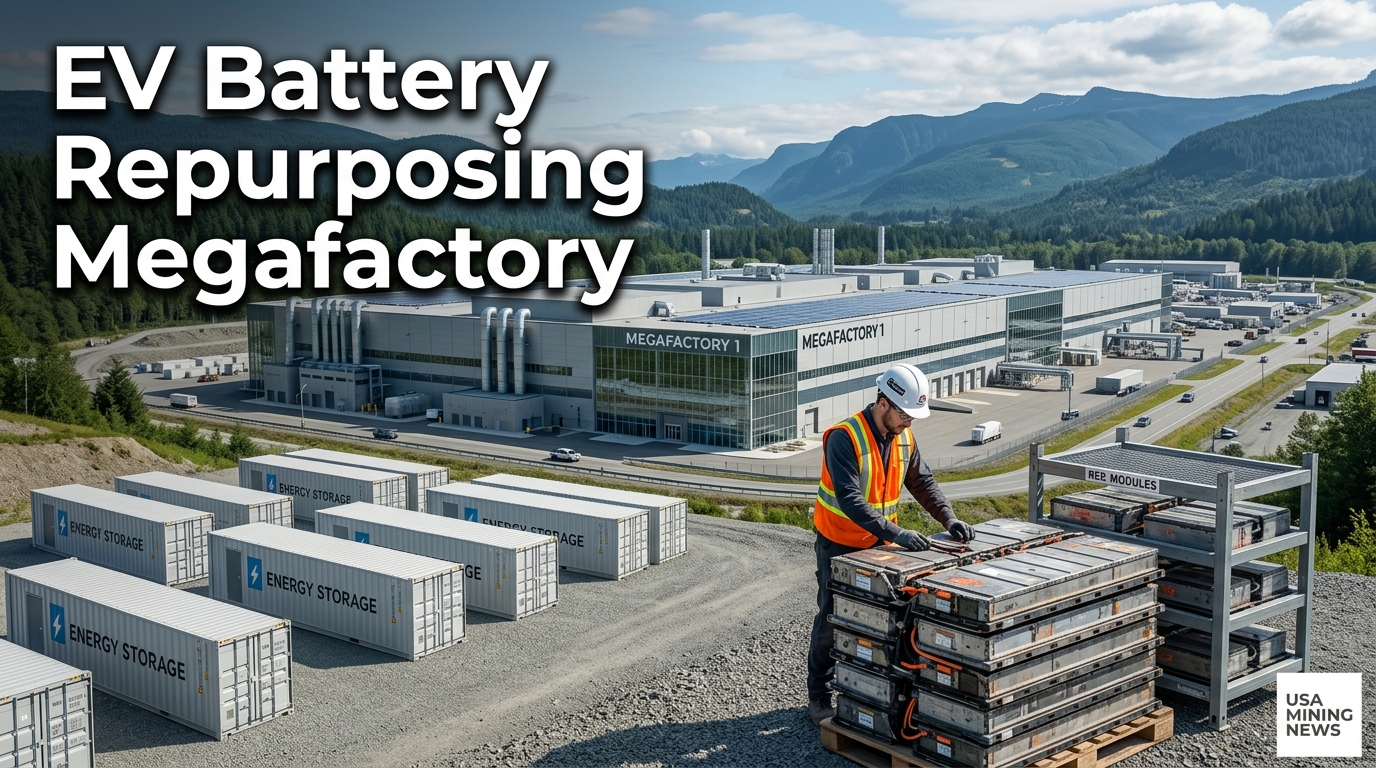
Monumental Opening: Moment Energy Unveils World's Largest EV Battery Repurposing Megafactory in British Columbia
Surrey, British Columbia – In a significant stride for sustainable energy solutions and domestic manufacturing, Moment Energy officially commenced operations at Megafactory 1 on Monday, June 24, 2026. Heralded as the largest electric vehicle (EV) battery repurposing facility globally, this groundbreaking installation in Surrey, British Columbia, is set to revolutionize how retired EV batteries are managed, transforming them into vital energy storage systems for critical infrastructure across North America.
The inauguration ceremony drew a distinguished gathering of investors, industry leaders, and government officials, underscoring the collaborative effort behind this ambitious venture. Moment Energy’s new facility directly addresses two pressing challenges facing modern society: the escalating demand for reliable electricity and the impending wave of retired EV batteries reaching their end-of-first-life. By converting these discarded power sources into cost-effective and rapidly deployable energy storage solutions, Megafactory 1 is poised to play a crucial role in supporting data centers, factories, microgrids, and the broader energy transition.
The Imperative for Second-Life Batteries: Addressing Dual Energy Transitions
The global energy landscape is undergoing a profound transformation, characterized by simultaneous and interconnected shifts. On one hand, the demand for electricity is surging at an unprecedented rate, largely driven by the exponential growth of artificial intelligence (AI), the expansion of colossal data centers, and the pervasive push towards grid modernization and decarbonization. These forces place immense pressure on existing energy grids, necessitating innovative and scalable solutions for energy resilience and supply stability.
Concurrently, the rapid adoption of electric vehicles over the past decade has created an entirely new challenge: the management of millions of EV batteries that are expected to retire from vehicular service in the coming years. While these batteries may no longer meet the stringent performance requirements for automotive applications, they often retain significant capacity, making them ideal candidates for less demanding stationary energy storage roles. Moment Energy’s strategy leverages this latent value, turning what could be an environmental liability into a valuable asset. The company asserts that this approach offers an immediate and scalable solution to energy shortages, effectively closing a critical loop in the battery lifecycle and contributing to a more circular economy.
Megafactory 1: A Catalyst for Domestic Battery Energy Storage Manufacturing
Situated in Surrey, British Columbia, Megafactory 1 is designed to be a high-volume manufacturing hub for battery energy storage systems (BESS). The facility's operational capabilities align with aggressive targets: Moment Energy projects that by 2030, the megafactory will produce 1 GWh of battery energy storage systems. This substantial capacity will significantly contribute to North America's domestic energy storage manufacturing capabilities, reducing reliance on international supply chains and fostering regional self-sufficiency in critical clean energy technologies.
The economic impact of Megafactory 1 extends beyond its direct output. The facility is expected to generate more than 100 direct jobs within British Columbia, spanning engineering, manufacturing, logistics, and management roles. Furthermore, its operations are anticipated to support over 1,000 indirect jobs across the province, stimulating growth in ancillary industries and services. Moment Energy CEO Edward Chiang highlighted the remarkable speed of the project's execution, stating in a news release,
"We announced this project six weeks ago. Today it’s operational. Demand for energy storage is accelerating, and so is the supply of retired EV batteries."
Chiang further emphasized the broader implications for industrial strategy, adding,"We show that the right technology can enable North America to re-onshore domestic manufacturing in weeks, not decades, creating thousands of jobs and economic prosperity."
This rapid deployment serves as a powerful testament to the feasibility of reshoring manufacturing processes when supported by pertinent innovation and strategic investment.Strategic Support and the British Columbia Innovation Ecosystem
Moment Energy's journey from a university-born startup to a global leader in second-life battery energy storage is a testament to the robust innovation ecosystem present in British Columbia. Founded in Vancouver in 2020, the company has successfully attracted a blend of private and government support crucial for scaling ambitious clean technology ventures. This foundational backing has enabled Moment Energy to develop its proprietary technologies and bring Megafactory 1 to fruition ahead of many industry expectations.
A significant component of this support comes from Pacific Economic Development Canada (PacifiCan), which invested a crucial $4.9 million into Moment Energy’s expansion. Gregor Robertson, Minister responsible for PacifiCan, praised the initiative, declaring,
"This is exactly the kind of homegrown innovation we want to see in British Columbia. With PacifiCan’s $4.9 million investment, Moment Energy is expanding clean manufacturing, creating good local jobs, and finding smart solutions to global challenges."
This public-private partnership exemplifies how targeted government funding can accelerate the development and deployment of clean technologies, addressing environmental concerns while simultaneously fostering economic growth and job creation.Operational Specifics and Technical Excellence
At its core, Megafactory 1’s operation involves a sophisticated process of receiving, testing, disassembling, conditioning, and re-packaging retired EV battery modules into new, custom-designed stationary energy storage systems. While the specific technical details of Moment Energy's proprietary processes remain confidential, industry best practices in this domain typically involve:
- Comprehensive Diagnostics: Initial testing to assess the remaining capacity, health, and safety of incoming EV battery packs.
- Disassembly and Grading: Careful dismantling of battery packs to extract individual modules, which are then graded based on their performance characteristics and potential for second-life applications.
- Reconfiguration and Integration: Designing and assembling these modules into new battery energy storage systems optimized for specific stationary applications, such as managing peak demand, providing backup power for data centers, or enabling microgrid stability.
- Quality Assurance: Rigorous testing of the final BESS units to ensure safety, reliability, and performance against design specifications.
These repurposed systems are designed to be cost-effective, offering a lower upfront investment compared to systems built with brand-new cells. Their rapid deployability is also a significant advantage, particularly for critical infrastructure experiencing immediate power demands or seeking enhanced energy security. The ability to supply tailored solutions for data centers and factories—sectors with rapidly growing and highly sensitive energy needs—positions Moment Energy at the forefront of a vital industrial transformation.
Market Dynamics and Broader Industry Implications
For the broader mining industry, Moment Energy's initiative holds several significant implications, particularly concerning battery metals and the burgeoning circular economy:
- Battery Metals Demand: While second-life applications don't eliminate the need for primary battery metals like lithium, cobalt, nickel, and manganese, they significantly extend the working life of these materials. This contributes to resource efficiency, reduces the immediate intensity of mineral extraction for certain applications, and promotes a more sustainable lifecycle for critical resources. As the supply chain for these metals faces increasing scrutiny and potential bottlenecks, repurposing offers a strategic avenue for maximizing their utility.
- Circular Economy Momentum: This megafactory is a powerful example of the circular economy in action within the mining and energy sectors. By creating value from waste, it reduces landfill burden and the environmental footprint associated with manufacturing new batteries. This trend will likely influence investment decisions in raw material processing and recycling infrastructure, driving innovation towards more sustainable practices across the entire value chain.
- Supply Chain Resilience: Localized repurposing capabilities, such as those at Megafactory 1, enhance North America's energy independence and supply chain resilience. The ability to source and process retired batteries domestically creates a more robust and less vulnerable supply of energy storage components, mitigating risks associated with geopolitical instabilities or global supply disruptions.
- Innovation in Energy Storage: The emergence of large-scale battery repurposing facilities also spurs innovation in battery design and manufacturing. EV battery manufacturers may begin to design batteries with second-life applications in mind, facilitating easier disassembly and repurposing, thus enhancing the overall economic and environmental viability of second-life markets.
The market for energy storage is projected to expand dramatically, with global installations expected to climb as renewable energy sources like solar and wind require dependable storage to ensure grid stability. Moment Energy's targeted approach to repurposing addresses a specific, growing segment of this market, demonstrating the economic viability of sustainable practices.
Future Outlook and Vision
The launch of Megafactory 1 positions Moment Energy as a pivotal player in the North American clean energy sector. Looking ahead, the company’s success could serve as a blueprint for similar operations globally, inspiring further investment in battery repurposing and recycling infrastructure. The goal of 1 GWh of production by 2030 is ambitious but aligns with the accelerating demand for stationary storage and the increasing availability of retired EV batteries. As the scale of operations grows, further efficiencies are likely to be realized, making second-life energy storage even more competitive.
Moment Energy’s trajectory suggests a future where battery materials are continuously reused and revalued, extending their economic life far beyond a single application. This not only mitigates environmental impact but also creates new economic opportunities and strengthens domestic manufacturing capabilities, particularly in regions committed to a sustainable and energy-secure future. The Surrey megafactory is more than just a production facility; it is a clear signal of the transition towards a truly circular and resilient energy economy.