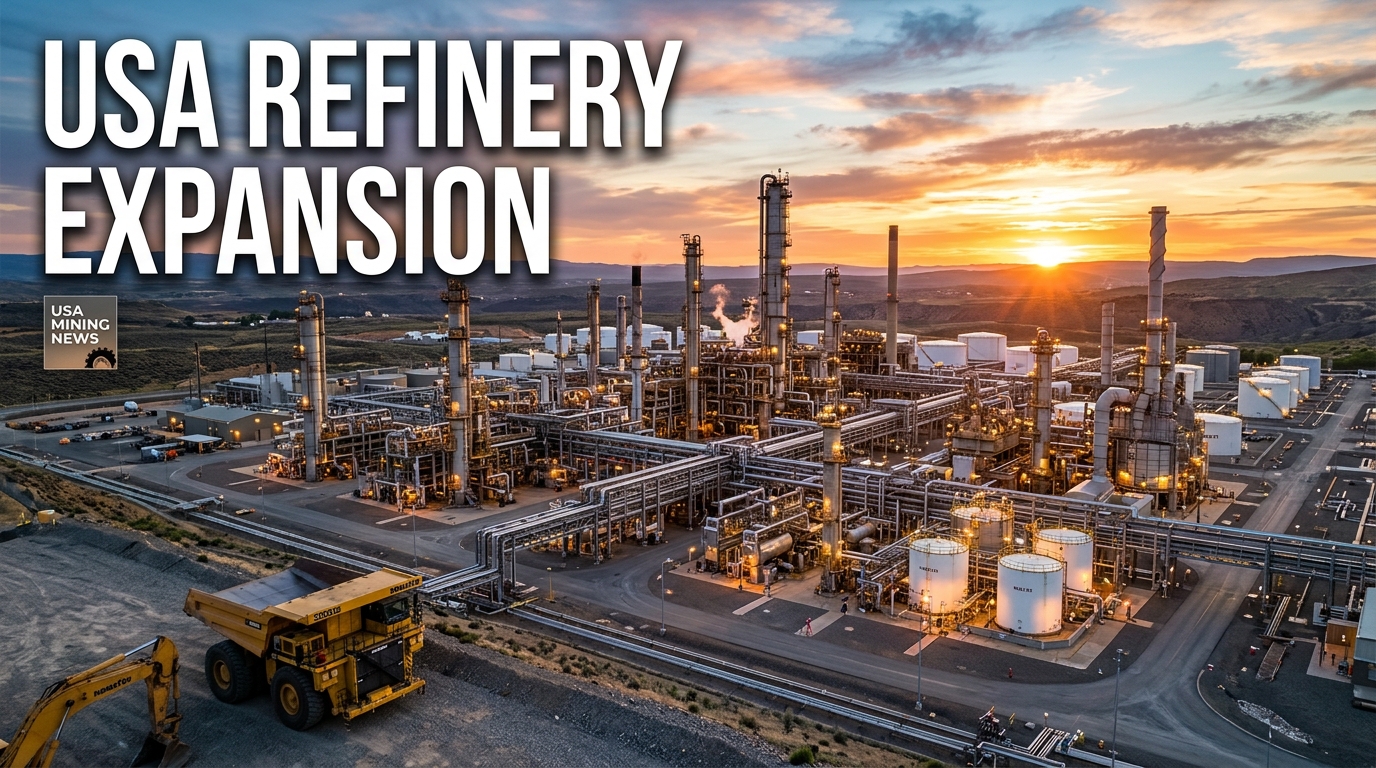
WASHINGTON D.C. – In a strategic move poised to significantly impact America's energy landscape, the Trump administration, on October 22, 2026, unveiled plans to deploy up to $150 million in Defense Production Act (DPA) Title III funding. This substantial investment is earmarked for expanding domestic petroleum production, storage, and logistics at refineries across the United States. The initiative, announced by President Donald J. Trump, is a direct effort to enhance the nation's refining capacity, aiming to increase the domestic output of critical fuels such as gasoline, diesel, and jet fuel by millions of gallons per day.
The announcement from the U.S. Department of Energy (DOE) signifies a concerted push to strengthen America's fuel supply chains, mitigate price volatility, and bolster national energy security. For the mining industry, a sector intrinsically linked to global commodity markets and heavily reliant on energy inputs, this development carries significant implications, promising greater stability in fuel costs and supply, which are vital for operational continuity and project economics.
Strategic Invocation of the Defense Production Act
The decision to leverage Defense Production Act Title III funding underscores the administration’s view of domestic refining capacity as a critical component of national security. The DPA, a Cold War-era statute, grants the President broad authority to compel businesses to accept and prioritize contracts for materials and services deemed necessary for national defense. Title III, specifically, allows for the expansion of domestic productive capacity and supply of critical materials and technologies.
U.S. Secretary of Energy Chris Wright articulated the administration's rationale, stating, "After 17 years of Democrat leaders enacting energy subtraction policies that led to the closure of refineries and more expensive refined oil products, the Trump Administration is taking action to expand our nation’s refining capacity and strengthen our energy security." Secretary Wright emphasized a pivot towards "energy addition policies," asserting that these funds would be used "strategically and in partnership with private industry to rapidly bolster America’s existing energy infrastructure." This approach is designed not only to restore but to expand America’s refining capabilities, building on the nation's already robust oil and gas production.
The administration’s stated objectives for this DPA invocation are clear:
- Increase Domestic Production: Boost the output of gasoline, diesel, jet fuel, and other petroleum products.
- Strengthen Fuel Supply: Enhance the resilience and reliability of the nation's fuel supply.
- Lower Prices: Contribute to more affordable fuel prices for American families and businesses.
- Bolster National Defense: Reinforce energy infrastructure deemed critical for national security.
Key Players and Policy Framework
At the heart of this initiative are President Donald J. Trump and U.S. Secretary of Energy Chris Wright. President Trump’s commitment to ensuring "all Americans have access to affordable, reliable, and secure energy" while strengthening infrastructure critical to national defense serves as the overarching policy driver. The funding is supported by broader federal allocations, specifically $1 billion in federal funding appropriated for energy-related projects critical to national security, made available through the Working Families Tax Cuts.
A formal declaration, Presidential Determination No. 2026-11, explicitly identifies domestic petroleum production, refining, and logistics capacity as "essential to national defense." This determination provides the legal and strategic underpinning for the DPA funding, framing refinery expansion not merely as an economic endeavor but as a matter of vital national interest. The emphasis on strengthening existing infrastructure through public-private partnerships aims to achieve rapid deployment and maximum impact.
Operational and Technical Scope of the Investment
The "up to $150 million" in DPA Title III funding is intended to be directed towards a range of projects designed to expand and enhance the operational capabilities of U.S. refineries. While specific recipient projects are yet to be announced, the scope of investment covers three primary areas:
- Petroleum Production: While primarily focused on refining, this aspect could encompass upgrades to facilities that process crude oil into feedstocks for further refining.
- Storage: Investments in expanding crude oil and refined product storage capacities, enhancing logistical resilience and buffering against supply disruptions. This includes tank farms, strategic petroleum reserves linkages, and terminal expansions.
- Logistics: Improving the transportation and distribution networks for both crude oil to refineries and refined products to market. This could involve upgrades to pipelines, rail facilities, and port infrastructure connected to refinery operations.
The expected outcome is a tangible increase in U.S. refining output by "millions of gallons per day." This ambitious target implies that the funding will likely target projects that can deliver significant capacity increases or reactivate dormant capacity efficiently. Such projects typically involve process unit debottlenecking, installation of new units (e.g., crude distillation units, hydrotreaters, catalytic crackers), or comprehensive upgrades to existing facilities to improve efficiency and yield.
Market and Industry Context: Implications for Mining
For the global mining sector, particularly in the United States, this announcement holds multifaceted significance. While not directly aimed at mining operations, the expansion of domestic petroleum refining capacity has several indirect, yet profound, implications:
Demand for Mined Commodities
Refinery expansion and infrastructure upgrades are highly material-intensive undertakings. Construction and maintenance of these facilities require vast quantities of various mined commodities:
- Steel and Iron Ore: For structural components, pipes, tanks, and pressure vessels.
- Copper: Essential for electrical systems, instrumentation, and various industrial applications within a refinery.
- Aluminum: Used in certain structural components, heat exchangers, and electrical conduits.
- Industrial Minerals: Such as aggregates for concrete foundations, clays for catalysts, and specialty minerals for corrosion resistance or insulation.
- Rare Earth Elements and Critical Minerals: Increasingly vital in advanced catalysts and specialized alloys used in high-temperature or corrosive environments within modern refineries.
An increase in refinery investment translates directly into increased demand for these raw materials, providing a potential boost for mining companies specializing in their extraction and processing. This reinforces the interconnectedness of industrial sectors, where growth in one area stimulates demand across the entire supply chain.
Energy Costs and Operational Stability for Mining
Mining is one of the most energy-intensive industries globally. Heavy machinery, transportation fleets, crushing and grinding processes, and power generation in remote sites all consume substantial amounts of refined petroleum products, especially diesel. Lower and more stable fuel prices directly translate into reduced operating costs for mining companies. This can significantly improve project economics, make marginal operations more viable, and free up capital for exploration, development, and technological improvements.
- Diesel Fuel: The primary energy source for excavators, haul trucks, drills, and generators. Price volatility can severely impact quarterly earnings and long-term planning.
- Jet Fuel: For air support in remote exploration and logistics.
- Asphalt and Lubricants: Crucial for maintaining haul roads and equipment.
By increasing domestic refining output, the initiative aims to stabilize and potentially lower these critical input costs, offering a more predictable operating environment for miners.
Energy Security and Supply Chain Resilience
A strengthened domestic fuel supply reduces the mining industry's vulnerability to geopolitical events, international supply chain disruptions, and natural disasters that can impact global energy markets. For a sector like mining, where operations are often continuous and highly dependent on reliable fuel deliveries, enhanced energy security is paramount. The DPA invocation itself highlights a focus on resilience, a concept increasingly important for all industrial sectors in an uncertain global environment.
Broader Economic Growth and Industrial Policy Signals
The Trump administration's emphasis on "energy addition policies" signals a broader industrial policy favorable to large-scale infrastructure projects and domestic manufacturing. Such an environment can foster overall economic growth, which in turn drives demand for mined commodities across various sectors, from construction to manufacturing. A proactive stance on critical energy infrastructure also suggests a regulatory climate that might be more accommodating to essential industrial development, including new mining projects.
Future Outlook and Next Steps
The DOE's announcement noted that the "selection process is ongoing and will be announced in the near future." This indicates that potential refinery operators or project developers are currently being evaluated for the DPA Title III funding. The strategic deployment of these funds will likely prioritize projects that offer the quickest and most substantial increases in refining capacity, align with national security objectives, and demonstrate a clear path to execution in partnership with private industry.
Industry stakeholders, including mining companies and investors, will be closely watching for these announcements. The success of this initiative could set a precedent for future DPA applications in other critical sectors, further shaping the industrial landscape. The long-term impact is anticipated to be a more robust and self-reliant American energy infrastructure, providing foundational support for energy-intensive industries like mining, and contributing to overall national economic resilience.
This initiative represents a significant federal intervention to reshape America's energy future, demonstrating a strong commitment to domestic industrial strength and national security. For the mining industry, it underscores the persistent and fundamental role of mined materials in supporting not just direct energy production, but the entire value chain of critical energy infrastructure.