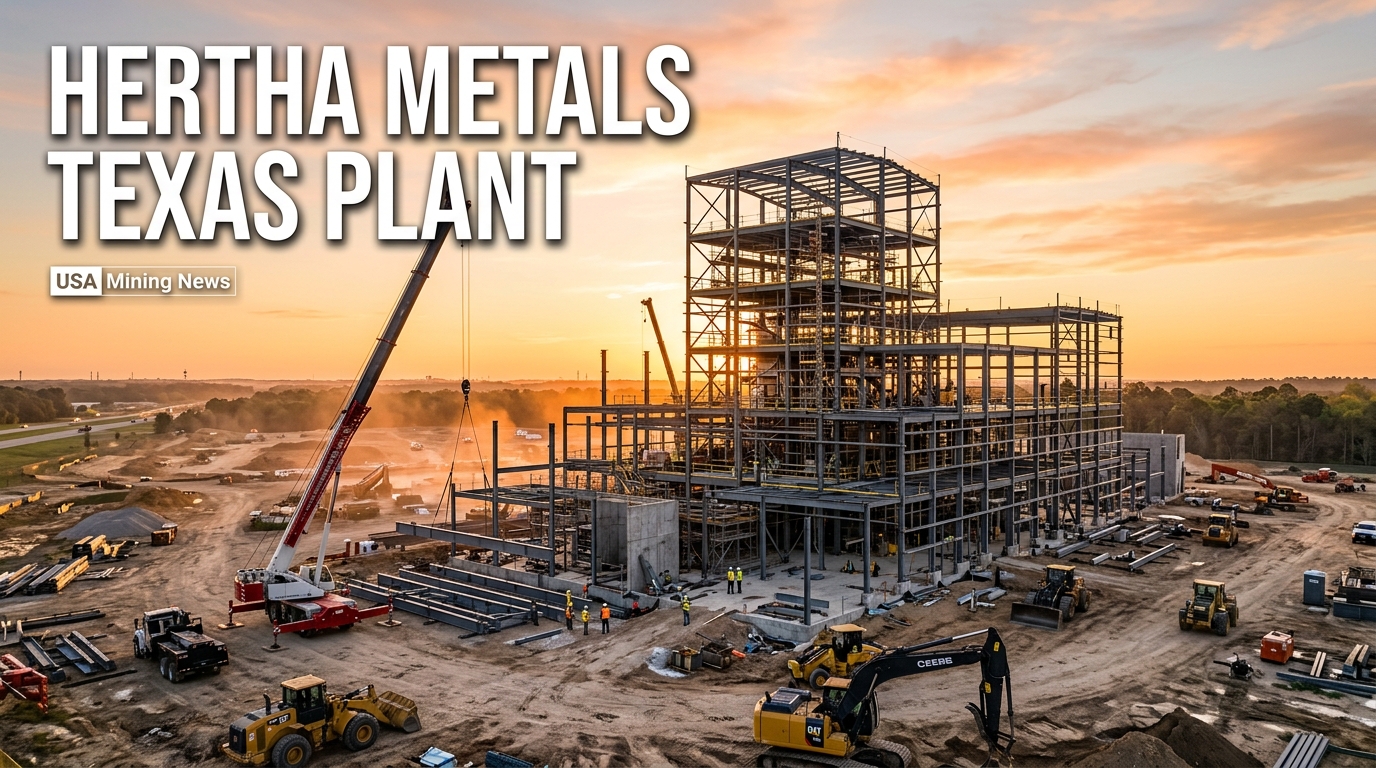
In a pivotal development for the American metals industry, Hertha Metals has initiated construction on its first commercial high-purity iron facility, the Hertha Chalyx plant, in Conroe, Texas. This announcement, made on October 9, 2026, signifies the establishment of what the company heralds as the first modern iron and steel innovation complex in the United States, poised to significantly bolster domestic supply chains for critical advanced manufacturing sectors.
A New Era for U.S. High-Purity Iron Production
The Hertha Chalyx plant represents a strategic investment in the future of American industrial independence. Located adjacent to Hertha’s existing Pi100 pilot plant in Conroe, Texas, the facility is engineered to produce approximately 10,000 tonnes per annum (tpa) of combined steel-grade and magnet-grade high-purity iron. The primary focus of this output will be to supply the burgeoning US rare earth magnet manufacturing sector, a segment vital to numerous strategic industries.
The high-purity iron produced at Chalyx is specifically destined for neodymium-iron-boron (NdFeB) magnets. These powerful permanent magnets are indispensable components in a wide array of high-technology applications, including electric vehicles (EVs), next-generation wind turbines, robust data center infrastructure, advanced robotics, and critical defense systems. The domestic production of this foundational material is crucial, given the current geopolitical landscape and the strategic importance of these end-use sectors.
Addressing Critical Supply Chain Vulnerabilities
The significance of Hertha Metals' undertaking cannot be overstated, particularly when viewed through the lens of global supply chain dynamics. According to the company, a staggering 94% of the high-purity iron currently utilized for these essential magnets is produced in China. This overwhelming reliance on a single foreign source poses considerable economic and national security risks, underscoring the urgent need for robust domestic alternatives.
For the US mining and manufacturing industries, the Hertha Chalyx plant offers a tangible step towards mitigating these vulnerabilities. By localizing a key input for NdFeB magnet production, the project aims to create a more resilient and secure supply chain, reducing exposure to geopolitical tensions, trade disruptions, and fluctuating international market conditions. This move aligns with broader national efforts to re-shore critical manufacturing capabilities and strengthen industrial self-sufficiency, particularly in sectors deemed strategic for economic competitiveness and defense.
Hertha's Innovative Single-Step Process
Central to the Hertha Chalyx project is the company's proprietary single-step process, a technological innovation designed to revolutionize iron production. This advanced method allows for the direct conversion of iron ore and natural gas within a single furnace, yielding either liquid steel or high-purity iron, depending on the specific operational parameters set. This contrasts sharply with conventional multi-stage blast furnace methods that have dominated the industry for centuries.
The Hertha process boasts several compelling advantages:
- Ore Flexibility: It can effectively utilize a wide range of iron ore grades, including lower-grade materials that might be less suitable or uneconomical for traditional processes. This expands the potential resource base and enhances operational flexibility.
- Cost Efficiency: Hertha Metals claims that its process can produce steel and high-purity iron at a 25% lower cost compared to the traditional blast furnace method, offering a significant competitive edge in the market.
- Reduced Emissions: The single-step process inherently offers reduced emissions when natural gas is used as the energy source. Furthermore, the technology is designed with future decarbonization in mind, promising even greater emissions cuts if hydrogen is incorporated as a fuel, aligning with global industry trends towards greener steel and iron production.
Laureen Meroueh, CEO and founder of Hertha Metals, emphasized the operational validation of their technology: "Over the last two years, our team has worked relentlessly to prove the promise of our technology through production. With Chalyx, we take the next step: proving the business and demonstrating that our technology can deliver commercially." Her statement highlights the transition from pilot-scale success to commercial viability, a critical milestone for any innovative industrial process.
Strategic Location and Domestic Sourcing
The selection of Conroe, Texas, as the site for the Hertha Chalyx plant is strategically astute. Texas offers a robust industrial ecosystem, access to skilled labor, and abundant natural gas resources, which will serve as a primary energy input for Hertha’s process. Furthermore, the facility plans to source its iron ore domestically, primarily from Minnesota’s historic Iron Range. This commitment to an entirely domestic supply chain, from raw materials to final product, reinforces the project's contribution to US economic resilience and job creation.
The sourcing of iron ore from the Minnesota Iron Range is particularly noteworthy. This region has been a cornerstone of American iron mining for over a century, and Hertha’s ability to utilize varying grades of ore potentially offers new life and demand for this vital domestic resource base, fostering renewed activity in an established mining region.
Key Players and Robust Financial Backing
The successful initiation of the Hertha Chalyx project is underpinned by strong corporate leadership and significant financial investment. Hertha Metals, under the guidance of its CEO and founder, Laureen Meroueh, has driven the development of this innovative technology and its commercial deployment.
To execute the project, Hertha Metals has partnered with CV Engineering, which has been selected as the engineering, procurement, and construction (EPC) partner. CV Engineering will assume responsibility for the comprehensive design and build phases of the facility, bringing specialized expertise to ensure the project's successful realization. This partnership is crucial for managing the complexities of constructing a first-of-its-kind commercial plant.
Financially, the project received a substantial boost from a $133.65 million Series A funding round, which concluded in the month prior to the construction announcement. This significant capital injection was co-led by prominent venture capital firms Khosla Ventures and Doerr Capital, underscoring investor confidence in Hertha's technology and its market potential. Such substantial backing from sophisticated investors highlights the perceived strategic value and long-term viability of re-establishing advanced metallurgy capabilities within the US.
Project Timeline and Future Vision
With construction now underway as of October 2026, Hertha Metals has laid out an ambitious but clear timeline for the Hertha Chalyx plant. The facility is scheduled to commence operations in late 2027. Following this operational start, initial production of magnet-grade high-purity iron is anticipated in early 2028, signaling the imminent availability of a crucial domestic supply for magnet manufacturers.
Looking beyond the initial 10,000 tpa capacity, Hertha Metals has a broader, more expansive vision. The company intends for the Chalyx plant to serve as an essential operational and economic base, providing the necessary proof of concept and market traction for a much larger scale-up. A proposed future expansion aims to boost production capacity significantly, targeting an ambitious 500,000 tpa. This strategic roadmap suggests that the Conroe facility is not merely an isolated project but rather the foundational element of a much larger initiative to transform the US iron and steel landscape, particularly for high-value, niche applications like advanced magnets.
Broader Industry Implications and Outlook
The construction of the Hertha Chalyx plant holds profound implications for the mining industry, advanced manufacturing, and national strategic interests. For the mining sector, it represents a new domestic demand for iron ore, potentially revitalizing regions like Minnesota's Iron Range and encouraging investment in exploration and production of suitable domestic feedstocks. It also showcases the potential for technological innovation to unlock value from a broader spectrum of ore grades.
For US rare earth magnet manufacturers, this project offers a critical step towards supply chain resilience, reducing reliance on volatile international markets and strengthening domestic competitiveness. The availability of domestically produced, cost-effective, and high-purity iron is a significant enabler for the growth of electric vehicles, renewable energy, and defense technologies within the United States.
Furthermore, Hertha's single-step process, with its claims of lower costs and reduced emissions, aligns with global trends towards sustainable mining and metallurgy. Should the technology prove scalable and commercially successful at the 500,000 tpa level, it could set a new standard for iron production, influencing future investments and process developments across the broader steel industry, particularly in regions keen on decarbonization and efficiency improvements.
In essence, Hertha Metals' commitment to domestic high-purity iron production in Conroe, Texas, is more than just a new plant; it is a strategic move to secure critical materials, enhance national economic and defense capabilities, and introduce innovative, environmentally conscious production methods to a cornerstone industry.