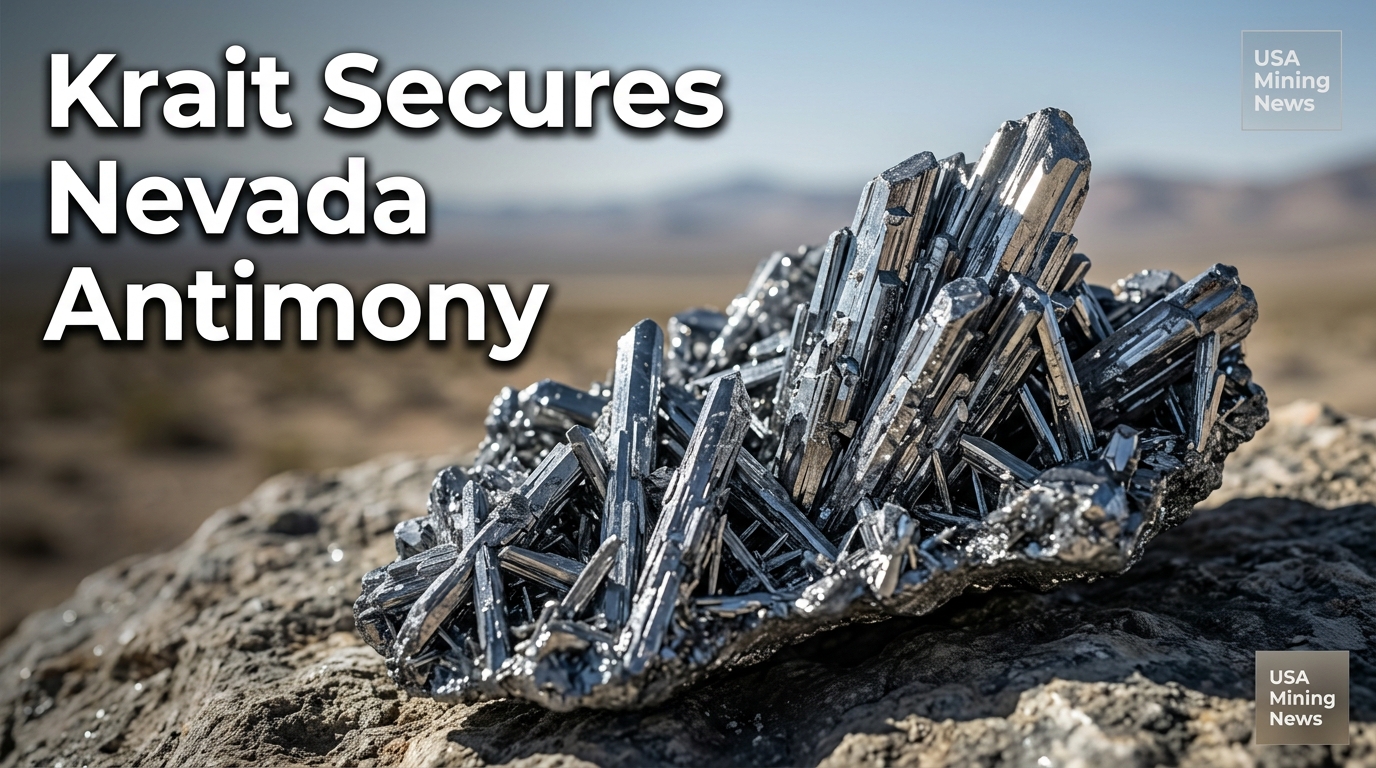
In a significant development for the North American critical minerals sector, Krait Critical Minerals announced on October 22, 2026, that it has entered into an exclusive option agreement with Sierra Antimony. This agreement grants Krait the right to acquire a full interest in 17 contiguous unpatented federal mining claims situated in Humboldt County, Nevada, USA. These claims encompass approximately 354 acres and host the Nevada Antimony Property, a site recognized for its historical small-scale, high-grade antimony production during the early to mid-20th century.
This strategic acquisition option underscores Krait’s commitment to expanding its presence in the United States and bolstering its portfolio of critical mineral assets. With the global demand for strategic metals intensifying and geopolitical factors highlighting the need for secure domestic supply chains, the pursuit of antimony resources within the U.S. is becoming an increasingly vital endeavor.
A Strategic Move for Critical Minerals in Nevada
Krait Critical Minerals, by securing this exclusive option, is making a calculated move to capitalize on the increasing strategic importance of antimony. The 17 claims, covering a substantial 354 acres, represent a brownfield opportunity—a site with documented past production, offering valuable geological insights and potentially reduced exploration risk compared to greenfield discoveries. The Nevada Antimony Property's historical pedigree of high-grade output, particularly in the 1920s through the 1940s, suggests promising underlying mineralization that Krait intends to investigate thoroughly.
Oscar Mendoza, CEO and Director of Krait Critical Minerals, articulated the company’s vision, stating, “The addition of this Nevada property represents another important step in expanding Krait’s footprint in the US and strengthening our exposure to critical minerals.” He further emphasized the timeliness and strategic nature of this initiative, noting, “With antimony playing an increasingly important role in US defence, advanced manufacturing and industrial supply chains, we believe building a diversified portfolio of prospective properties is a timely and strategic initiative.” This statement clearly positions the acquisition within the broader context of national critical mineral security and industrial resilience, a key driver for mining investment in the current climate.
Deal Structure and Financials
The agreement between Krait Critical Minerals and Sierra Antimony is structured to facilitate a staged acquisition over a two-year period, demonstrating a prudent approach to resource development. The financial commitments include a combination of cash payments and equity issuances to Sierra Antimony. Specifically, Krait is obligated to make total cash payments amounting to 75,000 U.S. dollars (equivalent to approximately 105,118 Canadian dollars at the time of the agreement).
In addition to the cash component, Krait will issue shares to Sierra Antimony according to a defined schedule:
- Within 30 days of the agreement’s effective date, Krait will issue 150,000 common shares.
- On the first anniversary of the agreement, Krait will issue additional common shares valued at C$200,000.
- On the second anniversary of the agreement, Krait will issue a final tranche of common shares also valued at C$200,000.
The precise number of shares for these anniversary payments will be determined based on the 20-day volume-weighted average trading price (VWAP) of Krait’s shares or the minimum allowable under Canadian Securities Exchange (CSE) policies, ensuring market-based valuation. Upon the successful fulfillment of these conditions over the two-year period, Krait will secure full interest in the Nevada Antimony Property.
A standard component of such agreements, a 2.5% net smelter return (NSR) royalty will be retained by Sierra Antimony. This royalty entitles Sierra Antimony to a percentage of the gross revenue from future production, after certain deductions. Krait, however, has negotiated an option to reduce this royalty, retaining the right to decrease the NSR to 1% by making a one-time payment of 2 million U.S. dollars. This flexibility allows Krait to potentially enhance the project’s economics if future exploration and development prove successful.
Historical Production and Untapped Potential
The Nevada Antimony Property boasts a compelling history of production that provides strong encouragement for Krait’s current initiative. Historical records indicate that the site was a notable source of high-grade antimony ore in the early 20th century. Specifically, in 1927, the property produced an impressive 30 tonnes of ore grading 50% antimony. Such a high grade is indicative of significant mineralization and potentially concentrated deposits. Further, smaller-scale outputs were recorded in 1941 and 1942, with grades reported to be as high as 54% antimony, underscoring the consistent presence of rich mineralization.
The historical workings on the property are extensive and provide valuable clues for modern exploration. These include a network of shafts, adits (horizontal tunnels), open cuts, and trenching that collectively extend along a trend of approximately 2.25 kilometers. Such infrastructure suggests that past miners actively pursued mineralized structures over a considerable strike length. While these workings demonstrate past activity, the site is currently not in production and, as is typical for historical mining claims, lacks modern infrastructure such as buildings, operational equipment, or installed power. This presents Krait with a clean slate for modern exploration and potential development, free from the constraints of existing, outdated infrastructure.
Antimony's Rising Profile: A Critical Mineral Perspective
Krait’s focus on antimony is strategically aligned with global and national priorities for critical minerals. Antimony is a metalloid element with a diverse range of industrial and military applications, making it indispensable to modern economies. It is listed as a critical mineral by several governments, including the United States Geological Survey (USGS), due to its essential uses and the potential for supply chain disruptions.
Its primary applications include:
- Flame Retardants: Antimony trioxide is widely used in conjunction with halogenated flame retardants in plastics, textiles, adhesives, and coatings, enhancing fire safety in various consumer and industrial products.
- Lead-Acid Batteries: Antimony is alloyed with lead to increase the hardness and strength of lead-acid battery grids, extending their lifespan and performance, particularly in automotive and industrial applications.
- Alloys: It is used to harden lead and tin in various alloys, including solders, bullets, and cable sheathing, imparting crucial mechanical properties.
- Semiconductors: High-purity antimony is employed in the manufacturing of infrared detectors, diodes, and Hall-effect devices, vital components in the electronics industry.
- Ceramics and Glass: Antimony compounds are utilized as decolorizing and fining agents in glass production and as pigments in ceramics and enamels.
More specifically, its role in “US defence, advanced manufacturing and industrial supply chains,” as highlighted by Mr. Mendoza, is particularly compelling. Antimony is critical for producing specialized alloys used in military hardware, ammunition, and night vision goggles. In advanced manufacturing, it contributes to the development of new materials and components for high-tech industries. Furthermore, antimony is gaining traction in next-generation energy storage solutions, particularly in liquid metal batteries for grid-scale energy storage, offering a promising future demand driver. Historically, the U.S. has been significantly dependent on foreign sources for antimony, primarily from countries like China and Russia. This reliance has spurred a concerted effort to identify and develop domestic sources, thereby mitigating supply chain risks and bolstering national security. Krait’s pursuit of the Nevada Antimony Property directly contributes to this national objective, aligning commercial strategy with geopolitical imperatives.
Krait's Forward Strategy and Industry Implications
Following the securing of this exclusive option, Krait Critical Minerals intends to move swiftly into the initial assessment phase for the Nevada Antimony Property. The immediate next steps involve a thorough technical and geological assessment. This will include detailed geological mapping, sampling of historical workings and surface outcrops, and potentially geophysical surveys to better understand the extent and nature of the mineralization. The objective of this preliminary work is to identify and prioritize future exploration targets, which will then guide more intensive drilling campaigns.
A notable aspect of the option agreement is that it does not stipulate a minimum exploration spend. This provides Krait with financial flexibility, allowing the company to allocate resources judiciously based on the findings of the initial technical evaluations. All subsequent exploration activities will be subject to rigorous technical evaluation and necessary regulatory approvals, ensuring a systematic and compliant approach to resource development. The transaction itself is also subject to broader regulatory conditions and adherence to Canadian Securities Exchange policies, reflecting the standard governance requirements for such corporate actions.
For the broader mining industry and investors, Krait’s move into Nevada’s antimony landscape signals the continued importance of critical mineral exploration within politically stable jurisdictions. The U.S. Interagency Working Group on Mining Reform and the Department of Energy’s focus on securing domestic supplies highlight a supportive environment for such ventures. Success at the Nevada Antimony Property could provide a vital domestic source of a highly strategic metal, reducing reliance on potentially unstable foreign suppliers and reinforcing the U.S. position in critical manufacturing and defense. The industry will be closely watching Krait’s progress as it embarks on defining the modern potential of this historically significant antimony asset.