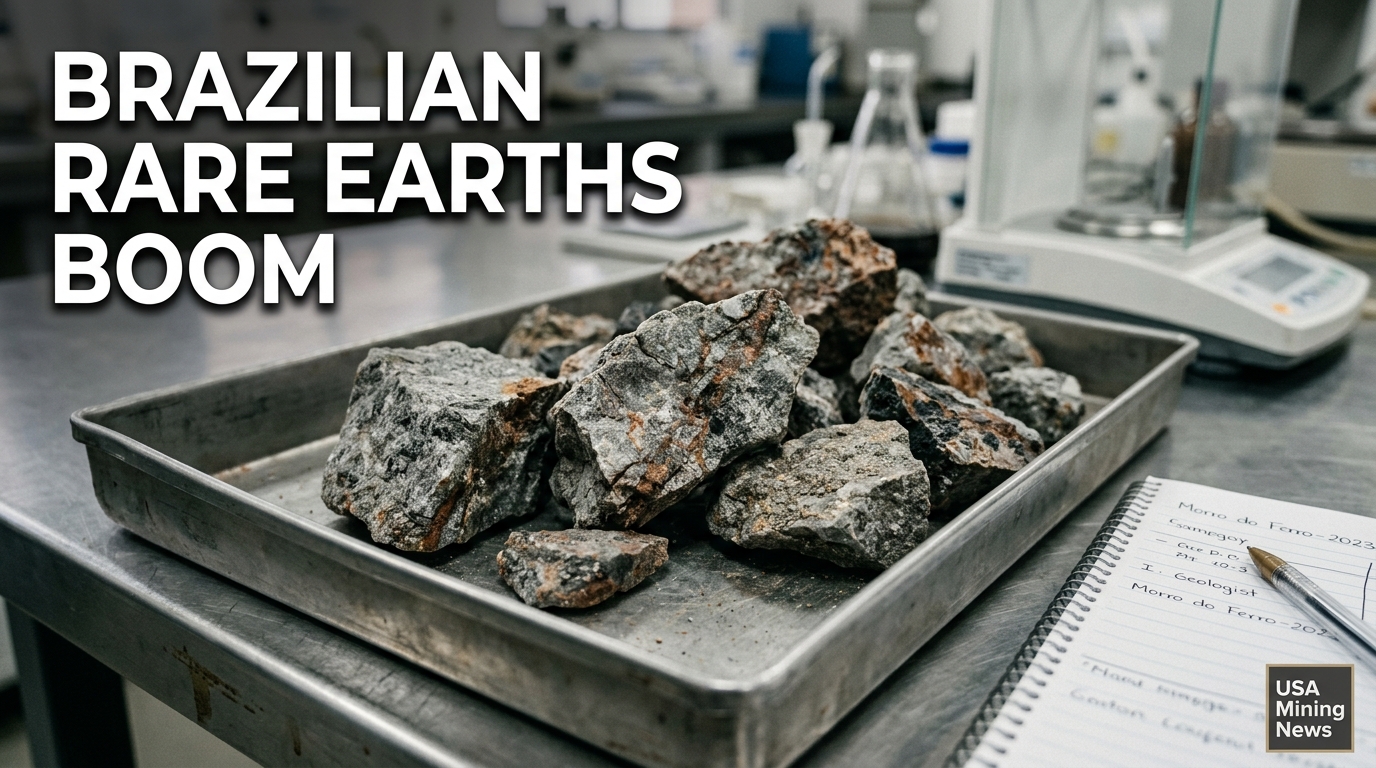
Power Minerals, a growth-focused mineral exploration company, has announced the successful conclusion of its acquisition of the Morro do Ferro (MDF) rare earths project. This significant transaction, formally completed on April 27, 2026, involved a definitive agreement with Mineração Terras Raras (MTR), a private exploration entity, solidifying Power Minerals' presence in Brazil's burgeoning critical minerals sector. Situated within the renowned Poços de Caldas Alkaline Complex in southern Minas Gerais, the MDF project is poised to become a key asset in the global supply of magnetic rare earth oxides (MREOs), essential for the rapidly expanding high-tech and green energy industries.
A Strategic Move Amidst Global Critical Minerals Dynamics
The acquisition of the Morro do Ferro project represents a calculated strategic advancement for Power Minerals, aligning with the intensifying global demand for rare earth elements (REEs) and the imperative to diversify supply chains. The Poços de Caldas Alkaline Complex is a geologically significant region, highly regarded for its distinctive alkaline intrusions that are often enriched with rare earth minerals. This geological characteristic makes the area a prime target for critical minerals exploration and development.
Power Minerals’ decision to proceed with the acquisition followed a comprehensive technical evaluation, which underscored the project's potential for notable concentrations of high-value rare earths. This rigorous due diligence process, spanning corporate, financial, and technical assessments, was initiated after a binding Letter of Intent (LoI) was established between Power Minerals and MTR. The positive outcomes from this thorough vetting confirmed Morro do Ferro’s strategic fit within Power Minerals’ expanding portfolio and its capacity to contribute to the company's long-term growth objectives in the rare earth sector.
Unveiling Morro do Ferro's High-Grade Potential
The Morro do Ferro project is characterized by highly encouraging historical drill results, which highlight its significant mineral resource potential. Drilling conducted by previous owners at the site has revealed compelling intersections, demonstrating high-grade rare earth mineralization. These results include:
- Drill-hole MFSR-47: An intersection of 35,332 parts per million (ppm) MREOs over 2 meters. This specific assay underscores the presence of highly concentrated magnetic rare earth oxides.
- Drill-hole MFSR-10: A substantial intercept of 100.44 meters grading 49,910 ppm total rare earth oxides (TREOs). This extensive mineralization suggests a large-scale deposit.
- Drill-hole MFSR-35: Another significant section of 60.85 meters with an impressive average of 89,177 ppm TREOs. This result further reinforces the project's potential for exceptionally high-grade rare earth deposits.
These figures are particularly noteworthy in the context of rare earth mining, where high concentrations typically translate into more economically viable extraction processes. The term "ppm" (parts per million) indicates the concentration of the valuable elements within the rock, with higher numbers signifying richer deposits. The identification of such high-grade zones bodes well for Power Minerals as it outlines future development strategies.
Magnetic Rare Earths: The Core of Market Value
A critical aspect distinguishing the Morro do Ferro project is its considerable concentrations of magnetic rare earth oxides (MREOs). These specific elements include neodymium, praseodymium, dysprosium, and terbium. These MREOs are not merely components of the broader rare earth family; they are the most economically significant, accounting for more than 80% of the total market value of all rare earth elements (REEs).
The dominance of MREOs in market value is directly attributed to their irreplaceable role in advanced technological applications. Neodymium and praseodymium are fundamental components of high-strength permanent magnets, which are critical for electric vehicle (EV) motors, wind turbine generators, and various consumer electronics. Dysprosium and terbium are crucial additives that enhance the heat resistance and performance of these magnets, especially in high-temperature environments. As the world rapidly transitions towards green energy solutions and increasingly relies on advanced electronics, the demand for these specific MREOs is projected to continue its sharp upward trajectory, making projects like Morro do Ferro strategically vital.
Power Minerals' Growing Brazilian Footprint
The acquisition of the Morro do Ferro project is not an isolated event but rather a continuation of Power Minerals' deliberate strategy to establish a robust footprint in Brazil's critical minerals landscape. Power Minerals managing director, Mena Habib, articulated this vision, stating, "The project represents a well-validated, high-grade, rare earth asset in an emerging global rare earth hub in Brazil and is an ideal complement to our Brazilian project portfolio." This expansion strategy gained significant momentum in August 2024 when Power Minerals successfully closed the acquisition of the Lítio Niobium Project, also located in Brazil, from Ita Iron Mineração.
This sequential acquisition approach underscores Power Minerals' long-term commitment to Brazil, recognizing the country's immense geological potential and its supportive regulatory environment for critical minerals development. By consolidating multiple projects within Brazil, Power Minerals aims to leverage regional synergies, shared infrastructure, and accumulated operational expertise, thereby enhancing the overall efficiency and attractiveness of its portfolio.
Operational Strategy and Future Exploration
With the acquisition complete, Power Minerals is poised to accelerate its exploration programs at Morro do Ferro. The initial phases of exploration will focus on several key areas to further define the extent and characteristics of the mineralization. These include:
- Deeper Diamond Drilling: To explore the continuity of mineralization at depth, given that the current resource delineation indicates open mineralisation.
- Reverse Circulation (RC) Drilling: Specifically targeting the main deposit area to provide higher resolution data and delineate the ore body more precisely.
- Aircore Drilling: Employed for broader reconnaissance across the project area to identify new targets and extend the known mineralized zones along strike.
These targeted drilling programs are designed to build upon the promising historical data and move towards defining a compliant mineral resource estimate. Mena Habib highlighted that the existing data points to "strong mineral resource potential and excellent expansion upside, subject to further exploration." Furthermore, the project enjoys "significant topographical advantages" that Power Minerals intends to exploit in any future development, potentially reducing operational costs and simplifying logistics. Leveraging the extensive technical expertise within its management team, Power Minerals aims to expedite these exploration efforts to fully realize Morro do Ferro’s potential value proposition for stakeholders and the broader market.
Industry Implications and Outlook
The acquisition of the Morro do Ferro rare earths project by Power Minerals has broader implications for the global mining industry, particularly for those focused on critical minerals and supply chain resilience. As geopolitical tensions continue to underscore vulnerabilities in the supply of essential raw materials, projects outside traditional dominant producers, such as those in Brazil, are gaining increasing strategic importance.
Brazil’s emergence as a significant rare earth hub offers a crucial alternative source for MREOs, which are vital for a multitude of sectors, including renewable energy, defense, and high-tech manufacturing. This diversification is seen as a key strategy to mitigate supply risks and ensure the continued growth of industries dependent on these elements. For investors, Power Minerals’ proactive stance in securing high-grade rare earth assets in a favorable jurisdiction signals a robust growth trajectory and a commitment to addressing critical supply gaps. The successful development of Morro do Ferro could significantly contribute to Western efforts to secure a stable and ethically sourced supply of strategic rare earths, thereby influencing future market dynamics and fostering greater stability in critical mineral supply chains.
Conclusion
Power Minerals' acquisition of the Morro do Ferro rare earths project marks a pivotal moment for the company and a notable development in the global rare earth sector. With its high-grade MREO concentrations, strategic location within the Poços de Caldas Alkaline Complex, and a clearly defined exploration pathway, Morro do Ferro is poised to become a valuable contributor to the burgeoning critical minerals market. As Power Minerals expeditiously embarks on its exploration and development programs, the project holds substantial promise to deliver strategic rare earth elements, vital for the ongoing technological revolution and energy transition, while reinforcing Brazil’s position as a key player in the global rare earth supply chain.