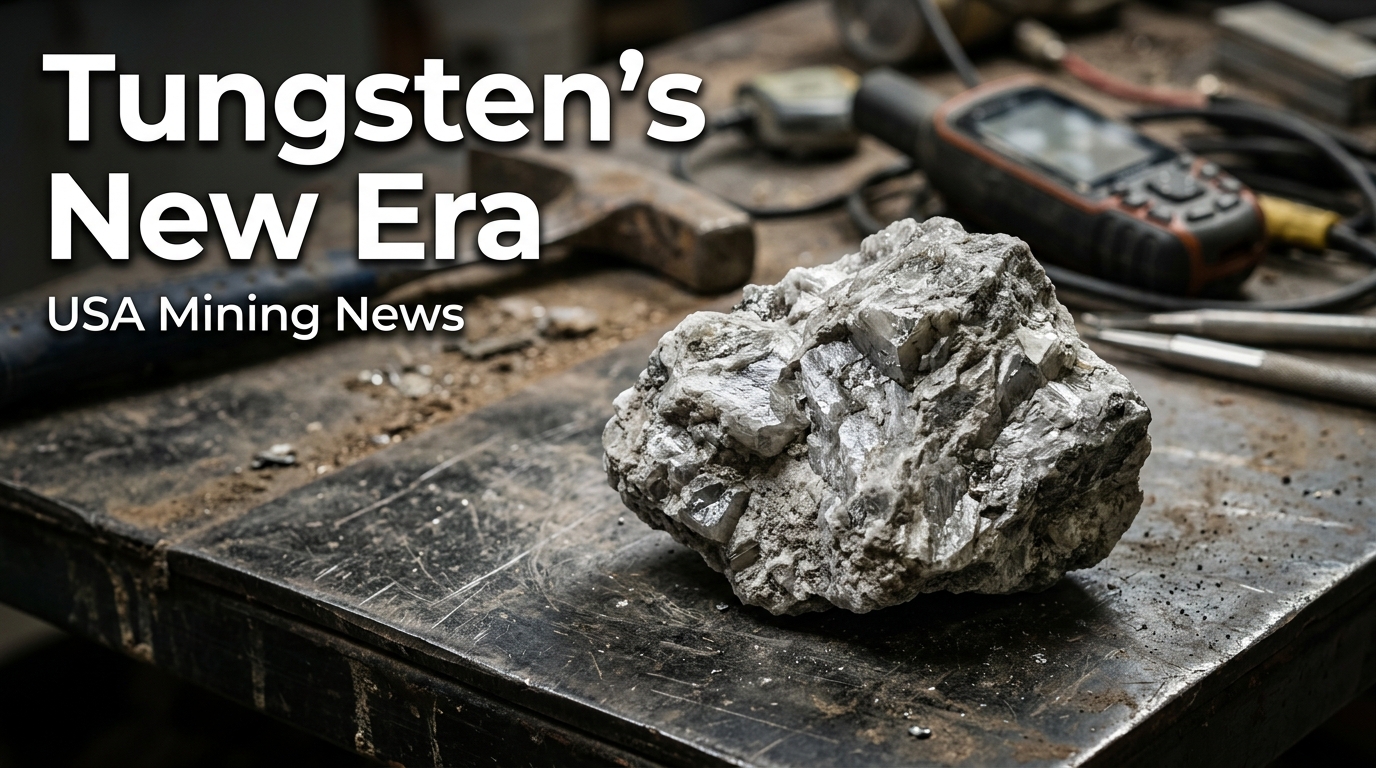
Western Star Resources Launches Key Exploration at Eagle Point Tungsten Project in New Mexico
ALBUQUERQUE, NM – Western Star Resources has officially initiated its first exploration and drill-planning program at the Eagle Point Tungsten Project, situated in the historically significant Little Hatchet mining district of Hidalgo County, New Mexico. This pivotal development, announced on August 13, 2026, marks a strategic step for the company as it moves to systematically evaluate a property with documented historical production and promising high-grade surface indications.
The comprehensive initiative is designed to collect robust geological and structural data crucial for refining existing geological models and, critically, for identifying and validating future drilling sites across the past-producing property. For mining industry professionals and investors, this represents a significant de-risking phase for a project positioned to contribute to the domestic supply of a critical mineral.
Systematic Exploration Underway with Expert Geological Support
The field exploration work at Eagle Point is being executed by Dahrouge Geological Consulting, a firm recognized for its expertise in mineral exploration. Their mandate at Eagle Point is multifaceted, encompassing a range of activities essential for a thorough project evaluation. These include detailed geological and structural mapping, which is fundamental for understanding the orientation and distribution of mineralized zones. Complementing this, systematic channel and grab sampling will be conducted to obtain representative assays from various rock types and alteration zones. A crucial component of this phase also involves the validation of existing project data, ensuring that historical records are accurately integrated with new observations and analytical results. This approach ensures a comprehensive understanding of the deposit's characteristics and potential.
Beyond the immediate proposed drill targets, the program is also strategically assessing outlying areas. This proactive step aims to identify opportunities for expanding future exploration activities, indicating Western Star Resources’ long-term vision for the property. The Eagle Point project itself comprises 24 lode mining claims, providing a substantial land package within a region known for its mineral endowment.
A Legacy of Production and Unfulfilled Potential
The Eagle Point project is not a greenfield discovery; it boasts a compelling history of past production, which provides a strong foundation for current exploration efforts. Historical records indicate that approximately 1,800 tonnes of scheelite-bearing material were extracted from the site during 1943 and 1944. This material was subsequently delivered to the US government stockpile located in Deming, New Mexico. This period coincides with the heightened demand for strategic minerals during World War II, when tungsten, critical for hardening steel and military applications, was in high demand for national security purposes.
Intriguingly, the historical narrative reveals a missed opportunity: the US government had previously prepared a contract to co-fund additional exploration at Eagle Point. However, for reasons not detailed in the available records, this agreement was never implemented, and the planned program did not proceed. This historical context suggests that the full potential of Eagle Point may not have been realized under previous exploration paradigms, leaving significant opportunity for modern, systematic exploration techniques to uncover further resources.
Prior exploration at Eagle Point was primarily conducted at surface, with only limited shallow drilling focused within the main open-cut area. This underscores the need for deeper, more extensive drilling that Western Star’s program aims to facilitate, moving beyond surface indications to define the subsurface mineralization.
Modern Confirmation of High-Grade Tungsten
The inherent prospectivity of Eagle Point has recently been validated by independent government agencies. Recent sampling conducted by the United States Geological Survey (USGS) and the New Mexico Bureau of Geology and Mineral Resources has yielded highly encouraging results. Surface samples collected from the project area returned high-grade tungsten values, providing crucial external confirmation of the project's potential. Most notably, one outcrop composite sample demonstrated an exceptional grade of 27.6% tungsten trioxide (WO3) along with 0.98% molybdenum. Tungsten trioxide is the common form in which tungsten grades are reported, reflecting the metal content. Such high-grade results from surface exposures are exceptionally rare and immediately elevate the project's profile.
Other samples collected during this government-led program also showed tungsten grades consistent with the material historically shipped from the site. While these were selective samples and, as such, may not be representative of average grades across the entire deposit, they nonetheless corroborate the presence of significant tungsten mineralization and validate the historical production records. This government endorsement provides an added layer of confidence for Western Star Resources as it embarks on its systematic exploration.
Strategic Integration for Future Drilling Success
The current exploration program is meticulously designed to integrate this wealth of new mapping and sampling data with all available historical information. The synergy between historical records and modern geological techniques is critical for building a comprehensive understanding of the ore body and its controls. This integrated approach will culminate in the identification and precise validation of priority drill locations, maximizing the potential for successful resource definition.
Western Star Resources anticipates completing the field portion of this intensive program by September 2026. Following this, the collected data will undergo rigorous analysis, leading to the generation of a refined geological model and the preparation of detailed drill plans. This methodical progression from historical context to modern geological investigation and target generation is a standard, yet critical, pathway in mineral exploration.
Leadership’s Vision for Eagle Point
Blake Morgan, President and CEO of Western Star Resources, articulated the company’s enthusiasm and strategic rationale behind the program. "This is the programme we have been eager to commence since acquiring Eagle Point," Morgan stated. He emphasized the transition from relying on historical data and surface indications to implementing a systematic, modern exploration methodology aimed at identifying and validating specific drill locations. This statement reflects a commitment to a diligent, science-based approach to exploration.
Morgan further highlighted the unique combination of factors that make Eagle Point particularly attractive in the current resource landscape. He noted, "Eagle Point has a combination that is increasingly difficult to find in the US: documented historical tungsten production, multiple mineralised skarn bodies exposed at surface, significant historical US Government involvement and modern government sampling that has confirmed very high-grade tungsten mineralisation at surface." This concise summary captures the essence of the project's compelling value proposition.
The presence of multiple mineralized skarn bodies exposed at the surface is a key geological indicator. Skarns are typically contact metamorphic deposits that can host significant concentrations of valuable minerals, including tungsten, often associated with intrusive igneous rocks. Their surface exposure offers accessible targets for initial evaluation and potential future mining.
Tungsten: A Critical Mineral for National Security and Technology
The renewed focus on the Eagle Point Tungsten Project is particularly timely given tungsten’s classification as a critical mineral by the United States government. Tungsten is indispensable across a vast array of industrial, technological, and defense applications due to its exceptional properties: it boasts the highest melting point of all metals, outstanding hardness, and excellent density and strength. These characteristics make it vital for:
- Hard Metals and Cutting Tools: Tungsten carbide is integral to manufacturing drill bits, cutting tools, and wear-resistant parts used in mining, construction, and manufacturing.
- Aerospace and Defense: Its density makes it valuable for counterweights, missile components, and kinetic energy penetrators.
- Electronics: Used in filaments for light bulbs (though less common now), electrodes, and electrical contacts.
- Alloys: Enhances the strength and heat resistance of steels and superalloys.
Global tungsten supply chains are heavily concentrated, with China dominating both production and processing. This presents a significant geopolitical vulnerability for nations, like the United States, that rely on stable and secure access to critical raw materials. Projects like Eagle Point, therefore, are not merely commercial ventures but contribute directly to national economic security and strategic independence. Diversifying the supply of critical minerals from domestic sources is a stated priority for the US government, and new discoveries or reactivations of historical mines align directly with these objectives.
Future Outlook and Investment Implications
The successful completion of the field exploration program by September 2026 will be a crucial milestone for Western Star Resources. Following data analysis, the company will be in a position to finalize drill targets, commence permitting procedures, and potentially announce its inaugural drilling campaign. A successful drill program could lead to a maiden resource estimate, which is a key de-risking event that provides a quantifiable measure of the mineral deposit and forms the basis for future economic studies.
For investors, Western Star Resources’ systematic approach to Eagle Point presents an opportunity in the critical minerals space. While early-stage exploration carries inherent risks, the combination of historical production, government-validated high-grade surface mineralization, and a structured modern exploration program significantly enhances the project's upside potential. The broader industry implications include the possibility of renewed interest in other historical tungsten occurrences across North America, as companies seek to leverage past knowledge with advanced exploration techniques to uncover new domestic critical mineral supplies. The successful advancement of projects like Eagle Point could help to mitigate supply chain risks and foster a more resilient domestic industrial base for strategic metals.